
Foxborough is a small town with a stadium-sized problem. About 18,000 people live there, but because Gillette Stadium sits inside its borders, the town became part of the 2026 World Cup map. A global tournament reached the town through invoices, staffing schedules, police deployments and a licensing decision that local officials could not wave through as ceremony.
The disputed figure was $7.8 million. Before granting the entertainment license for seven World Cup matches at Gillette Stadium, temporarily renamed Boston Stadium, Foxborough officials wanted security funding guaranteed. According to The Guardian, the cost could have worked out to more than $1,000 per household if the town had been left exposed. The same report noted that Police Chief Mike Grace objected to a proposed timeline that would have placed vital security equipment only 12 days before the first match. Money could be settled later. Radios, barriers and emergency equipment had to be ready before the crowd arrived.
Mega-events are sold through emotion. The World Cup presents itself as a festival of belonging. The Olympics speak in the language of unity, excellence and national pride. Host cities advertise themselves as open, modern and welcoming. None of that makes security hidden or illegitimate. It means the public story of the event depends on a quieter layer of work: police overtime, emergency planning, traffic control, insurance, federal coordination, private security contracts and rules about who may enter which space. The issue is not that this layer exists. It is how quickly it expands when the deadline is fixed and the audience is global.
The 2026 World Cup has made that expansion visible in the air. Since the tournament began in June, the FBI has seized more than 600 unauthorized drones across 11 U.S. host cities, The Guardian reported. Miami, Atlanta and Dallas recorded some of the highest totals. Federal aviation restrictions around stadiums and fan zones have been enforced with confiscations, heavy fines and possible prison terms.
Most of those drone operators may not have had sinister intentions. Some were likely tourists, hobbyists or small content creators chasing a dramatic view. Security planners do not get to rely on that assumption. A drone can film a restricted area, distract emergency personnel, threaten players or spectators, or simply trigger confusion in a dense crowd. Its operator can be blocks away, outside the search line and away from the stadium gate. For event security, distance has become part of the problem.
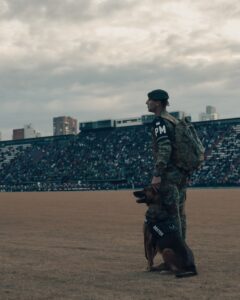
Fan zones turn that problem into a citywide one. Kansas City, for example, ran what Axios described as its largest World Cup security drill at the National World War I Museum and Memorial, the site of its Fan Fest, with more than 200 law enforcement officers and multiple agencies practicing a coordinated response. Police Chief Stacey Graves described a layered approach to screening people and vehicles. The drill matters because it shows what a fan zone really is. It may be presented as the democratic version of the stadium, open to people without tickets, but in security terms it becomes another venue: entrances, screening, emergency routes, weather plans, vehicle controls and command decisions.
No serious host can ignore those details. The recent history of crowd safety is too grim for that. At Indonesia’s Kanjuruhan Stadium in 2022, 135 people were killed after police fired tear gas and panic spread through the crowd; families were still seeking justice a year later, the Associated Press reported. That kind of history is why officials worry about exits, radios, water, medical access, transport flow and backup plans. Good planning can be intrusive, expensive and irritating. Bad planning can be fatal.
The unease begins when temporary planning starts to leave a longer imprint. Mega-events give governments permission to move quickly because the event cannot be postponed until every civic argument is settled. Agencies test tools. Laws are adjusted. Command centers are built. Private vendors enter public systems. Not every measure becomes permanent, and many should not. The real question is which emergency habits are retired after the tournament, and which ones quietly become normal procedure.
Paris is the clearest recent example. For the 2024 Olympics, France used a law adopted in May 2023 to test algorithmic video surveillance at major public events. Le Monde reported that 485 cameras were used with Cityvision software during the Games to detect situations such as abandoned objects, falls and crowd movements. The system was presented as an experiment for a high-risk event. It also excluded facial recognition, which matters: the Paris case is not proof that every Olympic security experiment becomes a full surveillance state. It is evidence of a narrower but still important pattern. A tool introduced for exceptional circumstances can become easier to defend afterward, especially when officials describe the trial as useful and limited.
Officials often arrive at these choices through ordinary pressures rather than grand ideology. A police chief wants equipment before the crowds arrive. A transit agency wants stations that do not jam. A mayor wants visitors to leave alive, local businesses to benefit, and television cameras to show order rather than embarrassment. The security stadium grows because each request is attached to a real operational fear, and because saying no before a global event is politically harder than asking what should happen afterward.
Foxborough gives that growth a human scale. Town officials wanted to know whether police and fire services would be paid for, whether equipment would arrive on time, and whether a small municipality would be left covering costs created by a tournament it did not control. Axios later reported that FIFA and the Kraft Group agreed to cover the $7.8 million in security costs, while local concerns about equipment and preparation remained. That resolution is important because it complicates the story. The money problem was not ignored forever. Yet the episode still shows how much leverage a mega-event can place on local institutions before the first match is played.
Security also arrives in gentle words. Officials usually speak of safety, flow, preparedness and guest experience, and much of that language is accurate. The Kansas City drill was framed around keeping Fan Fest safe and welcoming, not around control for its own sake. Still, service and control often use the same tools. A system built to move visitors safely through a crowded public space can also teach authorities how to watch, sort and redirect crowds with less visible force.
A better bargain is possible, but cities have to argue about it before the festival begins. Host governments should publish what equipment is being bought, who owns it afterward, what data is collected, how long it is kept, and which agencies can use it once the event is over. Local officials should not have to discover their financial exposure in the final months. Residents should know when a temporary restriction truly expires. Security plans cannot be fully public, but the limits around them can be.
The security stadium is built in small decisions: a drone rule, a funding grant, a camera trial, a fan-zone drill, a local license hearing. Each one can be reasonable on its own. Together, they show what mega-events now ask a city to practice.
Long after the match is over, that practice may matter.
