

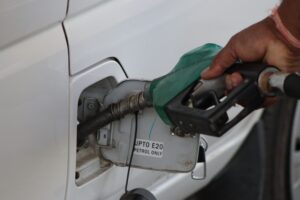
India’s ethanol programme has been one of the country’s most ambitious energy policy initiatives. It has helped reduce oil imports, created a new market for farmers, and supported the government’s push for greater energy security.
But as India moves beyond E20 petrol and begins exploring higher ethanol blends such as E85 and E100, a more complex question is emerging: who benefits from the next phase of the transition, and who bears the cost?
A Major Policy Milestone
India reached a significant milestone in 2025 when it achieved a 20% ethanol blend in petrol, five years ahead of the government’s original target. According to the Ministry of Petroleum and Natural Gas, ethanol blending increased from around 1.5% in 2014 to 20% in 2025.
The programme sits at the centre of India’s efforts to reduce dependence on imported crude oil, support rural incomes, and lower emissions from the transport sector. Government data shows that ethanol blending between 2014 and 2025 helped save more than ₹1.44 lakh crore in foreign exchange, substituted approximately 245 lakh metric tonnes of crude oil, and reduced carbon emissions by an estimated 736 lakh metric tonnes.
The first phase of the programme delivered relatively clear benefits. The next phase is likely to involve more trade-offs.
Who Wins?
Farmers are among the most visible beneficiaries of the ethanol programme.
India’s ethanol industry relies heavily on sugarcane-based ethanol while increasingly incorporating grain-based feedstocks such as maize. Rising ethanol demand creates an additional market for agricultural output and provides another source of income for farmers.
The government also benefits from lower dependence on imported crude oil. India imports more than 85% of its crude oil requirements, making fuel security a persistent economic and strategic concern. Every litre of ethanol blended into petrol reduces the amount of imported fuel required to meet domestic demand.
The ethanol industry itself has expanded rapidly alongside blending targets. Distilleries, ethanol producers, logistics providers, and associated supply chains have benefited from rising demand supported by government policy.
Automakers are also preparing for the next stage. Companies such as Maruti Suzuki and Toyota Kirloskar Motor have showcased flex-fuel vehicles capable of operating on significantly higher ethanol blends, positioning themselves for a future in which ethanol plays a larger role in India’s transport sector.
Who Pays?
The concerns are most visible among existing petrol vehicle owners.
Ethanol contains less energy per litre than conventional petrol. As ethanol content increases, fuel economy generally declines.
The Society of Indian Automobile Manufacturers (SIAM) has estimated that E20 fuel can reduce fuel economy by roughly 2% to 4% compared with pure petrol, although the actual impact varies depending on vehicle design, engine calibration, and driving conditions.
In practical terms, a vehicle that delivers 20 km per litre on petrol may achieve approximately 19.2 to 19.6 km per litre on E20 fuel.
Most vehicles manufactured in recent years have been engineered to operate safely on E20 fuel. However, owners of older vehicles continue to express concerns about long-term maintenance costs, component durability, and future resale values as ethanol concentrations increase.
The transition to E85 and E100 presents an even bigger challenge. These fuels require dedicated flex-fuel vehicles specifically designed to handle much higher ethanol concentrations. They are not intended as direct replacements for the existing petrol vehicle fleet.
As a result, many of the benefits associated with higher ethanol blends may initially accrue to owners of new flex-fuel vehicles, while owners of older vehicles face uncertainty about future compatibility.
The Food Versus Fuel Debate
The ethanol debate extends beyond transportation.
As demand for ethanol feedstocks grows, agricultural economists have raised concerns about how farmers may respond to changing incentives. Crops used for ethanol production can become more attractive if demand and prices rise, potentially influencing cropping patterns across the agricultural sector.
Critics argue that if maize and other ethanol feedstocks become significantly more profitable, less land may be available for crops linked to food production and edible oil security. India already relies heavily on imported edible oils, and some analysts warn that aggressive expansion of fuel crops could complicate efforts to reduce that dependence.
Supporters of the programme counter that improvements in agricultural productivity, crop diversification, and the use of multiple feedstocks can help balance fuel production with food security objectives.
The extent of the risk remains debated and will depend largely on future policy decisions, crop yields, and market conditions.
The Water Question
Water use remains another area of discussion.
Sugarcane, one of the primary feedstocks for ethanol production in India, is among the country’s most water-intensive crops. Critics argue that large-scale expansion of sugarcane-based ethanol could place additional pressure on water resources in regions that already face periodic shortages.
Supporters note that India’s ethanol programme is increasingly incorporating maize, damaged food grains, and other feedstocks, reducing dependence on sugarcane alone. Future technological improvements may further diversify ethanol production sources.
Nevertheless, water availability is likely to remain an important consideration as ethanol production expands.
The Next Phase
The government’s approach suggests a gradual rather than abrupt transition.
Rather than mandating higher ethanol blends nationwide, policymakers are introducing them through pilot programmes, dedicated retail outlets, and the development of flex-fuel vehicles. This approach allows ethanol use to expand while limiting disruption for existing vehicle owners.
The success of the next phase will depend on several factors, including the availability of compatible vehicles, consumer acceptance, feedstock supply, fuel pricing, infrastructure development, and the ability of the agricultural sector to meet growing demand sustainably.
Conclusion
India’s ethanol programme has already delivered measurable gains in reducing oil imports and expanding domestic fuel production. Farmers, ethanol producers, and parts of the automotive industry have benefited from its rapid growth.
The first phase of India’s ethanol story was relatively straightforward: blend more ethanol and import less oil. The next phase is more complicated.
As the country moves toward E85 and E100 fuels, policymakers will need to balance competing interests across farmers, motorists, automakers, fuel producers, and food systems. The challenge is no longer whether ethanol can be scaled, but whether its benefits can be expanded without shifting disproportionate costs onto consumers and other sectors of the economy.
Sources: Ministry of Petroleum & Natural Gas, Petroleum Planning & Analysis Cell (PPAC), Society of Indian Automobile Manufacturers (SIAM), company statements, government releases, and Reuters reporting.
