
Why a Few Hundred Miles of Ocean Floor Hold Up the Internet
Most people picture the internet as something that lives in the sky. Satellites, clouds, invisible signals bouncing overhead. The reality sits on the seabed. Roughly 600 fiber optic cables, each about the width of a garden hose, carry the vast majority of international data, estimates range from 95 to 99%. Money transfers. Video calls. Military orders. Over the past few years, a string of incidents involving vessels linked to China and Russia has raised a pointed question: whether undersea cables are becoming a favored target for exactly the kind of conflict that never quite rises to the level of war. No shots fired, no declarations made. A ship drags an anchor, a country goes dark for weeks, and everyone involved gets to call it an accident.
Matsu
Start with a place most people have never heard of. Matsu is a cluster of Taiwanese islands sitting just off the Chinese coast, home to about 14,000 people, connected to the rest of Taiwan by two submarine cables. In February 2023, both were cut within a week of each other. A Chinese fishing vessel was suspected in the first cut, a Chinese cargo ship in the second. Taiwanese officials stopped short of calling either one deliberate.
Matsu’s cables had already been cut or damaged more than twenty times in the previous five years, by various counts. Residents went 50 days on emergency microwave transmitters so slow that sending a text message took twenty minutes. People gathered outside telecom shops at night, trying to catch a usable signal.
Similar incidents have continued. A Chinese-linked vessel was suspected in another cut near Taiwan’s north coast in January 2025, and Taiwan investigated a possible act of sabotage after a cable break near Penghu the following month, though service continued on backup lines and no cause was confirmed. Researchers use a specific phrase for this kind of activity: gray zone tactics. A cut cable does real damage. Intent is almost never provable. It is never quite an act of war.
Not Just Taiwan
The same pattern showed up in the Baltic Sea. A Chinese vessel, the NewNew Polar Bear, damaged a gas pipeline and nearby cables between Finland and Estonia in October 2023. In November 2024, the Yi Peng 3, a Chinese-flagged bulk carrier that had just left a Russian port, was suspected of dragging its anchor over cables connecting Lithuania to Sweden and Finland to Germany, within a day of each other. Then, on Christmas Day 2024, a tanker called Eagle S was suspected of damaging a power cable and several data cables between Finland and Estonia after dragging its anchor for roughly 60 miles; the case against its crew has since been contested in court. Eagle S belonged to what investigators call Russia’s “shadow fleet,” the aging, opaquely owned tankers Moscow uses to move sanctioned oil. Hundreds of them cross the Baltic on any given day.
Investigators flagged the same detail in several of these cases: an unusual, meandering path, not the kind a ship takes by accident. Whether Beijing and Moscow are coordinating or simply drawing from the same playbook is still an open question. Within three weeks of the Christmas Day incident, NATO stood up a new operation called Baltic Sentry: frigates, patrol aircraft, and naval drones, built specifically to watch this stretch of water. Announcing it, NATO’s secretary general pointed to the stakes involved, noting that undersea cables worldwide underpin an estimated $10 trillion in financial transactions every day. It is, so far, one patrol, in one sea, watching a fraction of the routes this is happening on.
The Cables Were Always Being Tapped
Cutting is the loud version of this. The quiet version has been running since the Cold War.
The US Navy, CIA, and NSA once ran an operation called Ivy Bells, placing wiretaps directly onto Soviet underwater cables using modified submarines. Decades later, the method hadn’t disappeared so much as modernized. Edward Snowden’s 2013 disclosures revealed a British program called Tempora, run by GCHQ, which tapped fiber cables at their landing stations and reportedly pulled in tens of millions of gigabytes a day, shared with the NSA under the Five Eyes alliance. One facility named in the leaked documents was a base at Seeb, on Oman’s northern coast, valued for its direct access to nine cables funneling through the Strait of Hormuz toward the Red Sea. The submarine USS Jimmy Carter has been publicly described more than once as purpose-built for this kind of work.
A tapped cable keeps working perfectly. That’s the whole point.
Nobody Is Actually Guarding This
If cables are this valuable, why isn’t there a navy whose entire job is protecting them? Patrolling international waters is not like patrolling a border. Most cables run through territory no single country controls, which leaves two options: a multinational force nobody has fully agreed to fund, or one country unilaterally asserting military authority over water it doesn’t own. The NATO patrol in the Baltic is the closest thing to the first option, and it’s less than two years old.
The other problem is attribution. A trawler that happens to drag anchor over a cable and one sent to sever it deliberately look identical from a satellite, and proving intent days later, with a vessel that has already sailed off, is close to impossible. Without proof there’s no clean justification for a response, and without that, deterrence is hard to build. That gap isn’t an oversight in how gray-zone tactics work. It’s the entire point of them: ambiguity here isn’t a way of avoiding conflict because a side is too weak to escalate, it’s a deliberate strategic advantage in its own right.
Why the Same Places Keep Getting Hit
Cables cannot go anywhere they like. Engineers route them along the shortest workable path between two landmasses, hugging continental shelves and avoiding deep trenches where repair becomes nearly impossible. Political stability matters too, since a cable through unstable coastline is one that will eventually be damaged, delayed, or held hostage by a government demanding fees.
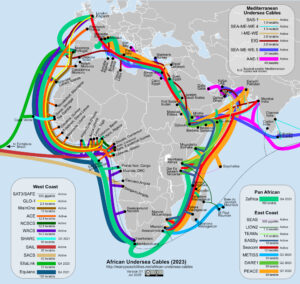
Those constraints funnel cables into the same narrow corridors again and again: the Taiwan Strait, the Red Sea, the Luzon Strait, the English Channel, the South China Sea. Most of the internet doesn’t feel this fragility day to day, since most routes have backups and traffic reroutes in seconds when one fails. The exception is corridors like the Red Sea, where multiple systems converge into the same few hundred miles of water. There, one disruption doesn’t take out one connection. It takes out several at once.
The Real Bottleneck Isn’t the Cable
Building a cable is expensive, with a new transatlantic system typically running $200 to $250 million. Repairing one is worse. Estimates put the world’s specialized cable repair fleet at somewhere around 60 ships, each costing $80 to $130 million to build, and a fault, which happens somewhere between 150 and 200 times a year globally, takes an average of close to two months to fix. Some repairs, especially in contested or heavily permitted waters, have dragged past a year.
In theory, an actor looking to maximize disruption wouldn’t need to cut more lines. It would only need to slow down the ships capable of fixing the ones already cut, through permitting delays, denied access to territorial waters, or repair crews unwilling to sail into a disputed zone. Matsu’s residents didn’t wait 50 days because the cut itself was catastrophic. They waited because so few ships exist to fix it, and fewer still can move freely into contested water on short notice.
Who Owns the Ocean Floor Now
One more shift is worth noting before the picture is complete. The cable business used to run almost entirely through consortiums of national telecom operators. Increasingly it doesn’t. Google, which finished the Firmina cable to Argentina back in 2023 and has since unveiled a new one linking the Maldives, Christmas Island, and Oman, now owns or co-owns a growing share of the world’s subsea capacity. So does Meta, whose 2Africa system is currently the longest cable network on Earth, with an even larger one, Project Waterworth, already under construction. No government has had to decide yet who answers for a privately owned cable if it becomes a sustained target rather than an occasional one.
What This Is
The internet is usually described as a virtual thing. The last few years suggest the opposite. It is a physical system, concentrated into a small number of places a ship can still reach with an anchor, which makes it less an abstract digital service and more a piece of critical infrastructure. Infrastructure has always eventually become part of geopolitics, whether it was railways, pipelines, or the strait an oil tanker has to pass through. Globalization was supposed to make information borderless. Instead it made the world more dependent than ever on a handful of physical corridors, guarded by nobody in particular, where a country can be quietly disconnected and nobody has to admit why.
Matsu’s cables have been repaired. Recent incidents suggest they may not be the last.
