

From street protests to tourist taxes, the world’s most popular destinations are turning against the visitors who helped make them rich
Barcelona spent decades trying to attract tourists. In 2026, the city’s first commissioner for sustainable tourism, José Antonio Donaire, put a number on when that effort should stop. The city received 15.7 million tourists in 2025, he told The New York Times, and that is the target he wants to hold the line at. We don’t want to grow more, he said. Not even one more tourist.
A decade ago, a sentence like that would have been almost unthinkable from a city tourism office. Growth in visitor numbers was the entire point of the job. Barcelona has not suddenly stopped valuing tourism revenue. The city, like a growing list of destinations around the world, has reached a point where more visitors cost more than they are worth.
That reversal is the real story here, and it raises a question sharper than whether there are too many tourists in the world. There are millions of places worth seeing on this planet, and by one widely cited industry estimate, roughly eighty percent of travelers concentrate in just ten percent of them. This is a story about a small number of neighborhoods absorbing a share of global demand they were never built to hold, and about what happens once the people who live in those neighborhoods stop treating that as an acceptable cost of a shared economy.
How we built mass tourism
Nothing about the current backlash makes sense without understanding how tourism reached this scale in the first place. Budget airlines put flights within reach of people who could never have justified the expense a generation earlier. A rapidly growing global middle class, especially across Asia, gained the income and the visa access to travel internationally for the first time in family history. Booking platforms erased the friction of finding a room. Smartphones turned every traveler into their own guide and photographer.
Then social media changed what a destination even was. A single video can turn an unknown viewpoint into a crowded one within weeks. The clearest 2026 example is Favignana, a small Sicilian island that found itself the backdrop for Christopher Nolan’s film The Odyssey. Local officials are now trying to capture the economic upside of that sudden attention while bracing for the same crowding that has hit larger destinations for years. It is a preview of a pattern that keeps repeating. The algorithm that recommends a hidden gem is often the same mechanism that ends its status as hidden.
No single company or government intended to create the outcome that emerged. Millions of individually reasonable decisions, from cheaper flights and easier bookings to viral recommendations, produced a collective result that almost nobody was managing for. That is a more useful starting point than looking for a villain, because it also explains why the backlash has been so hard to resolve. There is no single lever to pull.
Tourists are exposing problems that were already there
It is worth stating the sharper version of the argument early, because it should inform everything that follows. Look closely at where the anger actually concentrates in city after city, and it rarely points at travel itself. It points at a housing shortage that predates mass tourism in most of these places. It points at rental platforms that scaled faster than local licensing systems could track them. It points at water, transit, and waste systems designed decades ago for populations that now multiply every summer. Tourism is exposing weaknesses that were already there, while also adding new pressure of its own on top of them.
Framed that way, the sharper question is what kind of tourist arrives, when, and how concentrated the visits are. Raw numbers matter less than that. A long-stay visitor renting a licensed apartment in the off-season places very different demands on a city than ten thousand cruise passengers disembarking at the same hour in July. That distinction explains most of what governments have actually tried to do about this since.
From neighborhood anger to institutional policy
What makes 2026 different from previous rounds of complaint is where this argument is now being settled. In March, the European Parliament’s Transport and Tourism Committee voted 33 to 4, with four abstentions, to advance a strategy that explicitly names overtourism, short-term rental growth, and the concentration of visitors in a small number of destinations as problems requiring EU-level coordination, not just local improvisation. The following month, the full Parliament backed a broader tourism-management resolution by 439 votes to 42, with 129 abstentions. Neither vote is close. Lawmakers pointed to the same eighty-twenty concentration driving the rest of this article and called for actively redirecting visitors toward rural regions, mountain towns, and other places with room to spare.
That is what it looks like for a backlash to go mainstream. Five years ago this was residents with hand-painted signs. It is now a continental legislature treating tourism concentration as a structural policy problem.
When visitors compete with residents for housing
Nowhere has the backlash been sharper than in housing, and the numbers explain why. In March 2026, Spain’s High Court in Madrid rejected Airbnb’s request to suspend payment of a 64 million euro fine while the company appeals, one of the largest penalties ever imposed on a short-term rental platform in Europe. The penalty, issued by the consumer rights ministry in December 2025, concerned more than 65,000 listings that Spanish authorities said lacked valid registration numbers or misrepresented their licensing status. Spain’s consumer rights minister framed the stakes plainly. Thousands of families are living on the edge because of housing pressure, he said, while a small number of people profit from business models that push residents out of their homes.
Barcelona has gone further still. The city has committed to phasing out its roughly 10,000 licensed short-term tourist apartments by 2028, prioritizing long-term housing supply over nightly rental income. The mechanism is straightforward. A full-time tourist rental removes that unit from the long-term housing market, even if not every one of those apartments would otherwise have gone to a resident tenant.
When a local market stops serving locals
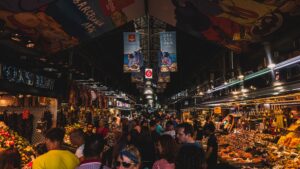
Housing pressure is only the first layer. In some neighborhoods, that pressure is followed by a change in the businesses around it. Barcelona’s La Boqueria market is a useful case study of how this happens without a single dramatic event. Stalls that once sold fresh vegetables, fish, and meat to home cooks increasingly sell cups of cut fruit and fried shrimp to visitors passing through. Many residents have simply stopped shopping there. Donaire himself, a longtime neighborhood resident, still goes, but strategically, entering through the back where deliveries arrive because that is now the only way to avoid the crowd at the front.
This is where the theme park comparison stops being an exaggeration and starts describing something literal. A place can remain physically intact, its buildings preserved and its stalls fully stocked, while the ordinary function that used to fill it quietly disappears. Kyoto restricted tourist access to private alleyways in its historic geisha districts back in 2024, after repeated complaints about visitors chasing photographs of residents there simply going about their day. It is a small rule, but it marks a shift from managing crowds to managing where the boundary between public street and private life actually sits.
Climate is redrawing the map
A newer pressure has entered the picture, and it is expanding the list of places dealing with overtourism instead of shrinking it. Record heat across southern Europe is increasingly cited as one reason travelers are looking toward cooler destinations, a shift the industry now calls coolcationing. Searches for cooler destinations have climbed sharply through 2026, and analysts project travel to Scandinavia could rise by as much as a third this year as visitors trade Mediterranean beaches for Nordic fjords, Scottish glens, and Baltic coastlines.
The complication is that many of these newly popular places were never built for high tourist volume. Norway’s own tourism board has explicitly linked hotter conditions in southern Europe to rising coolcation demand and identified it as a trend that will require stronger visitor management in the years ahead. Reykjavik and Bergen, both modest cities by European standards, are among the northern destinations now facing summer crowds well beyond anything they used to plan for. Climate change appears likely to redistribute tourism pressure rather than reduce it, moving demand toward places with none of the institutional experience that a decade of overtourism has forced onto Barcelona or Venice.
Governments start pricing access
Faced with all of this, governments across Europe have converged on a similar first response. They are charging more for the same visit. Barcelona doubled its municipal tourist tax in early 2026, pushing nightly charges as high as fifteen euros at five-star hotels and applying separate levies to holiday rentals and cruise passengers. Venice expanded its day-tripper entry fee. Paris added a regional surcharge worth two hundred percent of the base hotel tax, pushing the nightly charge at a five-star hotel from 3.60 euros to 11.70 euros.
Not every price increase is an overtourism measure, and it is worth keeping these mechanisms separate. In January 2026 the Louvre began charging visitors from outside the European Economic Area 32 euros instead of 22, a 45 percent increase expected to raise up to 20 million euros a year for security and renovation. The higher pricing had been planned earlier in the year, and a jewelry heist that exposed how underfunded the museum’s infrastructure had become gave the increase new urgency. Residents of EU and EEA countries continued paying the old rate. French labor unions called the change discrimination, warning that scrapping a universal entry fee sends the wrong message about who a museum belongs to. Both arguments are being made in good faith. The live question now is who should pay, how much, and what that money should buy, not simply whether visitors should pay more at all.
Visitor caps are a third and different tool, and they have spread furthest outside Europe. Peru’s Ministry of Culture now limits Machu Picchu to 4,500 visitors a day in low season and 5,600 at peak, enforced through mandatory advance booking and fixed circuit routes, replacing the free roaming that once wore down the site’s stone paths. Ecuador raised the international entry fee for the Galápagos Islands from 100 dollars to 200 in 2024, a measure rooted primarily in conservation funding rather than crowd control, though it lands on visitors the same way a tourist tax does. These are three different tools that were built for three different original purposes. At an increasing number of heavily visited destinations, desirability now comes with more cost, more controls, or both.
Europe is where this backlash has become most politically visible, largely because it built the infrastructure of mass tourism first and is hitting its limits first. But the underlying dynamic, concentrated demand outpacing local capacity, reaches far beyond Europe. It shows up anywhere a place becomes desirable faster than it can plan for it.
Who actually captures the gains
None of these policies answer the question sitting underneath the entire debate, which is who tourism’s money actually reaches. Tourism supports an estimated 12.3 million jobs across the EU and contributes about 10 percent of GDP once indirect effects are included, a scale that makes it easy to talk about the industry as a single economic force. It isn’t one. A hotel chain, a short-term rental platform, and a property investor can each extract steady returns from a neighborhood’s popularity without living anywhere near the wear that popularity creates. How much of that spending actually reaches the worker serving the tourist, and how much goes instead to the owner of the property, hotel, or platform collecting the booking? City governments collect tax revenue too, but typically with a lag behind the infrastructure costs a visitor surge creates.
This is the distinction that gets lost when the debate is framed simply as tourists against residents. The more accurate framing is that tourism generates real value, and different groups within the same city are capturing wildly different shares of it, while absorbing very different shares of the cost. A tourist tax that funds affordable housing, as a quarter of Barcelona’s new revenue is earmarked to do, is one attempt to correct that imbalance directly, not just make the city more expensive to visit.
A warning from Japan
The European Parliament’s votes show how far this backlash can travel through ordinary democratic institutions. Japan shows how it can travel somewhere more dangerous. Tourist arrivals hit a record 37 million in 2024, and crowding and visitor conduct became genuinely salient in national politics. The far right Sanseito party, campaigning on a Japanese First platform that treats both tourism and immigration as threats to national identity, won fourteen new seats in the July 2025 upper house election, growing its total from one seat to fifteen.
Tourism and immigration are not the same issue. But political movements do not always respect that distinction, and Sanseito’s rise is a reminder that unmanaged frustration with visitor numbers does not stay contained to visitor numbers. Left unaddressed, it can be absorbed into a far larger and more combustible argument about who belongs.
The cruise ship divide
Few groups draw more resentment than cruise passengers, and the economics explain why even without exaggeration. Thousands of people can disembark within the same hour, filling narrow historic streets and using infrastructure built for a fraction of that volume, often departing again before dinner. A day tripper can spend meaningfully in shops and cafes during a short visit, but a city can plan far more easily for visitor demand spread across a year than for thousands of people arriving at once on a single morning.
Cannes will cap daily cruise disembarkations at six thousand passengers starting in 2026 and stop ships carrying more than a thousand passengers from docking directly, requiring them instead to anchor offshore and tender passengers in on smaller boats, a change expected to cut large-ship calls by roughly half. Nice introduced its own limits the year before. Venice barred large cruise ships from its historic lagoon back in 2021. The logic connecting all of it is the same. A destination can absorb steady demand far more easily than it can absorb a spike.
The counterargument nobody can ignore
None of this is happening in a vacuum, and any honest account of the backlash has to include the industry’s defenders, because their case is real. As noted earlier, tourism supports an estimated 12.3 million jobs across the EU, and hotel staff, restaurant workers, tour guides, and small shop owners depend on visitor spending for their income. Many of them live in the same neighborhoods now organizing against overtourism. The OECD’s 2026 tourism report continues to describe the sector as economically essential even as it documents growing resident frustration and infrastructure strain. Cut off the flow of visitors too abruptly, and the first people to feel it are often the workers standing beside the protesters, not the property investors or platforms actually driving up rents.
That is the paradox sitting under this entire subject. The same tourism demand that can price residents out of housing is also paying the wages of a large share of that same resident population. Which is exactly why so few governments have tried to simply reduce visitor numbers outright. Many of the policy responses so far have aimed instead at extracting more value from each visitor, through taxes, caps, and dual pricing, while trying to preserve the underlying flow of spending that so many local economies still depend on.
Who is a city actually for
Strip away the taxes, the protests, and the policy language, and the entire conflict reduces to a question that used to have an obvious answer and no longer does. A resident who has lived somewhere for thirty years believes the city belongs to the people who stay. A property owner earning nightly rental income believes it belongs to whoever can pay for access to it. A worker whose wages depend on visitor spending believes it belongs to whoever keeps that spending flowing. A government balancing jobs, tax revenue, and growth sees the city as part of a tourism economy that cannot simply be switched off. And a tourist who saved for years, followed the rules, and paid every tax asked of them believes they have a legitimate claim to see a place that, in many cases, was built to be seen.
None of these five interests can simply be dismissed, and that is precisely why the conflict has no clean resolution. Tourism did not suddenly become harmful by 2026. The people who live inside these cities stopped accepting growth as an automatic good and started insisting on a say in how it happens. The likely outcome is more managed travel, meaning fewer visitors in the most fragile places, higher prices at peak times, tighter rules, and a growing expectation that tourists pay more of the costs their visit creates. These cities are now weighing whether they can remain functioning cities while still attracting the tourists they depend on.
