

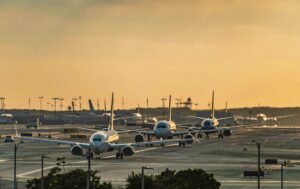
Aircraft became more capable, but congestion, longer taxi times and padded schedules have quietly made the journey slower.
Aircraft manufacturers spent the last sixty years solving the same problem from every angle. Engines got quieter and more fuel efficient. Navigation became precise to within meters instead of miles. Weather forecasting improved enough to route around storms hours before they form. Automation now handles most of what a flight crew used to manage by hand.
And yet a flight from New York to London or Los Angeles to San Francisco often takes longer today, according to the published schedule, than it did decades ago. The paradox sits right there on the ticket, where a trip has grown even as the machinery behind it improved.
The explanation involves a stack of decisions made by airlines, airports, regulators and engineers, each individually reasonable, that together absorbed the speed the technology created. Understanding why starts with separating two things that get treated as the same question, how fast a plane can fly and how long a journey actually takes.
What flight time actually measures
Most people treat a flight time as a straightforward number. It rarely is.
Airlines schedule what is called block time, or gate to gate time. That includes pushback, taxiing to the runway, waiting in a departure queue, the climb, cruise and descent, any holding pattern near the destination, and taxiing to the arrival gate. Airborne time, the period between takeoff and landing, is a smaller piece of that total and the one part that has genuinely improved with better engines and routing.
The ticket price and the boarding pass both describe block time. On many of the busiest routes, that is the number that has grown.
Modern jets cruise slower than the jets they replaced
The most counterintuitive fact in the entire story is that modern airliners fly slower in the air than the jets that preceded them.
Mark Drela, a professor of aeronautics and astronautics at MIT, has explained that a Boeing 707 in the 1960s cruised at roughly 525 knots, while today’s commercial jets typically cruise between about 480 and 510 knots. The reason comes down to engine design. Modern high-bypass turbofan engines route most of their air around the turbine rather than through it, which delivers major fuel savings but performs best at somewhat lower speeds than the narrower, higher-velocity engines of the jet age. Aircraft manufacturers chose that tradeoff deliberately, because fuel is one of the largest recurring costs in an airline’s operation, and the savings from a slightly slower cruise compound across a fleet flying millions of hours a year.
The plane you are on flies slightly slower than the plane your parents flew, at least on the metric that matters most to a raw travel time comparison, in exchange for burning less fuel per passenger mile. How much that costs a passenger depends on distance. Over a short domestic hop like Los Angeles to San Francisco, a 30-knot difference adds up to roughly two minutes, not enough to notice. Stretched across an ocean crossing like New York to London, the same gap adds closer to twenty minutes. That difference is real, though it’s smaller than what padding and ground delays add later in this story, and those two factors do most of the damage to a modern flight time.
Airlines add time to the schedule on purpose
Even accounting for slower cruise speeds, the gap between old and new schedules is larger than engine physics alone explains. Airlines pad their timetables.
Schedule padding means adding extra minutes to a flight’s published block time beyond what the aircraft needs under normal conditions. Airlines do this to protect their on-time performance statistics, which the U.S. Department of Transportation defines as any flight that arrives within 15 minutes of its scheduled time. A flight that would realistically take two hours under good conditions might be listed at two hours and twenty minutes. If it actually takes two hours and ten minutes, it lands ten minutes early and counts as a strong on-time result, even though the underlying flight was no faster than it would have been decades earlier.
Research from Singapore Management University, based on scheduled block times for heavily traveled U.S. routes going back to 1986, found that after controlling for traffic growth and airport-specific congestion, scheduled block times still grew by roughly six to ten minutes per flight over that period. Traffic growth explains part of that increase. The scheduling choices layered on top explain the rest, and those choices were made deliberately.
The incentive is straightforward. Late flights are expensive. They can trigger rebooking costs, disrupt crew duty limits, cascade into missed connections, and damage the on-time performance rankings that regulators publish and that some travelers use to choose an airline. A slightly longer published schedule is often cheaper for an airline than the alternative of chronically running late.
An analysis by the personal finance outlet FinanceBuzz, working from U.S. Department of Transportation flight records across millions of domestic departures in 2022, found padding levels that varied sharply by carrier. Southwest added the most, at roughly 13 to 14 percent of median flight time, followed by Alaska at about 11 percent and United at just over 10 percent, while Hawaiian added the least, under 5 percent. Two things are worth keeping separate here. The SMU figure above spans thirty years of data. The FinanceBuzz figure covers a single year, 2022, measured against median flight time as the denominator, so it’s better read as a snapshot of relative scale for that year than as a permanent ranking. Even with that caveat, the pattern is still worth noting. Southwest, a low-cost carrier built on fast turnarounds, padded its schedule harder than any full-service airline in the analysis, which suggests the practice tracks operational risk and hub congestion more than a carrier’s general pricing tier.
A flight can land ahead of schedule and still take longer than the same route did a generation ago, because it was the schedule that slowed down, not the plane.
The ground eats the time savings
A flight can hit its scheduled airborne time exactly and still lose significant time before it ever leaves the ground, or after it lands.
Airports have grown far busier than the runways and taxiways built to serve them. At Amsterdam Schiphol, the Polderbaan runway sits about five kilometers from the main terminal, and taxi times to and from it commonly run fifteen minutes or more, sometimes closer to twenty. Denver International Airport shows the same pattern for a different reason. Several of its runways sit two to three kilometers from the terminal, and taxi-time data compiled by the aviation analytics site Planestats.com, drawn from 2016 records, put average taxi times there at around fifteen minutes for departures and eight minutes for arrivals. That time is pure ground distance, covered at a fraction of cruise speed, and it never shows up in any comparison of how fast the aircraft itself can fly.
Gate availability compounds the problem. A flight can land on schedule and then sit on the tarmac because the assigned gate is still occupied by the previous aircraft, whose own departure was delayed. At capacity-constrained airports, the number of takeoffs and landings that can be handled each hour remains limited, so aircraft can spend time waiting in a queue before they even begin their takeoff roll.
Aircraft could, in principle, move people much faster than they do, held back not by physics but by asphalt and headcount.
The sky is more crowded than the plane
Air traffic congestion works the same way in the air that it does on the ground. There are simply more aircraft sharing a fixed amount of usable airspace than there were decades ago, and that airspace is not open in the way a highway is. It is divided into corridors shaped by air traffic control systems, required separation distances between aircraft, restricted military zones, and international borders.
The system managing that airspace is understaffed and aging
Traffic volume is only half of the airspace problem, since the system built to manage that traffic has not kept pace either.
Newark Liberty International Airport showed how directly this can affect a schedule. In late April 2025, controllers at the facility handling Newark’s air traffic lost radar and radio contact with aircraft for approximately 90 seconds, due to an outage in the telecommunications lines feeding data to controllers. A separate outage of roughly 90 seconds struck the same facility again in May. The underlying facility was budgeted for 38 certified controllers and had only 24 on staff at the time, a staffing rate of about 63 percent. Several controllers took extended trauma leave after the incidents.
The Federal Aviation Administration responded by capping the number of flights allowed in and out of Newark each hour, first through the end of 2025 and later extended through October 2026, in order to keep the reduced staff able to manage the traffic safely.
Nationally, the FAA has cited a shortage of roughly 3,000 air traffic controllers, a gap that traces back decades and predates any of the aircraft flying today. Training a new controller takes years, so the shortage cannot close quickly even with new hiring. Some of the country’s busiest airports still rely on aging equipment, including copper telecommunications lines the FAA has been working to replace with fiber optic connections. Transportation officials have warned that similar conditions could recur at other major airports.
Two separate constraints limit how many flights a busy airport can handle in an hour, traffic volume and staffing, and Newark shows what happens when staffing becomes the tighter of the two. The airspace itself could handle more aircraft than the control room could safely track at the time, so the FAA capped arrivals and departures at the number the reduced staff could manage, a limit set by people, not by the sky itself.
Geopolitics adds another layer that has nothing to do with engineering at all. Since Russia closed its airspace to European carriers in early 2022 in response to sanctions following its invasion of Ukraine, and the European Union reciprocally banned Russian aircraft, airlines flying between Europe and East Asia have had to reroute around Russian territory entirely. Lufthansa’s routes between Frankfurt and Tokyo, which ran around ten and a half hours before the closure, have taken as much as three hours longer since. Other European carriers flying between Europe and East Asia have absorbed comparable detours on routes that used to cross Russian airspace directly. A broader analysis of the affected routes found fuel consumption on Europe to Asia flights rose by close to fifteen percent as a result of the longer paths, with North America to Asia routes seeing a smaller but still significant increase. The added time traces to a legal boundary that governments drew rather than to any technical limit, since the aircraft flying these routes remain just as capable of using the airspace they can no longer enter.
For a passenger checking a flight tracker mid-journey, none of this registers as anything more specific than an unfamiliar arc on the map and an extra hour before landing. The cause sits several layers upstream of anything happening in the cabin, in a decision made in a control room rather than a cockpit.
Why airlines rarely fly at top speed
Even where nothing forces a slower routing, airlines rarely fly at the maximum speed their aircraft can technically sustain. Modern flight management computers calculate an optimal cruise speed using what the industry calls a cost index, a figure that weighs the cost of fuel against the cost of time. Pushing an aircraft closer to its top speed burns disproportionately more fuel for a relatively small reduction in flight time, so unless a tight connection or a network disruption makes the extra minutes valuable, airlines default toward the more fuel-efficient setting.
The engineering question used to be framed around how quickly an aircraft could cross an ocean. Airlines now frame it around how efficiently they can move the largest number of passengers at the lowest sustainable cost per seat. The two goals overlap, but optimizing for one doesn’t guarantee the other.
Concorde and the question of what aviation chose
Nothing illustrates the shift in priorities as clearly as Concorde.
Concorde cruised at roughly Mach 2, more than twice the speed of a conventional jet, and could cross the Atlantic from London to New York in under four hours, compared to around seven hours on a standard flight. It entered service in 1976 and represented, at the time, the industry’s clearest statement that speed itself was the frontier worth chasing.
It also never became viable as anything other than a niche product for a small number of wealthy or business travelers. A round trip between New York and London cost roughly 7,500 dollars in 1996, more than 12,000 dollars in today’s money. The aircraft carried around 100 passengers, far fewer than a comparable widebody jet, and burned close to 4,800 gallons of fuel per hour. British Airways and Air France operated it for nearly three decades, but rising maintenance costs on an aging fleet, a fatal crash in 2000, and a sharp decline in premium transatlantic travel after the September 11 attacks made the economics impossible to sustain, and both airlines retired the aircraft in 2003.
Concorde shows what the industry chose when it was actually forced to choose. Faced with building a fleet around speed at a steep cost premium, or building a fleet around efficiency at a price the mass market could afford, commercial aviation settled on efficiency, and stayed there for more than two decades. Every decision covered so far in this piece, from cruise speed to schedule padding to cost index optimization, is a smaller version of that same choice, made again and again at a scale too routine to notice.
That choice isn’t necessarily final. A startup called Boom Supersonic has built and flown a scaled demonstrator aircraft that broke the sound barrier in January 2025, and it holds non-binding orders and pre-orders from United, American and Japan Airlines for a full-scale successor called Overture, targeting commercial service around 2029. The full-size aircraft has not yet flown, and Boom has not yet demonstrated it can solve the cost and noise problems that ended Concorde’s run in the first place. Whether Overture reaches passengers on schedule or joins the long list of supersonic projects that did not, the industry’s default for the last two decades has been efficiency over speed, and nothing about Overture’s current stage changes that default yet.
What the passenger actually experiences
A full journey extends well beyond anything block time measures, into the parts that happen outside the aircraft altogether but still shape how long the trip feels. Security screening, identity verification and baggage procedures expanded substantially after the early 2000s and remain a fixed cost of the process regardless of how fast the plane itself flies. Larger hub airports, built to handle more connecting traffic and more destinations, often mean longer distances between gates and longer walks between security and the boarding area. That full arc has grown even in years when average airborne time held roughly steady.
One delayed aircraft moves through the whole network
A modern airline does not operate flights in isolation. An aircraft that lands late in one city often has another flight scheduled to depart soon after, with the same crew and the same airframe. A delay in one place can ripple into delays elsewhere in the network, a pattern the industry calls a reactionary delay. Airlines that concentrate traffic around major hubs gain efficiency and lower costs across the network as a whole, but they also become more exposed to this kind of cascading disruption, because a single congested hub can affect passengers who never set foot there.
That tradeoff is built into the hub-and-spoke model most major airlines use. Concentrating flights through a handful of central airports lets an airline connect far more city pairs than it could with point-to-point routes alone, and it lets the airline schedule fewer aircraft to cover more of its network, since a single plane can serve several spokes in sequence from the same hub. Both effects lower cost per seat, which is why the model dominates. But concentrating traffic also means dozens of aircraft converge on the same runways and gates within the same narrow windows, several times a day, rather than arriving at a steady pace spread evenly across the schedule. A hub that runs efficiently on a normal day has very little slack to absorb a single bad one. A weather delay, a staffing shortfall, or one broken piece of ground equipment at the hub can cascade into hundreds of downstream delays within hours, in a way a network of scattered point-to-point routes would not.
Airlines build in schedule buffers that look excessive for any individual flight because the buffer exists to protect the network rather than that one plane. It can look like overkill from a single passenger’s seat and still be the right call for the airline running the whole system.
The larger pattern
Put all of this together and a consistent shape emerges. Aircraft technology improved. Engines got more efficient, navigation more precise, weather prediction more accurate. But the system built around that technology grew in every direction at the same time. More people started flying. Airports expanded into far larger and more congested hubs than the ones aircraft designers had in mind decades earlier, and the hub-and-spoke networks airlines built to serve them traded resilience for lower cost per seat. Security requirements added time that has nothing to do with the aircraft. Airlines built cost structures around efficiency instead of raw speed. Schedules increasingly protect on-time statistics as much as they represent an honest estimate of travel time. Airspace became more contested, both by traffic volume and by geopolitics, while the controllers and equipment managing that airspace fell behind the demand placed on them.
Some routes have meaningfully improved with better navigation and more direct paths, and it would be inaccurate to claim that every flight has slowed down. But on many of the busiest and most heavily traveled corridors, the scheduled journey has grown even as the underlying aircraft became more capable, because the growth happening around the aircraft outpaced the improvements happening inside it.
Commercial aviation had a working demonstration of what pure speed looked like. It retired that demonstration in 2003 because the fares required to run it were too high for most travelers and the costs required to operate it were too high for the airlines flying it. Those extra minutes on your boarding pass are the bill for that decision, still being paid in small amounts at nearly every gate, on nearly every schedule, more than twenty years later.
