
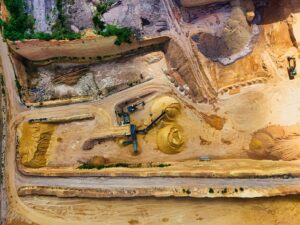
The world is using sand faster than nature can replenish it, and the sand modern cities need is becoming harder to extract without damaging the ecosystems around it.
The Desert Paradox
Along the southern rim of the Persian Gulf, concrete towers rise against a horizon of endless desert dunes. Yet when developers expanded Dubai’s coastline, they turned away from the surrounding desert. When constructing the Palm Jumeirah, specialized vessels dredged an estimated 94 to 110 million cubic meters of marine sand directly from the seabed of the Gulf, with project records and engineering reporting varying across accounts and contractor Van Oord citing the higher figure.
The paradox of the modern construction industry is visible in that single choice. Humanity can stand in a landscape covered in sand and still face a shortage of the right material.
Sand is not a uniform commodity. The global economy relies on a specific physical asset that requires particular grain geometries, exists in limited geographical pockets, and performs essential hydrological functions when left in nature. As urban expansion accelerates worldwide, the challenge is not an absolute absence of grains on Earth. The challenge is an allocation conflict between the sand required to build modern cities and the sand required to keep natural coastlines, deltas, and rivers functioning.
The Scale of Global Aggregate
Modern urban development consumes bulk materials on a scale that rivals planetary geological flows. According to the UNEP Sand and Sustainability Report, global extraction of sand and gravel reaches approximately 50 billion metric tonnes each year. This makes sand and gravel the most extracted solid material on the planet and the second most used natural resource overall, surpassed only by water.
UNEP’s headline 50-billion-tonne figure covers sand and gravel together. The bottleneck described here is narrower: the availability, location, and sustainability of sand and other fine aggregates suitable for particular construction uses.
Commonly cited industry estimates put the ratio at roughly 6 to 7 metric tonnes of sand and gravel for every metric ton of cement manufactured. Sand forms the volumetric bulk of structural concrete, asphalt roadway foundations, structural fill, glass, and industrial mortars.
In the UNEP May 12, 2026 Assessment on Sand Resources, researchers projected that global demand for sand in the building sector alone could rise by up to 45% by the year 2060. Because industrial extraction operates on project deadlines while natural rock weathering and sediment transport operate across centuries, extraction in heavily exploited basins such as the Mekong River can outpace the natural replenishment of sediment.
The Geometry of Desert Grains
The reason desert sand cannot easily solve construction demand lies in its physical characteristics. Sand suitability for concrete depends partly on grain size, shape, and grading.
In desert environments, wind moves sand particles through constant surface friction over long periods. This continuous aeolian abrasion polishes individual grains into rounded, relatively uniform particles. When mixed into standard concrete formulations, rounded desert grains slide past one another under load rather than interlocking mechanically, making un-engineered dune sand difficult to integrate into standard structural concrete without extensive chemical or mechanical modification.
Water-transported sand from rivers and floodplains experiences a different physical process. Moving water breaks and fractures rocks along natural mineral lines, producing a broader distribution of particle sizes with angular edges. These irregular surfaces interlock under load, allowing standard concrete to achieve its required structural strength with predictable binder ratios. While engineered mix designs and fine-grinding techniques can allow certain desert sands to serve as supplementary micro-fillers, natural dune sand cannot simply be shoveled into standard concrete batching plants.
The Economic Barrier of Weight
Even when suitable construction aggregate exists, moving it to where buildings are being erected is constrained by basic economics. Sand has a low value-to-weight ratio. The material itself is relatively cheap at the extraction site, but transporting heavy granular mass across land consumes substantial energy and freight capacity.
In aggregates logistics, trucking costs mount so quickly that road freight can exceed the quarry-gate value of the material within a few dozen miles, restricting construction projects to tight regional supply radii unless deep-water barge or rail corridors are available. Because land transportation quickly erodes the economic viability of the material, construction aggregate markets are intensely localized. An urban center undergoing a building boom cannot economically import aggregate from an inland quarry hundreds of miles away unless direct water transport routes exist.
The economics therefore favor relatively local supply networks, concentrating pressure on accessible sources around growing cities. When a metropolitan area expands, nearby river channels, estuaries, quarries, and shallow coastal deposits can come under greater extraction pressure. When those immediate local deposits deplete or face regulatory limits, the localized deficit cannot be resolved by global abundance elsewhere.
Dead Sand Versus Alive Sand
The extraction crisis is fundamentally an allocation conflict between two competing roles for the same material. In its May 2026 findings, the United Nations Environment Programme defined this tension as the divide between dead sand and alive sand.
Dead sand refers to aggregate that has been extracted from the natural environment and locked into physical infrastructure, such as concrete towers, paved highways, and reclaimed port land. Alive sand refers to sediment that remains active within river corridors, floodplains, deltas, and coastlines, where it functions as vital natural infrastructure.
In natural river systems, active sediment stabilizes riverbeds, regulates water flow velocity, and supports riverbank stability during seasonal floods. Natural sand deposits along river corridors facilitate groundwater recharge and filtration into underground aquifers. Coastal sediment also helps absorb wave energy and buffer communities against storms and rising seas. In coastal deltas and river mouths, sediment deposits help limit saltwater intrusion into agricultural soils and municipal drinking water supplies.
In the Mekong Delta, the consequences of this trade-off are already visible. Upstream hydroelectric dams trapping sediment combined with intensive downstream riverbed dredging have reduced the volume of sediment reaching the delta. As a result, riverbanks have destabilized and collapsed, delta land has subsided, and saline ocean water has pushed further inland into agricultural rice paddies during the dry season.
The Marine Dredging Frontier
Marine extraction has become another major source of construction aggregate as inland river extractions face local depletion and tighter environmental regulation. Commercial trailing suction hopper dredgers lower heavy dragheads onto the seabed, drawing marine sediment into onboard hoppers through high-powered suction pumps.
Data from the UNEP Marine Sand Watch platform estimates that roughly 6 billion tonnes of sand are dredged from the marine environment annually. The platform’s analysis revealed that about half of all tracked marine dredging companies operate within Marine Protected Areas, yet those operations account for approximately 15% of the total marine volume dredged worldwide. This disparity is consistent with a pattern where extraction inside protected waters is characterized by numerous smaller-scale operations rather than a few massive extraction projects, showing that company presence alone does not capture physical extraction scale.
Marine extraction presents distinct operational and environmental trade-offs. The environmental impact varies sharply with extraction location, depth, intensity, and the sensitivity of the surrounding ecosystem. Where marine aggregate is intended for reinforced concrete, chloride content has to be carefully controlled because excess chlorides can accelerate reinforcement corrosion. On the ocean floor, suction dredging strips away benthic organisms, alters seabed topography, and generates suspended sediment plumes that can drift across surrounding marine habitats.
Horizontal Territory and Export Restrictions
The consumption of sand is not limited to vertical building envelopes. Coastal cities confronting geographic constraints have consumed hundreds of millions of tons of dredged marine sediment to create entirely new land for container ports, industrial facilities, and urban developments.
Singapore has expanded its total land area by more than 20% since the 1960s, relying heavily on imported maritime aggregate to support its reclamation programs. The enormous volume of material required for regional projects created acute environmental pressures across source locations. In response, Indonesia first prohibited sea sand exports in 2003 and reinforced the ban in 2007 to protect low-lying islands from disappearing. In 2023, the Indonesian government issued regulations to reopen sea sand exports under the classification of sea sedimentation management, a move enacted in late 2024 that triggered continuous legal challenges and environmental opposition through 2025 and 2026. Cambodia similarly banned the export of coastal sand in 2017 following damage to mangrove estuaries and local fisheries, though investigative reporting has documented persistent enforcement challenges and localized circumvention.
These trade restrictions demonstrated that when local extraction becomes politically or environmentally constrained, aggregate demand does not disappear. Instead, restrictions can redirect demand toward more distant or informal sources, creating new incentives for unregulated extraction in waterways where oversight is weak.
Engineered Alternatives and the Structural Balance
Addressing the sand bottleneck requires moving away from the assumption that modern infrastructure must rely entirely on virgin natural sediment.
One of the most established alternatives is manufactured sand, produced by crushing and processing suitable hard rock from inland quarries. Mechanical crushing allows operators to control grain gradation and angularity, producing an aggregate that can meet the performance requirements of structural concrete when properly produced and specified.
India’s construction sector provides a documented example of this transition. In response to state-level restrictions on riverbed mining in states such as Karnataka and Tamil Nadu, major metropolitan construction markets, including Bengaluru and Chennai, enacted policy frameworks promoting manufactured sand. In these markets, manufactured sand typically trades at a substantial discount to scarce natural river sand, establishing it as the dominant source of fine aggregate across several southern Indian construction markets.
Manufactured sand is not a frictionless replacement. Establishing crushing plants requires significant capital investment, steady electrical power, and operational dust control, which shifts resource demand from river ecosystems to rock quarries and regional energy grids. Secondary alternatives include the processing of mineral ore tailings from mining operations after appropriate testing and treatment, as well as the circular crushing of demolition waste into recycled concrete aggregate for road bases and non-structural fills.
These engineered solutions demonstrate that the sand bottleneck is not an inescapable physical dead end. The world is confronting the limits of using natural riverbeds and coastlines as free, unmanaged quarries. The challenge is therefore not to find more sand at any cost, but to build a system in which construction demand does not depend on dismantling the sediment systems that protect cities from the sea.
