
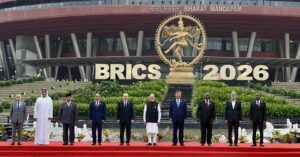
A quiet power move committed to shaping a changing world order.
I. The Photograph at Bharat Mandapam
On the morning of 12 September 2026, the leaders of an expanded global assembly gathered inside the glass-and-steel concourse of Bharat Mandapam in New Delhi for the opening session of the grouping’s 18th summit.
The official photograph captured an arresting diplomatic tableau. Narendra Modi stood alongside Vladimir Putin and Xi Jinping, surrounded by leaders representing BRICS’s eleven member states (per the bloc’s own presidency materials, though Saudi Arabia’s accession remains formally unconfirmed in independent reporting) and invited partner countries. To outside observers viewing the gathering through the lens of great-power confrontation, the image appeared to signal an emerging counter-pole to Western dominance.
Beyond the conference halls, another visual narrative circulated across international media. Photographic dispatches set summit posters and high-level branding against the everyday rhythms of the capital: cyclists, auto-rickshaws, and crowded streetscapes. The result was a striking visual juxtaposition: the polished architecture of a rising global power placed alongside the everyday contrasts of a developing economy.
The summit’s substance pointed toward an alternative reading: two days of intensive negotiation aimed chiefly at widening India’s own room for maneuver.
During its year-long chairmanship, the host government guided negotiations toward the unanimous adoption of the 140-paragraph New Delhi Declaration. India’s chairmanship was not confined to the summit itself: more than 350 meetings and high-level engagements were held across 25 cities during the year, turning the chairship into a sustained exercise in agenda-setting rather than a two-day diplomatic showcase. Addressing the plenary, the Indian Prime Minister described the structural stagnation of global governance. Developing nations, he noted, have absorbed the sharpest shocks of recent geopolitical conflicts, high inflation, and economic protectionism while remaining excluded from the institutions that write global rules. His argument pivoted on a specific mandate: the Global South must transition from being “rule-takers” to becoming “rule-shapers.”
The host nation used its position at the head of a growing forum to expand its own diplomatic options, pressing for institutional reform through the collective weight of emerging economies while keeping its foreign policy independent of any Beijing- or Moscow-led agenda.
II. The Architecture of Multi-Alignment
For decades, external observers viewed non-alignment as a defensive reflex: a legacy policy of keeping distance from superpower rivalries. In recent years, New Delhi has reshaped that tradition into an active, pragmatic doctrine of multi-alignment.
Multi-alignment rejects permanent loyalty to any single geopolitical pole. It treats international relations as a series of issue-based partnerships designed to protect national sovereignty and advance economic development.
This approach rests on an essential analytical distinction: the difference between a forum that is non-Western and one that is anti-Western.
For Indian policymakers, the grouping provides a vital platform for the non-Western world. It creates collective leverage to demand representation across the United Nations Security Council, reform quota allocations at the International Monetary Fund, and build alternative development finance. It amplifies voices that often struggle for equal representation in Washington, Brussels, or Geneva.
At the same time, India has strong structural incentives to resist any evolution of the forum into an explicitly anti-Western instrument. Because decisions require consensus, every member retains formal leverage over that direction. In its official diplomatic posture, New Delhi maintains that the forum must prioritize institutional reform, economic cooperation, and sustainable development over confrontational geopolitical alignment.
The text of the 2026 declaration reflected this balance. In practice, the declaration sought consistent enforcement of existing trade rules; its target was unilateral measures and extraterritorial sanctions, not the WTO framework itself. The collective focus remained the fair and transparent application of international trading norms.
III. The Frontier and the Contested Table
The most persistent obstacle to turning the forum into a unified geopolitical bloc sits directly along its disputed Himalayan frontier.
Unlike Western security pacts founded on mutual defense treaties and shared political models, this grouping contains two nuclear-armed continental neighbors divided by deep strategic competition. The military clashes of 2020 in Eastern Ladakh froze bilateral ties for years, compelling Indian defense planners to permanently station substantial forces along the Line of Actual Control.
Xi Jinping’s visit to India was his first in seven years, providing the stage for another bilateral meeting with Narendra Modi following their previous discussions in Tianjin in August 2025. Both leaders agreed that bilateral differences should not be allowed to become disputes, committing their diplomatic and military mechanisms to seek an early and mutually acceptable resolution to the border question.
The meeting represented a step toward stabilization, though structural strategic competition remained unresolved. The underlying drivers of rivalry remain active: an undemarcated boundary, heavy military infrastructure along the frontier, Beijing’s extensive security relationship with Pakistan, and a bilateral trade deficit running heavily in China’s favor.
In response, New Delhi has maintained defensive economic measures. Under Press Note 3, foreign direct investments from countries sharing a land border with India, or where the beneficial owner is situated in such a country, can only proceed through the Government route, requiring prior official approval. Under amendments to public procurement regulations, bidders from countries sharing a land border with India face mandatory registration and security vetting to participate in government tenders, while national security directives regulate trusted sources for telecommunications network equipment. Furthermore, digital authorities have repeatedly invoked powers under the Information Technology Act to block mobile applications assessed as prejudicial to national security and public order.
This bilateral tension directly shapes India’s multilateral strategy. In Indian strategic calculations, disengagement would risk allowing Beijing’s economic weight to guide the forum’s agenda without an internal counterweight. India participates assertively in the grouping precisely to ensure it does not become an instrument for Chinese regional primacy.
The strategy carries an inherent contradiction. The stronger the grouping becomes, the greater the institutional space available not only to India but also to China, whose economic weight remains far larger than that of most members. India therefore faces the paradox of strengthening an institution whose cohesion can simultaneously increase the influence of the power it is trying to balance.
The diplomatic benefits of staying at the table were evident in the summit’s security outcomes. In the declaration’s text, member states issued an explicit condemnation of the 22 April 2025 terrorist attack in Pahalgam, Jammu and Kashmir, which claimed twenty-six lives, coupling this with language condemning cross-border terrorist movements, safe havens, and financing networks. While the declaration preserved collective consensus by not naming Pakistan, securing consensus across an expanded forum that includes China on language condemning a specific terrorist attack in Jammu and Kashmir was a clear diplomatic achievement. For New Delhi, the outcome demonstrated the practical value of negotiating from inside a forum that includes its principal regional rival.
IV. The Mechanics of Currency Realism
Public commentary surrounding the grouping frequently predicts the collapse of the US dollar and the launch of a unified alternative currency. Inside finance ministries and central banks, the conversation is far more sober.
The New Delhi Declaration contained no announcement of a common currency. As Commerce and Industry Minister Piyush Goyal stated in August 2026, the country opposes the idea of a common BRICS currency, viewing national economic interests as incompatible with a shared monetary unit.
Indian officials recognize the practical realities of international monetary systems. Given that the US dollar remains the dominant currency for global trade invoicing, foreign exchange reserves, and international debt servicing, India’s macroeconomic interests are served by international financial stability rather than volatility in the primary global reserve asset.
BRICS members operate under widely divergent monetary regimes and capital controls, and they lack the deep institutional integration and fiscal coordination required to sustain a unified currency. Furthermore, New Delhi has no interest in substituting reliance on the dollar for reliance on the Chinese yuan, which would expose other members to Beijing’s managed exchange rate regime and strategic priorities.
The 2026 summit focused on pragmatic diversification. The declaration supported expanding the use of national currencies in bilateral trade, improving cross-border settlement mechanisms, and broadening local-currency financing through the New Development Bank.
The operational experience of bilateral settlement mechanisms illustrates this dynamic. Under guidelines from the Reserve Bank of India, international trade can be settled in Indian rupees through Special Rupee Vostro Accounts, enabling participating banks to process transactions in national currencies. Yet bilateral trade imbalances place operational limits on these arrangements. In trade with Russia, where Indian energy imports significantly exceeded reciprocal exports, foreign accounts accumulated substantial rupee balances that faced deployment constraints within the bilateral corridor. As acknowledged in bilateral financial discussions and official commentary, redeploying those balances required expanding purchases of Indian goods or utilizing permitted investments in domestic financial instruments. The episode demonstrated that currency settlement mechanisms cannot resolve structural trade imbalances on their own.
V. Sovereign Rails and Emerging Payment Systems
While avoiding grand monetary experiments, the 2026 summit pushed forward a broader practical agenda around digital infrastructure, emerging technologies, and the digital plumbing of international payments.
At Bharat Mandapam, discussions addressed how digital public infrastructure could make cross-border commerce more efficient and resilient. Rather than constructing an artificial alternative to the dollar, the summit examined how digital connectivity could streamline transactions between existing currencies.
The declaration’s text reflected this approach: member states endorsed the concept of interoperable digital public infrastructure, backed the creation of a proposed digital infrastructure repository, and agreed to pursue voluntary pilot projects across digital ecosystems. Simultaneously, the BRICS Payment Task Force continued studying ways to improve interoperability between national payment and messaging systems, alongside wider use of domestic currencies in commercial clearing.
This initiative builds on real domestic achievements. Platforms such as the Unified Payments Interface in India and Pix in Brazil have demonstrated the technical capacity and scalability of public digital payment rails within large developing economies.
Connecting domestic payment networks across borders remains in its developmental stages, but the strategic logic is clear: exploring mechanisms for cross-border settlement using domestic currencies, without requiring a centralized supranational monetary apparatus.
This framework aligns with New Delhi’s broader technology policy: promoting open, modular, and sovereign digital systems. Developing nations are not forced to choose between closed technological ecosystems. Instead, they can evaluate interoperable digital infrastructure that respects domestic regulatory sovereignty and data governance. It is a pragmatic, technical path to financial efficiency that avoids the political complications of a common currency.
VI. Unilateral Tariffs and the Washington Ledger
India’s role within the forum cannot be understood without examining its relationship with the United States. Strategic autonomy is not maintained in isolation; it is continuously tested by the policies of major powers.
India entered 2026 facing two separate U.S. tariff measures: an initial 25 percent reciprocal tariff on commercial goods, alongside an additional 25 percent duty imposed on Indian imports over the country’s purchases of Russian crude oil dating from 2025.
The ensuing diplomatic engagement showed how New Delhi manages pressure from partners. By February 2026, Washington and New Delhi had reached a framework for an interim agreement that established an 18 percent baseline for the reciprocal tariff on Indian goods and eliminated the additional 25 percent duty on Indian articles linked to Russian oil purchases. Even after the February framework, trade friction persisted: in July 2026, the Office of the United States Trade Representative finalized an additional 10 percent duty following a multi-economy Section 301 investigation concerning the prohibition and enforcement of bans on goods produced with forced labor.
Parallel to trade friction, bilateral security cooperation has continued to deepen. The strategic partnership with the United States is anchored by foundational defense agreements, operational coordination in the Indian Ocean through the Quad, and technological cooperation under the Initiative on Critical and Emerging Technologies.
United States strategic frameworks and high-level bilateral dialogues emphasize an independent and capable India as an important partner in maintaining a stable balance of power across the Indo-Pacific.
That dynamic gives New Delhi meaningful diplomatic room, but not unlimited leverage. Washington has demonstrated that it can impose economic costs when its interests diverge from India’s, while Beijing remains a major security challenge along the northern frontier. India’s diplomatic flexibility stems from maintaining productive ties across multiple capitals, preserving strategic options without committing to an exclusive alignment.
VII. The Material Limits of Autonomy
Any serious assessment of this foreign policy must acknowledge its material boundaries. Strategic autonomy requires concrete material foundations, not merely diplomatic articulation.
A nation’s geopolitical maneuverability is bounded by its material dependencies. In national defense, while domestic procurement and indigenous manufacturing initiatives have expanded, the armed forces remain reliant on foreign aerospace components, precision guidance systems, and spare parts for legacy equipment of Russian origin. In the industrial sector, the domestic economy depends on imported semiconductors and specialized components where global manufacturing and critical mineral processing remain heavily concentrated in East Asia.
Similarly, economic expansion remains tied to external flows. India imports over eighty percent of its crude oil requirements via maritime supply corridors, making domestic inflation sensitive to global energy shocks. At the same time, expanding domestic employment and industrial capacity depends on continued integration with Western consumer markets, technology transfers, and foreign direct investment.
These economic and technological dependencies impose discipline on statecraft. An emerging power cannot afford to turn strategic autonomy into reckless defiance. Confrontation with major markets or disruptions to international supply chains would carry immediate domestic economic costs.
India’s chairmanship also pushed the grouping toward more resilient global value chains and logistics cooperation, an effort that reflects the same strategic problem from another direction: reducing vulnerability without replacing one external dependency with another.
The refusal to choose sides reflects a calculated response to material realities: the trade, technology, and capital flows that a formal alignment in either direction would put at risk. Aligning permanently with an anti-Western bloc would threaten the modernization of the domestic economy. Aligning exclusively with the West would complicate continental security, restrict energy access, and surrender policy independence. Staying in the middle preserves the wide range of external partnerships required to fuel internal growth.
VIII. The Multipolar Trajectory
The lasting significance of the 18th summit in New Delhi lies not in the creation of a new geopolitical bloc, but in the institutional evolution of global governance.
The summit did not resolve the substantial disputes that divide its participants. It did not bridge the strategic distrust between New Delhi and Beijing, resolve the differing external priorities of Tehran and Abu Dhabi, or reconcile the varied economic models of its members.
What the summit actually demonstrated was the growing institutional weight of a multipolar order still under construction, well short of any full post-Western arrival.
Yet institutional weight cannot be measured by declarations alone. India itself has called for stronger continuity and implementation mechanisms so that annual changes in the chairmanship do not interrupt institutional momentum. The test of the grouping will therefore be whether its agreements become functioning systems rather than recurring summit language.
According to Indian government data released for the 2026 presidency, the expanded grouping accounts for approximately 49.5 percent of the world’s population and around 40 percent of global gross domestic product measured at purchasing power parity. Under Indian chairmanship, this diverse assembly reached consensus on a wide-ranging declaration without adopting an anti-Western agenda.
The chairmanship also advanced the BRICS Economic Partnership 2030, extending India’s agenda beyond political declarations into trade, services, technology, investment, and financial cooperation.
Throughout its presidency, the host government acted as a moderating force. It focused the agenda on institutional reform, advocated for the wider Global South (building on the African Union’s accession to the G20 during New Delhi’s 2023 presidency), advanced practical cooperation on digital public infrastructure, and secured collective consensus on terrorism.
In an increasingly divided international system, the refusal to enlist in a formal bloc represents a deliberate diplomatic strategy. The real power move is the preservation of choice. For now, India’s strategy is to keep that choice open for as long as its national interests allow.
