

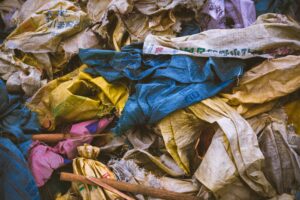
How discarded fashion travels across borders, creates new livelihoods and leaves some communities paying for the waste.
A Desert Full of Clothes
Outside Alto Hospicio, discarded clothing stretches across parts of the Atacama Desert. Jackets, trousers and shirts lie exposed in a landscape where rainfall is scarce. Some of these garments travelled thousands of miles before reaching northern Chile.
The garments reveal a gap in the international secondhand trade: clothing can cross continents and change owners several times, but the cost of managing what cannot be sold may remain with the communities where it finally arrives. In September 2025, a Chilean court ordered the State to prepare a plan to repair environmental damage caused by illegal dumping in Alto Hospicio.
Two sets of UNECE figures do not line up, and the article treats the mismatch as a finding rather than smoothing it over. On the dumps’ extent, a UNECE press release describes approximately 30,000 tonnes of discarded clothing across 30 hectares near Alto Hospicio, while the underlying UNECE-ECLAC report gives an area of roughly 300 hectares. Neither publication reconciles the two. On imports, the same press release reports that Chile received 126,000 tonnes of textiles in 2021. The joint report instead cites Chilean customs data of 124,000 tonnes in 2022, and says that around two-thirds of second-hand clothes entered through ZOFRI in the Tarapacá region. The two import totals describe different years and are not interchangeable. Neither measures the clothing accumulated in the desert; each is a year’s trade (UNECE press release; ECLAC publication record; UN iLibrary record; report executive summary).
The court case began in March 2022, when lawyer Paulin Silva Heredia brought an environmental claim over illegal dumping near Alto Hospicio against the Chilean State and the Municipality of Alto Hospicio. On 5 September 2025, Chile’s First Environmental Tribunal found the State responsible for environmental damage in four sectors: Pampa Norte, Pampa Sur, Mollecita Norte and Mollecita Sur. It ordered the State to submit a repair plan within six months. The waste included discarded clothing, tyres, rubble and other materials. The tribunal rejected the claim against the municipality, finding that it had taken concrete steps to manage the waste. It also found that those efforts had not resolved the structural problem (Emol; La Tercera).
A year later the order had still not produced a repair plan. Meganoticias reported on 27 September 2026 that, according to Silva, the State had not presented the plan. She also said the State Defence Council’s challenge was awaiting review by the Supreme Court. The reports concern compliance with the order. The outcome of the challenge, and the identity of the businesses that supplied the dumped clothing, remain unaddressed (Meganoticias).
The desert preserves what arrives. Extremely dry conditions can slow the biological breakdown of some textile materials, while sunlight and weathering can fragment synthetic fabrics. UNECE and ECLAC also report burning at parts of the dumps and identify hazardous emissions associated with burning synthetic textile waste. What nearby residents have actually been exposed to would require evidence specific to the affected sites.
Chile’s Environment Ministry launched a Circular Economy Strategy for Textiles to 2040 on 2 October 2025, with one of its priority goals being to prevent and eradicate illegal textile dumps. Coverage of the launch describes new rules and standards for imports of used clothing and the inclusion of textiles in Chile’s extended producer responsibility law, which would make importers and producers responsible for the waste their products generate (Ministry of the Environment; CNN Chile). These are planned actions, not completed measures. Announcing a strategy is different from financing remediation: the published strategy does not by itself state the cost of cleaning up the existing dumps or how that work will be paid for.
The Myth of the Donation Bin
Dropping a garment into a charity bin transfers it to a collection system, not necessarily to another wearer. Some donations sell locally. Others are transferred between shops, sent to commercial sorters or exported. Their destination depends on condition, demand and the collecting organisation’s arrangements.
Oxfam’s shops in Britain show how collection and sorting decide a garment’s route. Clothing donated to its UK shops that does not sell can be sent to its Wastesaver facility in Batley, West Yorkshire, for sorting. In written evidence submitted to a UK parliamentary committee in December 2018, Oxfam reported that Wastesaver processed around 12,000 tonnes of textiles annually and sold approximately 30 percent of its clothing to Frip Ethique, its social enterprise in Senegal. Oxfam reported that more than 500 small traders bought stock from Frip Ethique at the time, so the British sorting operation ultimately supplied hundreds of small businesses in Senegal (Oxfam GB; UK Parliament written evidence).
Oxfam is one collector among many in a much larger collection and export system, and the categories that system handles overlap in ordinary language. Donated clothing, commercially traded used clothing and legally classified textile waste are not interchangeable in trade or waste statistics.
At the scale of the EU, the European Environment Agency estimates that people consumed an average of 19 kilograms of clothing, footwear and household textiles in 2022. Member states generated approximately 6.94 million tonnes of textile waste that year, equivalent to around 16 kilograms per person. Separately, EU exports of used textiles exceeded 1.44 million tonnes in 2025, more than twice their 2005 volume, and have remained at approximately 1.4 million tonnes annually since 2015. Together, these measures show why collection systems must manage both large volumes of discarded textiles and an established international market for material that can still be sold (EEA textile indicators; EEA used-textile export indicator).
Over the 15 years covered by its analysis, the Ellen MacArthur Foundation reported that clothing production approximately doubled while clothing use declined by almost 40% (Ellen MacArthur Foundation). Garments entering collection systems vary widely in durability, construction and resale potential. Low-quality items can be difficult to sell or repair, while mixed fibres and decorative components may complicate recycling.
The Business of the Unwanted
A secondhand garment may pass through a collector, sorter, exporter, wholesaler and retailer before reaching another wearer. Charities, municipal collection systems and private collectors supply sorting companies, which grade clothing for domestic resale, compress it into export bales, direct it to recycling or discard it. Each sale transfers the clothing and its commercial risk to the next buyer. Sorting and grading help exporters price a shipment, but they cannot show a retailer what a sealed bale contains.
According to The Or Foundation, Kantamanto importers can request clothing grades but cannot specify the contents of individual bales. Retailers pay before inspecting their purchases and cannot obtain refunds when a bale contains unsellable garments. The risk of discovering a bale’s resale value therefore falls on the buyer. Exporters’ profit margins cannot be inferred from these transactions without accounting for their own costs (The Or Foundation FAQ).
That chain is hard to trace once it crosses borders. Clothing may pass through several countries for sorting or re-export, while customs records identify the traded goods rather than documenting every subsequent resale or disposal decision.
Customs records distinguish worn clothing under HS heading 6309 from rags and specified textile scraps under heading 6310 (World Customs Organization, Harmonized System 2022: heading 6309; heading 6310). The codes describe the goods, but do not by themselves establish whether a shipment is legally waste. A consignment described as reusable clothing may contain damaged or contaminated garments, or material intended for disposal. Determining its legal status can therefore require evidence about condition, intended use, sorting and the applicable waste rules.
The EU has introduced new rules intended to make the distinction between reusable textiles and waste more enforceable. Under its revised Waste Framework Directive, separately collected used and waste textiles are generally classified as waste upon collection. An exception applies to items handed directly to reuse operators or social-economy organisations and professionally assessed as fit for reuse at the point of collection. The Commission says the new sorting requirements are intended to prevent waste from being falsely labelled and exported as reusable. Unsorted textile waste remains subject to the applicable Waste Shipment Regulation. The revised directive entered into force in October 2025, but member states have until June 2027 to transpose it into national law. Its practical effect on textile exports will depend on national implementation and enforcement (European Commission announcement; Directive (EU) 2025/1892).
Iquique shows why a trading hub does not identify the business behind a particular dump. Its free-trade infrastructure supports the storage and redistribution of imported used clothing. ZOFRI’s general manager told CBS News that the zone’s officials do not buy or sell the clothing and are not responsible for the resulting waste. His statement represents the zone’s position. Determining who handled garments later abandoned near Alto Hospicio would require records linking particular shipments to transport and disposal decisions (UNECE press release; CBS News, December 2023).
The EEA’s statistics identify the recorded destinations of EU exports classified as used textiles, primarily worn clothing and other worn textile articles, with a smaller quantity of rags and textile scraps. Asia received approximately 48 percent of the EU’s used-textile exports in 2025 and Africa 43 percent. Pakistan and the United Arab Emirates were major destinations over the period the indicator covers. The shares describe recorded exports and their first reported destinations, not what happened to the clothing afterwards (EEA used-textile export indicator).
The Markets That Give Clothes Another Life
At Ghana’s Kantamanto Market, the value of an imported garment can change after it reaches the retailer. Repairers replace broken zippers, stitch torn seams and alter oversized clothing for another buyer. Their work extends the useful life of garments that have already passed through international collectors and exporters. It also takes labour, time and customers willing to pay. A bale containing clothing that cannot be repaired or sold leaves the retailer with a different problem: what to do with the remaining material.
Bales cost from $75 to more than $500, according to The Or Foundation. By its estimate, a retailer is on average $1.58 in debt per garment when a bale is opened, after accounting for bale prices and business fees. The published FAQ gives no sample size or calculation period for that figure, so it is not an independently established average for every Kantamanto retailer. The foundation also reports that fewer than 20 percent of retailers make a profit on an average bale, and describes borrowing used to repay earlier loans (The Or Foundation FAQ).
The Or Foundation estimates that approximately 15 million garments arrive at Kantamanto each week. It distinguishes the 4 to 6 percent considered waste when bales are first opened from the roughly 40 percent it estimates eventually becomes waste after garments move through the market. The figures concern different stages of the trade and are not directly comparable. The foundation says it has documented the approximately 40 percent figure since 2016 through surveys, interviews and detailed waste-data analysis, but the cited FAQ does not publish the underlying dataset needed to reproduce it independently (The Or Foundation FAQ; Sourcing Journal).
The physical demands of the trade extend beyond the market stalls. In Kantamanto, female head-load carriers known as kayayei transport heavy bales through crowded commercial streets and narrow market passages. They are paid approximately 30 cents to $1 per trip and need assistance to lift bales weighing about 120 pounds, according to a 2025 account by an Or Foundation co-founder (Atmos, July 2025). The reported payments and loads illustrate the physical labour required to move clothing through the market, work that is largely invisible in the export price of a bale.
A fire that broke out on 1 January 2025 devastated large sections of the market. The Or Foundation committed $1 million to emergency relief on 3 January (The Or Foundation, 3 January 2025) and reported on 11 January that, as of 8 January, it had confirmed 8,890 stalls destroyed and estimated that more than 10,000 people were affected, based on records coordinated with market section leaders. These are the foundation’s figures, not audited totals (The Or Foundation, 11 January 2025). No official cause of the fire had been identified in the reporting reviewed. It destroyed infrastructure shared by the traders, repairers and carriers on whom the market depends.
Restrictions on used-clothing imports raise questions about domestic manufacturing, affordability and trade policy. In March 2016, East African Community members agreed to phase out used-clothing and footwear imports within three years to support domestic production. In 2017, the US secondhand textile industry petitioned Washington to review the countries’ eligibility for trade preferences. Kenya then restored its earlier tariff rates and committed not to impose a ban through other measures. The US Trade Representative subsequently decided that a special review of Kenya was unwarranted.
Rwanda took a different course. In 2018, the United States determined that it no longer met the relevant eligibility requirements. It suspended duty-free treatment for eligible Rwandan apparel under the African Growth and Opportunity Act, rather than withdrawing all its AGOA benefits. The episode illustrates the policy constraints facing governments seeking to support domestic textile production while preserving existing trade preferences. Whether restrictions improve domestic factories’ performance is a separate question the episode leaves open (USTR, March 2018; USTR, July 2018).
Where the Unsold Clothes Go
At Kantamanto, waste collection begins with the garments that retailers cannot sell. According to June 2026 reporting by Sourcing Journal, a team of approximately 40 people selected by market leaders removes an estimated seven to 20 tons of discarded clothing during evening collection operations and transports it to a sanctioned dumpsite (Sourcing Journal). According to The Or Foundation, retailers also pay sanitation fees towards waste management and rent to store clothing they cannot sell (The Or Foundation FAQ).
Emergency spending after a major disruption is a separate matter. After the January 2025 fire, the foundation said it was paying more than GHS 8,000 a day for trucks and a payloader to move burnt debris, including burnt garments, towards the Adepa dumpsite. That figure concerns fire cleanup and is not the ordinary cost of collecting the market’s textile waste (The Or Foundation, 5 January 2025).
A different problem is visible along Accra’s coast. The Or Foundation reports documenting tangled masses of fabric it calls textile tentacles through weekly beach monitoring. Its published observations include tentacles up to 30 metres long, textile mounds taller than 180 centimetres and other deposits buried more than two metres below the sand. The foundation believes that the visible material represents only a fraction of the textile waste lying on the seafloor, but that belief is not a measured estimate of underwater accumulation. The observations concern particular deposits; the cited FAQ gives no citywide total or defined survey period (The Or Foundation FAQ).
The available evidence does not connect particular consignments to particular deposits, or show how much coastal waste passed through the market’s collection system or originated elsewhere.
Market collection and coastal cleanup therefore require different responses. Collection depends on regular labour, transport and disposal capacity, while coastal cleanup requires locating and removing deposits whose origins are not fully documented. Both involve work that continues after the garments concerned have lost their resale value, but no available figure gives the total cost of either operation.
The Limits of Recycling
In India, Panipat shows what can happen to used textiles when they are treated as raw material. A February 2026 draft diagnostic study by the Foundation for MSME Clusters, circulated for public comment, estimates that the cluster in Haryana processes approximately 4,000 metric tonnes of textile waste daily, a major portion of it imported. It separately reports an average inflow of about 170 containers carrying roughly 22 tonnes each and an estimated annual inflow of approximately 1.45 million tonnes. The container figures imply about 3,740 tonnes a day, or 1.37 million tonnes if sustained for 365 days. The study’s rounded daily, container and annual estimates therefore do not reconcile exactly and should not be treated as precise measurements. None is an independently audited national statistic (FMC diagnostic study).
Processing begins with workers sorting incoming textiles by fibre, colour and potential use. They remove accessories such as zips and buttons, which can be sold separately. The study describes this manual sorting as the first and most labour-intensive stage, done largely by women and migrant workers in informal jobs. Quality is inconsistent, and only a few units have introduced mechanical sorting. Suitable material is then torn into fibre on machines, many imported from Italy in the 1980s and 1990s, which the study associates with low throughput and fibre loss. The fibre is spun into shoddy or open-end yarn and woven into blankets, rugs, home furnishings and industrial rags.
Tracking material through this chain is at an early stage. The study reports that only export-oriented firms with certifications such as GRS and GOTS have adopted partial tracking, while most small enterprises rely on paper or spreadsheet records. It identifies stronger traceability as an emerging requirement from export customers and evolving EU sustainability and product rules. This does not mean every Panipat mill is already subject to a uniform legal traceability obligation.
Blended fabrics limit what mechanical recycling can recover. Cotton, polyester and elastane have different properties, and coatings or finishes can complicate sorting and processing. Chemical methods may recover certain polymers or their constituent chemicals, but their commercial viability depends on the input material, energy use and processing costs. Neither approach can economically recover every discarded garment.
UNEP estimates that 92 million tonnes of textile waste are generated globally each year. Its October 2025 report also states that recycled sources supplied approximately 8 percent of textile fibres in 2023, while less than 1 percent of the global fibre market came from textile-to-textile recycling. The gap exists because recycled fibre can come from other materials: recycled polyester, for example, is commonly made from plastic bottles rather than old garments (UNEP, Transforming the Textile Industry: Learning to Manage Waste, Better, October 2025).
The Panipat study also cites an industry estimate of more than 54,000 metric tonnes of PET polyester staple fibre spun into yarn annually. The study reports this PET figure separately from its estimates of recovered textile material. Without evidence establishing the origin of the PET feedstock, the figure cannot independently show how much fibre came from discarded textiles rather than other sources.
Recycling changes what can be recovered, but it does not remove the cost of managing what cannot be recovered. The question then becomes who pays for collection, treatment or disposal.
Who Pays for the World’s Wardrobe?
The benefits of clothing reuse and the costs of managing its waste can arise in different countries. Existing regulations address collection, producer responsibility and international shipments, but they do not necessarily finance disposal where exported clothing ultimately becomes waste. The following measures operate at different points in that chain.
January 2025, EU separate collection. EU member states were required to introduce separate collection of textile waste, creating a distinct stream of material for reuse and recycling. It is a legal requirement operating within the country of collection; it does not establish a funding mechanism for waste management in importing countries. The EEA notes that greater collection could increase export volumes, while tighter export controls and expanded domestic circularity could work in the opposite direction (EEA used-textile export indicator).
October 2025, EU Waste Framework Directive. Adopted law requires every member state to establish an extended producer responsibility scheme for textiles and footwear, under which producers pay a fee for each product they place on the market. The Commission says the fee finances collection schemes and the management of collected textiles, including reuse, recycling and disposal, and is adjusted for factors such as durability and recyclability. Schemes must be established within 30 months of entry into force, by 17 April 2028. The directive establishes producer responsibility for collection and subsequent management within the EU system; it does not create a general mechanism to finance disposal of exported garments in countries such as Ghana or Chile (European Commission announcement, 16 October 2025; Directive (EU) 2025/1892).
February 2026, UNECE and ECLAC. Making Trade Work for Circularity: Improving Circularity in Second-Hand Clothing Through Trade Regulation examines how trade-related technical regulations could improve the quality of internationally traded secondhand clothing, consistent with World Trade Organization rules. It proposes approaches for governments to consider rather than binding requirements, and it addresses the quality of traded goods, not the financing of waste management (UNECE publication record).
Basel Convention. In 2025, the Convention’s parties adopted decision BC-17/21, adding used textiles and textile waste to the Open-ended Working Group’s 2026 to 2027 programme. At its meeting on 23 to 26 June 2026, the group considered the issue as part of preparations for further work. It is developing options concerning cross-border movements and the distinction between used textiles and waste for consideration at the Conference of the Parties in 2027. No new textile-specific controls had been adopted through that process as of September 2026. The Basel process therefore addresses how textile waste is classified and moved across borders, not who ultimately pays for managing it (official work programme; June meeting record).
September 2026, Apparel Recovery Coalition. The Or Foundation launched the coalition with H&M, Inditex, Bestseller and Adidas at Kantamanto Market. It is a voluntary initiative intended to develop and test a two-year blueprint covering reuse, upcycling, recycling and waste management beyond the brands’ primary sales markets. Trade press reports that the brands will fund work on circular textile systems in countries receiving used clothing (Vogue; Ecotextile News, 29 September 2026). Its results will depend on the contributions delivered, the waste-management activities financed and independently reported outcomes for workers and communities in importing markets.
The central gap is geographic: enacted EU rules establish producer funding obligations and regulate textile management within member states, while international proposals examined here address shipment quality and waste classification. The voluntary Apparel Recovery Coalition is testing whether producer support can extend beyond brands’ primary sales markets. None of the enacted measures examined here imposes a general obligation to finance disposal of exported garments in the countries where they eventually become waste.
The Or Foundation proposes a fee of $0.50 to $2.50 per newly produced garment, adjusted for fibre content, to support communities dealing with imported clothing waste. Its proposal would fund activities including repair, recycling, collection and remediation of existing dumps. Unlike the EU’s producer-responsibility schemes, it is designed to direct resources beyond the country where clothing was originally sold. It remains an advocacy proposal, not law (The Or Foundation FAQ).
The foundation proposes prioritising countries that receive large quantities of used clothing relative to their populations and have limited financial resources. But turning that principle into an accountable funding system would require an agreed allocation method, transparent spending, independent verification and a way to handle garments traded through several countries. Customs data can help identify trade flows but do not show where every garment is eventually discarded.
A Second Life Without a Second Landfill
A year after Chile’s First Environmental Tribunal ordered the State to prepare a repair plan for the illegal dumps near Alto Hospicio, September 2026 reporting indicated that the plan had still not been submitted. The judgment established the State’s responsibility for the environmental damage, but did not trace the discarded garments to particular businesses.
Kantamanto’s traders and repairers recover value from imported clothing. Accra’s waste collectors handle some of what cannot be sold, while Panipat’s recyclers turn suitable textiles into other products. These activities extend the useful life of clothing and recover materials, but they do not eliminate the cost of managing what remains. For any cross-border funding arrangement, the real test begins after the money is promised: where it goes, what it pays for and whether anyone independent can verify what changed.
