

How Wall Street Turned Childhood Nostalgia into Fractional Securities, and What Happens When the Buyers Disappear
I. The Object of Desire
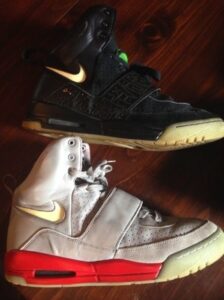
In April 2021, a size 12 Nike Air Yeezy 1 prototype worn by Kanye West at the 2008 Grammy Awards sold in a private transaction for a reported $1.8 million. The buyer was Rares, a startup that planned to let retail investors buy fractional interests in the shoe. The transaction and the reported price were covered by Complex and recorded by Guinness World Records.
Rares’ SEC-filed offering circular for its Series Grammy set a minimum offering of 72,000 shares at $25 each and a maximum of 120,000 shares. The offering circular described the shares as non-voting except with respect to certain matters set forth in the Operating Agreement. It does not establish how many shares were ultimately sold or how much investors eventually recovered. (Rares Series Grammy offering circular)
A planned sale through Christie’s was canceled in October 2022, as reported by Artnet News. The pair later sold through Goldin in September 2023 for a reported $150,000, with the auction total reported at approximately $180,000 after buyer’s fees. Rares co-founder Gerome Sapp told Complex that the company had begun winding down after it could not raise enough capital to continue operations, and that it hoped liquidation would provide payouts to investors. The auction price alone does not establish Rares’ net loss or the amount ultimately returned to any investor.
The shoe was one example of a wider experiment. Platforms including Rally, Otis and Collectable offered retail investors fractional economic interests tied to high-value collectibles. The appeal was straightforward: investors could gain exposure to a card, watch or sneaker without personally storing or insuring it. But dividing an economic interest in an object does not create a reliable market in which investors can sell that interest.
Collectibles can carry cultural memory as well as financial appeal. A sneaker may evoke a performer or a particular era; a trading card may connect an owner to childhood fandom. That emotional appeal can help explain why an object attracts attention, but it does not guarantee future investment demand. Here, the Wall Street connection is the use of securities structures and marketplace language to turn interests in collectibles into investments, not evidence that traditional investment banks drove the experiment.
II. The Architecture of Securitization
Some fractional-asset platforms used Regulation A, an exemption from registration under the Securities Act for qualifying public offerings. Under Tier 2, an eligible issuer may offer up to $75 million in securities during a 12-month period, but sales cannot begin until the SEC has qualified the offering statement. The exemption does not itself excuse a platform operating a securities exchange from applicable exchange-registration requirements. (SEC Regulation A guidance)
One structure used a Delaware LLC with separate series for individual assets. Delaware law permits series-level separation, but liability separation depends on the applicable statutory regime and its conditions. For a protected series under §18-215, those include separate records, provisions in the LLC agreement and notice in the certificate of formation; registered series are addressed separately under §18-218. The applicable provision depends on the series and relevant dates, and separation is not an unconditional guarantee against every claim. (Delaware Code, §§18-215 and 18-218)
Investors bought securities or membership interests in the relevant series, not personal title to a fraction of the physical object. The manager and the governing documents controlled custody, expenses and the process for any sale. The precise rights varied by issuer and offering.
The fees also varied. Rares’ Series Grammy offering disclosed a 1% brokerage cash success fee payable to Dalmore Group and an annual management fee of 5% of the post-offering value of the underlying asset or assets. (Rares offering circular)
Collectable’s 2025 Form 1-K disclosed that, for applicable offerings closing escrow after May 15, 2022, the manager could charge a monthly management fee of up to 2% of the asset’s carrying value. The filing says carrying value is calculated monthly using the series’ volume-weighted average price over the preceding month, and that this method applies only to months in which the series traded for the full month. The manager could also charge a disposition fee of up to 5% of gross sale proceeds when an asset was sold. These are different fee structures, not a single industry-wide tariff. (Collectable 2025 Form 1-K)
Consider a hypothetical offering: an asset acquired for $100,000 is offered as 10,000 shares at $11.50 each. The $115,000 gross offering target is not profit. Brokerage, offering, acquisition, management and operating costs affect how much remains in the asset-holding series and what may ultimately be distributed to investors.
III. When Trading Stops
A collectible generally produces no operating cash flow, dividend or interest. Its resale value depends on factors such as collector demand, condition, provenance, available sales channels and the price a later buyer is willing to pay. An investor’s ability to sell a fractional interest is a separate question from whether the physical object can be sold.
These risks can be separated into three forms of liquidity. Collectible liquidity is the ability to sell the underlying object. Investment liquidity is the ability to sell the fractional interest to another investor. Platform liquidity is the ability of the marketplace to process trades. Corporate solvency is a related operating condition: a platform short of cash may struggle to maintain trading systems and pay continuing costs even if the underlying objects remain in storage.
A market can become unusable even without proof that every potential buyer has disappeared. A platform may halt trading because operating the marketplace has become too costly, leaving investors unable to sell through the channel they expected to use.
Collectable Sports Assets provides a documented example. Its 2025 Form 1-K reported more than 90,000 registered users and over 10,000 investors who had participated in an offering. The company said secondary trading had been halted in 2024 because of cost considerations and remained halted in 2025. Its earlier Form 1-U, filed May 1, 2024, had reported a temporary halt after the company failed to file its annual report by the April 29 deadline. The filings give different explanations at different points in time; they should not be collapsed into one reason. (Collectable 2025 Form 1-K; Collectable May 2024 Form 1-U)
Collectable’s 2025 Form 1-K reported $915,976 in impairment charges across 35 items for 2024, and no impairment charges in 2025. The filing explains that the company used market capitalization based on volume-weighted average price to measure impairment. Because secondary trading was halted, it had no trading data for that calculation in 2025. Management said outside market research suggested that the remaining asset values had at a minimum remained steady. That was management’s assessment, not an independently established market valuation. The same filing reported no new offerings and no off-platform asset sales in 2024 or 2025. (Collectable 2025 Form 1-K)
In its Form 1-SA for the six months ended June 30, 2025, Collectable stated that, as of September 29, 2025, management doubted whether the company had enough liquidity to operate for the next 12 months without additional liquidity. This was a company disclosure about its operating outlook, not a finding that each underlying collectible had become worthless. (Collectable Form 1-SA)
For an investor whose account displays a nominal value of $50,000, a trading halt can mean that the displayed amount cannot readily be converted into cash. Any eventual recovery depends on the underlying asset’s sale price, expenses, liabilities and the terms governing that series.
IV. The Regulatory Reckoning
In July 2023, the Securities and Exchange Commission found that RSE Markets, the operator of Rally’s trading platform, had operated an unregistered national securities exchange. The SEC order described more than 55,000 transactions totaling approximately $5.8 million between July 2018 and November 2021. The platform matched orders during scheduled trading windows using a price-and-time priority algorithm. The order stated that RSE Markets did not charge fees for secondary trading and had not earned a profit since inception. RSE consented to the order and agreed to a $350,000 civil penalty without admitting or denying the findings, except as to jurisdiction. (SEC administrative order, Release No. 34-97878)
The case illustrates that a platform matching buyers and sellers of fractional securities may fall within the statutory definition of an exchange and face registration requirements. The SEC’s findings concerned RSE’s specific conduct during the period examined. For investors, the episode shows that a platform’s ability to facilitate secondary trading depends not only on finding counterparties but also on the legal status and operating model of the marketplace. These findings do not, by themselves, prove that regulatory costs caused the wider fractional-collectibles market’s decline.
V. Who Owns What?
The practical question was how much control investors retained over the asset and the timing of a sale. The offering circular for Rares’ Series Grammy described the shares as non-voting except with respect to certain matters set forth in the Operating Agreement. (Rares offering circular)
Rares’ Series Grammy operating-agreement disclosures permit the manager to consider its own interests and state that it has no fiduciary duty to the company, its series or shareholders. This is a term of the Rares agreement and should not be generalized to every platform. (Rares offering circular)
Collectable’s 2025 Form 1-K further states that, if a series’ operating expenses exceeded its revenue and reserves, its manager could lend money to the series at interest or issue additional interests that dilute existing holders. It also describes asset-sale procedures under which liabilities, expense reimbursements and a disposition fee may be deducted before net proceeds are distributed. The specific terms of each offering matter. (Collectable 2025 Form 1-K)
A holder of 0.4% of a card or sneaker cannot take physical delivery of 0.4% of the object. The investor’s financial outcome depends on any eventual sale price and on the expenses, liabilities and distribution terms that apply to the series.
VI. The Exit
Court proceedings involving Collectable show how operational problems can become disputes over records and governance. In Cornett v. Collectable Sports Assets, LLC, the Court of Chancery addressed a books-and-records dispute, missed production deadlines, contempt, sanctions and the appointment of a receiver. Its September 2025 order and December 29, 2025 decision describe the contempt and receiver proceedings. A January 5, 2026 third-party docket record reports that the parties settled the books-and-records dispute and that the company had paid the fees, sanctions and receiver costs specified in earlier orders; it records the litigation as dismissed with prejudice. The case documents a records dispute and its resolution; it does not establish fraud or prove that assets were missing. (September 2025 Court of Chancery order; December 29, 2025 Court of Chancery decision; third-party docket record of the January 2026 dismissal)
Otis followed a different contingency model. Public’s published guidance states that if Public and its Otis affiliate go out of business, Otis or a selected liquidator would wind up alternative-asset offerings, liquidate assets and distribute after-tax proceeds under the governing documents. That procedure is specific to the relevant offerings and should not be generalized to other platforms. (Public’s alternative-assets wind-down guidance; contemporary acquisition report)
When trading stops, investors’ route back to cash depends on the manager, the governing documents and an eventual sale.
