

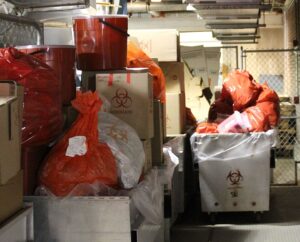
Where Medical Waste Goes After the Treatment Ends
In January 2021, a tip-off sent customs officers in Dumai, Riau Province, Indonesia, to monitor a ship unloading at an informal port. They intercepted four trucks carrying used medical rubber gloves and plastic face shields, along with medicines moved without customs clearance (UNODC and UNITAR, December 2024).
The interception raises a question that follows healthcare waste long after it leaves the ward. Where does it end up? Hospitals are judged by what they keep away from patients, and far less attention goes to the used material afterward. Healthcare also adds to climate change, and the World Health Organization (WHO) estimates that the sector accounts for about 5% of global greenhouse gas emissions (WHO, 2025). This article follows the waste from the ward toward its final destination and marks the points where the public record runs out.
Most waste is ordinary
WHO estimates that about 85% of healthcare waste is general and non-hazardous, similar to household garbage. The remaining 15% is infectious, pathological, chemical, pharmaceutical, cytotoxic or radioactive. The volume is large, with about 16 billion injections given worldwide each year (WHO fact sheet).
The line between ordinary and hazardous waste is easiest to preserve when staff separate the streams at the point of use. When separation fails, ordinary refuse mixes with infectious waste and enlarges the volume that needs special handling. The WHO and UNICEF Joint Monitoring Programme found basic healthcare waste services in 61% of hospitals in 2021 (WHO/UNICEF, 2023). Its 2023 data update found them in only 25% of facilities in fragile contexts (WHO/UNICEF, 2024). The two figures cover different populations and years, so they cannot be read as a decline.
The risk sits in how waste is destroyed
Safe treatment depends on method. WHO notes that open burning, low-temperature incineration and the burning of material that contains chlorine can release dioxins and furans. Treatment capacity therefore matters for public health as much as for logistics. Where compliant treatment is scarce or costly, waste may be harder to control, and there may be an incentive to move it elsewhere.
What the trade data show
The UN Office on Drugs and Crime (UNODC) and the UN Institute for Training and Research (UNITAR) examined United Nations Comtrade records filed under Harmonized System code 382530, a customs heading for clinical waste that does not capture every movement of it. Countries in the Association of Southeast Asian Nations (ASEAN) declared about 20,485 tonnes of clinical waste imports from 2017 to 2023. China banned imports of 24 types of solid waste from the start of 2018 (State Council plan, 2017 and China Daily, 2018). Declared ASEAN clinical-waste imports rose sharply in the following years, although the trade data alone cannot establish why.
| Year | Declared ASEAN clinical waste imports (tonnes) |
|---|---|
| 2017 | 25.06 |
| 2018 | 58.63 |
| 2019 | 2,420.33 |
| 2020 | 8,765.46 |
| 2021 | 8,677.16 |
| 2022 | 271.55 |
| 2023 | 266.78 |
The seven annual figures sum to 20,484.97 tonnes, 0.01 tonnes above the total printed in the same UNODC table. Declared imports fell from more than 8,600 tonnes in 2021 to fewer than 300 tonnes in both 2022 and 2023. The data record the decline and leave its cause unexplained.
WHO has reported that the pandemic caused large increases in healthcare waste (WHO, 2022). The trade figures alone cannot show how much of the 2020 and 2021 import peak that increase explains.
Little of the ASEAN clinical-waste trade recorded under this customs code came from the European Union. Imports from the EU totaled 28.41 tonnes over the whole period, under 0.14% of ASEAN’s declared imports under the same code, and they fell 95% between 2019 and 2020, from 25.32 tonnes to 1.18 tonnes. The alert reports that trade within ASEAN accounted for more than 45% of total reported ASEAN imports over the period.
Reported imports and exports of clinical waste under this code also do not reconcile. UNODC lists non-reporting, classification differences and unreported trade in processing zones among the possible explanations, and its own review found numerous discrepancies among countries’ reports and with other databases such as Eurostat. In 2019 and 2020, the alert’s ASEAN import figures of 2,420 and 8,765 tonnes exceed its global import totals of about 1,700 and 5,700 tonnes. The alert does not reconcile these differences, so the figures should not be treated as directly comparable. Such gaps can arise from reporting differences alone, which limits what these records can establish about illicit trade.
UNODC’s December 2024 alert identifies import restrictions on clinical waste in Indonesia, Malaysia, Thailand and Vietnam. It describes a different legal basis and scope for each country, and the current scope of each has not been independently verified here. The Riau interception illustrates one enforcement challenge, which is identifying and stopping used medical materials before their final destination is established. The alert notes that no public information was available on the penalties imposed in the case.
Reducing what leaves the ward
Prevention reduces how much waste has to be tracked at all. NHS England puts the NHS Carbon Footprint at 4.7 million tonnes of carbon dioxide equivalent in 2024/25, 68% below its revised 1990 estimate (NHS England). The NHS targets net zero for that footprint by 2040 and for its wider influenced emissions by 2045. Those dates are targets, and only the 2024/25 reduction is an achieved result.
Reuse faces its own barriers. National law decides whether single-use medical devices may be reprocessed at all. Under the EU Medical Device Regulation, an external reprocessor assumes manufacturer obligations. A health institution may reprocess devices under common specifications where national law permits it. The European Commission evaluated the rules as applied through December 2023 across 30 European Economic Area countries and reported four findings (European Commission, 2024).
- 10 countries permit reprocessing.
- 6 of 38 surveyed notified bodies offer the relevant certification.
- No certificates had been issued by the end of 2023.
- Only two commercial reprocessors were active in the EU.
These findings describe a region at a point in time and do not describe any one country. They show the tension between circularity and infection control.
What this article cannot yet trace
The sources reviewed here do not adequately trace two other waste streams, pharmaceutical manufacturing waste and donated medical equipment. Market forecasts and general electronic waste studies do not establish where these streams end up or who is harmed. This article therefore makes no claim about them. Primary monitoring data and official waste inventories would be needed first.
The question after treatment ends
Most healthcare waste is ordinary refuse and a smaller share is hazardous. The trade records show how hard it is to follow reported shipments to a final destination. Treatment that protects the patient is complete only when evidence shows the waste was received and treated at its destination. Three steps follow from the evidence above.
- Separate waste at the bedside so that the hazardous share stays small.
- Cut avoidable emissions and disposable use at the source.
- Require manifests that follow each stream to a documented end point.
Such a manifest would record the waste’s origin and classification, each transporter, the treatment facility, and proof of receipt and treatment at the final destination. No universal requirement of this kind exists today, so this is a recommendation. The Riau interception began with a tip-off. A manifest with proof of receipt would give officers a record to check against, and that record would still need independent verification.
Sources
- UNODC and UNITAR, Unwaste Trendspotting Alert, Bulletin No. 7 (Clinical waste), December 2024
- UNODC Unwaste project page
- General Office of the State Council of China, Implementation Plan for Prohibiting the Entry of Foreign Garbage and Advancing the Reform of the Solid Waste Import Administration System (No. 70 [2017]), via the UNEP Law and Environment Assistance Platform
- China Daily, report on China’s solid waste import controls, 5 February 2018
- WHO, Health-care waste fact sheet
- WHO, Measuring greenhouse gas emissions in health systems (2025)
- WHO, Global analysis of health care waste in the context of COVID-19
- WHO/UNICEF Joint Monitoring Programme, Water, sanitation, hygiene, waste and electricity services in health care facilities: progress on the fundamentals (2023)
- WHO/UNICEF Joint Monitoring Programme, WASH in health care facilities 2023 data update, special focus on primary health care
- NHS England, Five years of a greener NHS: progress and forward look
- European Commission, evaluation of MDR provisions on single-use devices
