Standfirst: Summer in Europe was once an economic asset. Now, it is exposing the hidden vulnerabilities of a continent built for a climate that no longer exists.
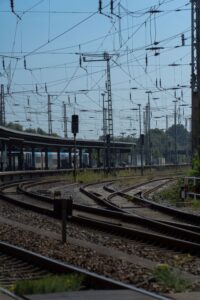
Along the East Coast Main Line in the United Kingdom, track engineers have spent recent summers walking the railways with buckets of white paint. Their target is the rails themselves. Painting the steel white can lower its temperature by five to ten degrees Celsius. It is a desperate, analog intervention in a highly digitized transport network, an attempt to prevent a physical phenomenon known as a sun kink.
Modern railway tracks are formed from continuous welded rail, laid and stretched to a specific stress-free temperature. This metric is a calculated midpoint between a region’s historical winter lows and summer highs. According to UK Rail Engineering Standards, that baseline is strictly maintained: “In the United Kingdom, CWR is stressed to 27°C, the mean summer rail temperature.” It is an engineering assumption based on decades of meteorological data. But as the standards also note, track temperatures routinely run 20 degrees higher than the ambient air. When the air reaches 40 degrees, the steel exposed to direct, sustained sunlight absorbs thermal energy until its surface exceeds 60 degrees.
The metal is forced to expand. Because the track is rigidly anchored to concrete sleepers, the expanding steel has nowhere to travel laterally or longitudinally. It accumulates immense compressive force until the rail violently buckles, twisting out of alignment. To prevent derailments, network operators are forced to drastically reduce train speeds or halt traffic.
The expanding steel is a visible symptom of a continent-wide miscalculation. For the past century, civil engineers, urban planners, and financial modelers have relied on historical weather data to design the built environment. Infrastructure is essentially a massive, highly illiquid bet that the future will closely resemble the past. Bridges, power grids, telecommunications cables, and urban housing are engineered to tolerate a specific, bounded band of environmental stress. When temperatures breach that upper limit, the built environment turns on its inhabitants.
The iconic zinc-roofed apartment buildings of Paris, designed in the mid-19th century under Georges-Eugène Haussmann, were built for a temperate, rainy climate. Zinc is cheap, lightweight, and highly waterproof. But in a 40-degree heatwave, a zinc roof acts as a massive thermal radiator. It traps heat in the top-floor apartments, effectively turning them into ovens. The structural failure of this specific material carries a severe human cost; a study published in The Lancet Planetary Health quantifying the impact of extreme temperatures in France found that living in a Paris attic room directly under the roof increased the risk of death by more than fourfold.
Surviving these historic apartments now requires mechanical cooling, fundamentally altering the continent’s energy profile. Historically, fewer than one in ten European households possessed air conditioning. That figure is now surging. The International Energy Agency notes that the global installation of new air conditioning units is adding the equivalent of a new power plant to the grid every single day. This rapid adoption creates a vicious feedback loop: cooling systems draw massive amounts of electricity from the grid while their compressor units dump waste heat straight into urban streets, further raising local ambient temperatures. Crucially, these cooling systems are pulling this power precisely when the grid’s generation capacity is physically constrained by the same heat.
France derives approximately 70 percent of its electricity from nuclear power, but the thermodynamic reality of these massive steam engines requires vast, continuous volumes of river water to cool their condensers. Strict environmental regulations dictate that this water cannot be discharged back into the Rhône or Garonne if it raises downstream temperatures above 28 degrees Celsius, a limit designed to prevent the collapse of aquatic ecosystems. When an extreme heatwave strikes, the ambient temperature of the rivers rises before the water ever reaches the plant, vanishing the thermal buffer.
During the severe heatwaves of July and August 2022, this limit pushed the French grid to the brink. As the French nuclear safety authority (ASN) documented in its emergency decrees, the regulator granted environmental waivers for five power plants to “maintain a minimum of power production.” The plants were permitted to discharge overheated water, accepting temporary ecological damage to avoid a baseload generation shortfall. Even with the waivers, thermal stress cost EDF an estimated 500 gigawatt-hours of lost production that summer, forcing the country to buy spot-market power at exorbitant premiums precisely when the rest of the continent was scrambling for supply.
The digital economy accelerates this strain on the grid. Europe’s data centers, clustered heavily in places like Frankfurt, Dublin, and London, were strategically placed to exploit free cooling—using naturally cold outside air to chill server racks. When the outside air reaches 35 degrees, free cooling fails. Data centers must immediately switch to mechanical chilling, pulling enormous power loads simultaneously with residential consumers. During the record-breaking July 2022 heatwave, ambient temperatures overwhelmed the mechanical backup systems at both Google and Oracle data centers in London. The facilities suffered partial cooling failures, forcing both companies to preemptively power down cloud servers and terminate virtual machines to prevent hardware damage. The infrastructure that underpins the modern economy was forcibly shut off because the physical air required to cool it was too hot to use.
When France throttles its nuclear output, the physical limits of river water translate instantly into financial volatility for industrial consumers across the continent. But the rivers are more than just cooling mechanisms for the grid; they are the logistical foundation of European heavy industry. As the water warms, it evaporates.
The Rhine River connects the industrial heartland of Germany, Switzerland, and France to the North Sea ports of Rotterdam and Antwerp. It carries millions of tons of chemicals, coal, grain, and manufactured goods. At the Kaub gauge, a critical geographical chokepoint west of Frankfurt, water levels during recent summer heatwaves have dropped to fractions of their historical averages. The Kiel Institute for the World Economy notes that this specific depth acts as a hard economic barrier: “When the gauge level is below 40 cm, freight navigation is practically impossible.”
The structural implications of a dry Rhine are severe enough that heavy industry is abandoning the assumption of a normal river. A chemical giant like BASF, which relies on the waterway to supply its Ludwigshafen complex, cannot simply switch its logistics network to rail. After repeated low-water crises, BASF commissioned a purpose-built vessel, the Stolt Ludwigshafen, engineered with a unique hull design to navigate at extreme low drafts. The investment is a multi-million-euro admission that the historical depth of the Rhine is no longer a reliable metric. Until specialized vessels like this scale across the industry, companies must scramble to secure standard road freight when the river fails. Because the road network lacks the rolling stock and drivers to absorb millions of tons of diverted bulk cargo, freight rates skyrocket, and the delivery of critical raw materials becomes unpredictable.
The entities that price physical risk are already modeling this cascading failure from tracks to grids to rivers. Actuaries operate free of political rhetoric; they are governed by the mathematics of frequency and severity. In its sigma 1/2022 report covering the previous year’s data, the Swiss Re Institute explicitly warned that the property and casualty sector must reprice for “secondary perils”—a category capturing the compounding, systemic effects of severe heat and drought. That data showed these secondary perils accounted for more than 70 percent of all insured natural catastrophe losses globally in 2021.
When Munich Re assesses business interruption today, underwriters are quantifying the exact supply chain paralysis that occurs when the Kaub gauge drops below 40 centimeters. The financial consequences of these physical bottlenecks are massive; during the severe 2018 Rhine drought, BASF alone reported a €250 million earnings hit directly caused by low-water logistical failures. To hedge against this newly permanent volatility, industrial operators are turning to specialized parametric insurance policies, structured by commercial insurers like Swiss Re Corporate Solutions, where payouts trigger automatically the moment the river water evaporates below a contracted depth. Capital is retreating from the continent’s newly discovered physical vulnerabilities, stranding investments that looked secure on a spreadsheet only a few years ago.
This physical and financial repricing points to a deeper macroeconomic shift: the end of the optimization era. For the last half-century, the global economy was built on the relentless pursuit of frictionless efficiency. Supply chains were stripped of inventory to reduce carrying costs, power grids were designed with narrow margins to avoid the expense of idle capacity, and infrastructure was built to exactly match historical climate baselines to save on materials.
That efficiency was highly profitable in a stable environment. But by engineering the margins of error out of the physical world, the global economy stripped away its own shock absorbers. The heatwaves now testing Europe are making those missing buffers visible. When the thermal envelope is breached, the economy is forced to absorb the massive friction it spent decades trying to eliminate.
Rebuilding those shock absorbers is a mandatory capital expenditure. A European Commission assessment estimates that the continent faces a climate adaptation investment gap of up to €70 billion per year just to maintain baseline infrastructure. The era of frictionless efficiency is over. The heat is a permanent, systemic friction, demanding a retroactive payment for every shock absorber the continent systematically removed—a bill that begins with track engineers carrying buckets of white paint.
Thermal Expansion: Why Extreme Heatwaves Are Sending Critical Stress Signals Across Europe’s Grids