
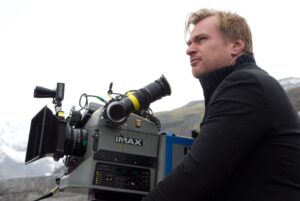
Christopher Nolan’s The Odyssey opens this weekend as the most expensive film of his career, on an estimated $250 million budget. It’s the first movie ever shot entirely on IMAX 70mm film, and much of the cast spent months on actual open water instead of standing in front of a green screen. Every external signal points to Universal treating this as the safest bet in Nolan’s filmography: a story old enough to predate copyright, adapted by the director whose Inception proved an original concept could open like a franchise tentpole, and whose Oppenheimer proved a three-hour biopic could outgross most of the summer’s actual franchises.
There’s a problem with calling this safe, though. The genre Nolan just spent his largest budget ever on is one of the most reliable ways to lose money in modern Hollywood.
The ledger
Mythological and public-domain epics have a track record that should make most studio executives flinch. Gods of Egypt cost $140 million and grossed $150 million worldwide, a loss estimated at up to $90 million once marketing is factored in. Ben-Hur, a $100 million reimagining of one of the most famous stories in the Western canon, opened to $11.4 million domestically and got lumped in with Pompeii and Exodus: Gods and Kings as one of that year’s defining epic flops. All three posted similarly grim numbers on similarly large budgets. King Arthur: Legend of the Sword cost around $175 million, opened to roughly $15 million domestically, and made about $140 million worldwide, killing a planned six-film franchise before the second one ever got made.
Openings clustered in the low-to-mid teens, on budgets between $100 million and $175 million. Four different studios ran essentially the same play in the same decade: take a story everyone already knows, and let the recognition do the selling. They got burned the same way each time, a pattern too consistent to blame on any single studio’s bad judgment. It looks much more like the ceiling the genre actually has.
If ancient stories were inherently valuable, none of this should happen. Familiarity is supposed to be the cheat code: audiences already know Troy falls, Ben-Hur survives, Arthur pulls the sword, so nobody has to be sold on the world or the stakes. The IP does exactly what it’s supposed to do, and it keeps not being enough.
The comparison Hollywood avoids
The industry’s instinct when a mythological epic flops is to treat it as a genre problem, specific to togas and swords. That instinct only survives if you don’t look at what’s happening on the other side of the ledger, because ancient IP turns out to be the clearest evidence of a pattern that has nothing to do with age at all.
The Flash had seventy years of DC mythology and one of the most recognizable heroes in fiction behind it, and still underperformed badly enough to become a cautionary tale inside its own studio. Indiana Jones and the Dial of Destiny had four decades of franchise loyalty behind it and still posted the weakest opening in the series. Recognition failed to convert in both cases, the same way it failed for Arthur and Ben-Hur.
Meanwhile Barbie and Oppenheimer became two of the defining box-office events of the decade with nothing resembling ancient or franchise IP behind either one. One was built around a toy-aisle mascot with no story attached. The other was an unglamorous three-hour physics biography.
The most interesting case sits in between the two. Dune is adapted material, decades old, and had already produced one famous failed adaptation in 1984. What changed wasn’t the source text. What changed was that Warner Bros. handed it to Denis Villeneuve after Arrival and Blade Runner 2049 had proven, to critics and audiences alike, that he could be trusted with difficult material at scale. The book hadn’t changed. What Warner Bros. was willing to bet on Villeneuve had.
Put both sides together and you get a pattern that neither “old stories fail” nor “old stories succeed” explains by itself. Recognition alone has shown little predictive power. Execution, and specifically who the audience trusts to deliver it, explains the variance recognition can’t.
Why this time is different
That’s the frame that makes sense of Nolan’s bet. Universal isn’t trusting The Odyssey to sell itself. Universal financed Nolan’s reputation, and handed him one of the oldest stories in existence to spend it on.
That reputation has a track record almost no other director’s does, and it isn’t tied to genre. Oppenheimer, three hours long, dialogue-heavy, and centered on a twentieth-century physicist, outgrossed most of that year’s superhero movies. Inception, an original script with zero pre-existing audience, became one of the most rewatched films of its decade largely because of who made it. Nolan’s name has functioned, consistently, as a signal that lowers uncertainty before a single review exists. That’s precisely the job ancient IP is supposed to do, and mostly doesn’t.
The production details read less like budget flexing and more like a director spending earned credibility: two million feet of film shot, ninety-one days of principal photography across seven countries, a cast placed on actual open water instead of a tank or an LED volume. Nobody underwrites that kind of production for a script alone; they underwrite it for a person they already trust.
Ancient stories as raw material
Once you see the mechanism this way, “ancient IP” stops looking like an asset class and starts looking like raw material. The Odyssey, Hamlet, Dracula, Frankenstein: these stories persist not because any given adaptation is guaranteed to work, but because they’re sturdy enough to survive being pulled apart and rebuilt by whoever picks them up next. The story supplies a shape, not an audience.
That’s also why public-domain status has never, on its own, produced a reliable run of hits, despite removing licensing, the one cost that should have made these projects easier to greenlight. If cheap access to a beloved story were the missing ingredient, the 2010s would have been a golden age for mythological cinema instead of a graveyard. Licensing was cheap or free the entire time. What was scarce was someone the audience believed could be trusted to pick the material up and reshape it.
There’s a version of this happening a level down from the studios, too. A24 hasn’t built its audience by owning any particular story. It’s built one by curating which stories and directors it stands behind, so that people now buy a ticket to “an A24 film” roughly the way they buy a ticket to “a Nolan film,” trusting the label more than they trust any specifics about the plot.
Why now
None of this is new, exactly, but it’s getting sharper, and the reason is fairly mundane: the cost of producing new content, original or adapted, keeps falling, especially as AI-assisted tools mature. When almost anyone can generate something that looks like a story, stories stop being the scarce thing. What’s scarce is a name the audience already trusts enough to spend two and a half hours on before they know anything else about the project.
The market already placed its bet
By the time The Odyssey actually reaches theaters, the question of whether trust beats genre history won’t hinge on the weekend’s real number. It will already have been answered by the people whose job is pricing risk before anyone buys a ticket. Industry tracking has the film projected to open between $85 million and $120 million domestically, with worldwide estimates crossing $200 million. Set that against the genre’s real ceiling: low-to-mid teens, on budgets of $100–175 million, every time Hollywood bet on recognition alone over the last decade.
That gap is the clearest evidence the thesis is going to get, and it doesn’t need the weekend’s actual gross to make its point. Exhibitors and trackers aren’t pricing in Homer. The genre has told them for ten years what “ancient story” is worth on its own, and it isn’t this. What they’re pricing in is a director whose name alone has moved projections by a factor of five to eight over what the source material would predict in anyone else’s hands.
The reviews will settle whether The Odyssey is actually a good film, but the tracking numbers have already settled what Nolan’s name is worth, regardless of how that verdict lands.
The close
Whatever the film ends up earning, the tracking already made the point a decade of mythology flops couldn’t. Every studio in this article’s ledger had access to the same public-domain material Universal did. Most of them lost money on it.
Universal didn’t commit a quarter of a billion dollars because Homer wrote a good story. It committed that money because Christopher Nolan chose to direct one.
Hollywood has spent two decades hunting for safer intellectual property, mostly in the wrong place. The story was never the asset. The person you trust to tell it is.
