
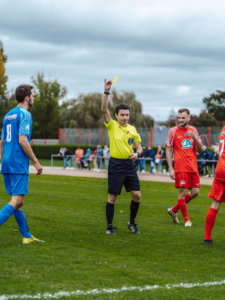
Every World Cup produces a few bad calls people argue about for years. This one produced something bigger. Coaches, players, and a growing chunk of the fan base aren’t just asking whether the officiating has been inconsistent. They’re asking whether it’s been inconsistent in a way that keeps helping the same teams and the same stars. FIFA insists it’s the former.
The incident that started it
Lionel Messi opened Argentina’s tournament with a hat-trick against Algeria. The bigger story was a foul he committed on Algerian captain Aïssa Mandi, studs up, raking down the shin, the kind of challenge that usually ends a player’s afternoon. The referee blew his whistle, Messi looked apologetic, and nothing came out of his pocket. VAR checked it and left the call alone. Messi faced no consequences on the pitch. The fallout happened entirely online, where the non-call fed weeks of chatter about whether the tournament was protecting its biggest name.
A few weeks later fans got something to compare it to. US forward Folarin Balogun went up for a header against Bosnia and Herzegovina, his foot caught an opponent’s ankle on the way down, and he got sent off. Even the Bosnian defender who took the contact said afterward he didn’t think it deserved a red. Side by side, the two challenges looked roughly similar. The outcomes weren’t close.
When politics got involved directly
Then it stopped being just a refereeing story. President Trump personally pressured FIFA to lift Balogun’s suspension so he could play in the round of 16 against Belgium. FIFA lifted it. UEFA called the move a “red line” that had been crossed. Belgium’s own federation objected. FIFA president Gianni Infantino said the disciplinary process had acted “independently,” a claim that did not stop this from becoming the tournament’s clearest case of outside pressure changing what happened on the field.
It wasn’t the only place politics beat the players onto the pitch. Somali referee Omar Abdulkadir Artan, well regarded within the profession, was turned away at Miami International Airport despite holding a valid visa and missed his assigned matches entirely. Customs and Border Protection said he’d been flagged for “derogatory information, including association with suspected members of terror organizations.” Officials never explained what that association was supposed to be. Artan went home to a hero’s welcome in Somalia. He’s been assigned next season’s UEFA Super Cup, which is a fairly clear signal of how his own federation and UEFA read the unspecified claim against him.
Argentina-Egypt: the match that made neutral fans suspicious
No single game did more to fuel the “is this rigged or just bad” argument than Argentina’s round-of-16 comeback against Egypt. Egypt led 1-0 in the second half when Mostafa Zico appeared to double it, only for VAR to flag a foul in the buildup and wipe the goal off, a level of scrutiny that struck a lot of neutral observers as unusually sharp for that stage of a knockout match. Zico got his second goal for real a few minutes later, this one standing, and Egypt took a 2-0 lead into the closing stretch. They still had it with eleven minutes left on the clock. Then Argentina scored three times before the final whistle to win 3-2. In the buildup to the third, Alexis Mac Allister appeared to grab Egyptian substitute Hamdy Fathy’s shirt inside the box. Moments later, in a separate and unrelated incident near the same spot, Mohamed Salah went down under contact from Julián Álvarez. Neither was reviewed. Enzo Fernández broke away and scored the winner in stoppage time off the ensuing move.
Egypt’s manager, Hossam Hassan, said afterward that he suspected pressure had been put on the referee to keep Argentina alive, and Egypt’s federation formally asked FIFA to look into the officiating. Goalscorer Mostafa Zico went further in his own live TV interview after the match, telling broadcasters flatly that “it’s clear this tournament has been fixed.” Days after that, FIFA quietly pulled the match referee, Francois Letexier, along with fellow Frenchman Clement Turpin, from the rest of the tournament. A few outlets reported that as a response to the fixing accusations. FIFA and L’Équipe’s own reporting say something less dramatic: France had just advanced to the semifinals, and FIFA’s standard rotation policy stands down officials from a country still competing, purely to avoid conflict of interest. Both explanations can be true at the same time, and nobody has confirmed either one over the other. FIFA’s head of refereeing rejected the bias claim outright. What’s actually on the record: a string of calls that look bad stacked together, a federation’s formal complaint, a manager’s public accusation, and a referee reassignment FIFA says had nothing to do with any of it. No outlet covering this has produced proof that anyone manipulated the result.
The smaller stuff that added up
A handful of smaller incidents kept the “something’s off” feeling alive on their own, without proving much individually.
England were awarded a goal against Norway in the quarterfinal after replays suggested the ball had clipped a camera cable hanging above the pitch, which should have stopped play if true. FIFA said afterward there was no evidence of contact. Plenty of people who watched the replay didn’t buy it.
A supporting VAR official was investigated by FIFA’s disciplinary committee over a hand gesture caught on broadcast. He said it was an unconscious twitch. He was cleared, but only after the clip had already made the rounds.
Germany went out on penalties following a disallowed extra-time goal that their own coach, Julian Nagelsmann, called a bad call on the spot, insisting there’d been no clear foul. FIFA said the decision matched guidance issued before the tournament started.
None of these prove anything by themselves. Stacked together, they’re a big part of why this World Cup has generated more “the referees are picking winners” talk than any recent tournament, even among fans who’d normally shrug off a questionable offside flag and move on.
Where this actually leaves things
Two different claims keep getting blended together in this conversation, and they’re not the same claim. One is that specific calls have been inconsistent, sometimes badly. That’s barely even in dispute anymore. FIFA has had to issue clarifying statements after several of these incidents just to keep pace. The other is that officials are being steered to favor certain teams or players on purpose. That’s a much heavier accusation, and outside of the Balogun case, where the political pressure on FIFA is documented rather than suspected, it’s still sitting in allegation territory, not proven fact.
What’s different about this tournament is how hard it’s gotten to see daylight between those two claims from the stands. Enough calls have broken the same way, for the same handful of stars and favored teams, that “the officiating is inconsistent” and “the fix is in” have started sounding like the same sentence to a lot of people watching, even when the evidence for each claim is not remotely the same.
sourcing: the Balogun/Trump episode leans mostly on Al Jazeera’s rundown of the tournament’s controversies, which also covers the Somali referee’s visa denial. The Argentina-Egypt sequence and Hossam Hassan’s comments come from Al Jazeera and NBC’s coverage of the match. Sports Illustrated’s referee-decisions ranking was the main source for the Messi/Balogun comparison, and Yahoo Sports had the most detail on the England-Norway camera cable and on the Letexier rotation story. Wikipedia’s running list of 2026 World Cup controversies was useful for cross-checking dates against multiple outlets. A few things here, including Egypt’s investigation request, hadn’t been resolved as of mid-July and are worth a second check before this goes up.
