
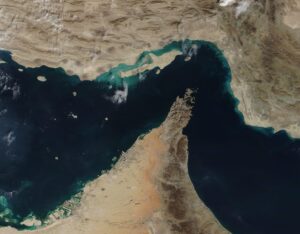
Two oil tankers, the Mombasa B and the Al Bahyah, were sailing through Omani waters in the Strait of Hormuz on July 14 when Iranian cruise missiles hit them. One Indian crew member died. Eight more were injured. A third, smaller tanker took fire a few hours later. It barely made international front pages outside the shipping trade press, which tells you something on its own: an attack that would have been a global crisis in 1990 now reads as a Tuesday update in a live blog.
That’s not because the stakes are lower. It’s because we’ve gotten used to watching wars fought this way. Twentieth-century militaries wanted land, factories, population centers. Today the more valuable target is often a strait, a canal, a mineral refinery, or a cable landing station — the places where the world’s stuff has to physically pass through a bottleneck. You don’t need to defeat a navy to hurt an economy anymore. You just need to make forty miles of water too dangerous to sail through.
The real story isn’t Iran. It’s what globalization built.
Here’s the thing that gets lost in the day-to-day coverage: none of this is really about Iran, or the Houthis, or China specifically. It’s about a system that was built for one purpose, cheapness, and is now paying the bill for never being built with a second purpose in mind, which is not being disrupted.
For forty years, companies chased efficiency almost exclusively. Just-in-time manufacturing. Lean inventories. A single supplier for a component that goes into half the world’s phones. Containerization made ocean freight astonishingly cheap, which is genuinely one of the great achievements of the last century. But it also meant nobody was paying to keep three redundant routes open when one worked fine 99% of the time. Redundancy is expensive. Nobody wanted to pay for it in peacetime, so almost nobody did.
Hormuz is the clearest demonstration of what that tradeoff costs. It’s 21 miles wide at the narrowest point. Around a fifth of the world’s oil and gas moves through it. When the war first broke out after the February 28 strikes and traffic through the strait effectively stopped, the International Energy Agency did something it had only done five times before in its fifty-year history: it coordinated a release of 400 million barrels from members’ emergency reserves. That was in March, months before the tanker attacks — a separate shock, from a separate moment in the same war, that produced comparable panic. The strait didn’t even need to be permanently closed to cause that. It just needed to look closed for a few weeks.
The Mombasa B, for what it’s worth, was reportedly part of a workaround. Its commercial manager, South Korea’s Sinokor Group, had it running with its transponder off, moving crude quietly out of the Gulf. I’d be careful calling that a confirmed target. Nobody’s published proof that Iran specifically hunted down dark-fleet shuttle runs rather than just striking any tanker in range. But the effect either way is the same. You don’t have to sink a ship to make every insurer nervous. BIMCO, the shipping industry’s own trade body, has already warned that war-risk premiums are likely to spike again if attacks resume. That’s the whole mechanism in one sentence: fear moves faster than missiles.
Carriers can reroute. Around the Cape of Good Hope instead of through Suez, adding ten to fourteen days per voyage. It works, technically. It also ties up global fleet capacity for weeks at a time, which shows up as container shortages in ports nowhere near the actual fighting. Somebody in Rotterdam pays for a war they’ve never heard the details of.
It’s not just Hormuz. That’s what makes this structural.
The Red Sea has been running this experiment for almost three years now. Houthi attacks starting in late 2023 pushed most major carriers off Suez entirely. Even during a lull in attacks in late 2025, shipping lines mostly stayed on the longer Cape route rather than risk going back. When the Iran war escalated again this year, Houthi officials signaled they’d resume strikes too. Freight rates on Asia-Europe lanes have stayed well above pre-crisis levels through most of this period, though how much depends on which month and which analyst you ask. A militia with no navy has managed to bend a meaningful share of world trade around Africa for years. Nobody planned for that when they designed the “just sail through Suez” model.
Panama shows the same vulnerability without an enemy at all. A drought in 2023 and 2024 forced the canal authority to cut daily transits, and some shippers ended up paying millions of dollars in auction premiums just to jump the queue. Nature did what a blockade would have done. Which is presumably part of why US officials now talk about the canal in the same breath as national security, alongside worries about Chinese commercial influence near it.
Taiwan and rare earths are the version of this story where nothing needs to be a waterway at all. Taiwan makes most of the world’s advanced chips. China controls most of the world’s rare earth processing capacity, the stuff that goes into everything from jet engines to EV motors. Earlier this year, Beijing restricted rare earth exports to Japan and tied the move explicitly to Japanese comments about defending Taiwan. No ship was stopped. No missile fired. Just a licensing form that stopped getting approved. The message was identical to the one Iran is sending in Hormuz: we own a bottleneck, and you don’t have a way around it. The US, Japan, and Australia are now spending real money trying to build one anyway.
Then there are the cables. Roughly 95 to 99% of intercontinental internet traffic, depending on whose estimate you use, runs through fiber lines lying on the ocean floor, frequently near the same maritime bottlenecks already under strain elsewhere. Cables have already been cut or damaged near the Baltic and in the Red Sea, degrading connections between Europe and Asia. Nobody notices until it happens. NATO and several Asian governments have started treating undersea cable protection as seriously as they treat a physical border, for the same reason everything else on this list matters: concentrated, basically undefended, and expensive to lose in a way you can’t easily substitute your way out of.
Geography got expensive again
For most of the last thirty years, the working assumption in business and in a lot of government planning was that geography mattered less every year. Cheap shipping, fast logistics, global supply chains: distance was a solved problem. The last few years have quietly reversed that. Governments are starting to treat trade-corridor security as a real budget line rather than a footnote, and companies that spent two decades optimizing for cost alone are now, slowly and at real expense, building in redundancy they used to consider wasteful. That’s an expensive lesson to relearn, and a lot of firms are only relearning it because they got hit first.
None of this means territory has stopped mattering. It means the map worth watching closely isn’t only the one with front lines drawn on it. It’s the one with the straits, the canal locks, the mineral refineries, and the cable landing stations marked, the handful of narrow points where a small, well-aimed disruption can still rattle an economy that spans the entire planet.
