
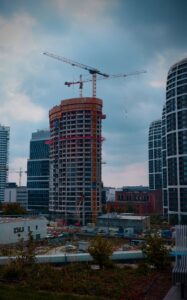
How getting approval became as scarce as capital
There’s more money looking for somewhere to build right now than at almost any point in modern history. Pension funds and sovereign wealth funds sit on trillions earmarked for infrastructure. Engineering software can model a bridge in an afternoon. AI can screen a drug candidate in weeks instead of years.
Ask an engineer whether something can be built, and the answer is almost always yes. Ask whether it will be allowed, and the answer gets a lot harder to give.
A solar project can sit in a grid queue for five years before it generates a single watt. A new mine in the United States takes seven to ten years just to clear its permits, and close to three decades from discovery to first production. A data center in Northern Virginia can wait more than a decade for a grid connection, even after its owner has already written the check for the building. A mid-rise apartment building in San Francisco can take five years to go from application to construction. An identical building in Oakland, twelve miles away, takes six months.
None of this is a money problem, and mostly it isn’t a technology problem either. Labor shortages and supply chains matter too; this isn’t an argument that permission is the only thing holding growth back. But across housing, energy, mining, and computing infrastructure, getting approval has become slow and scarce enough to belong in the same conversation as capital. And the more you look at it, the more it starts to resemble a form of capital itself, one that institutions, not markets, decide who gets to hold.
Who holds the veto
It’s tempting to tell this as a story of decline, a fall from some simpler past when a builder with enough money could just start digging. That past didn’t really exist. Robert Moses reshaped New York against ferocious political resistance. The interstate highway system tore through cities and displaced whole neighborhoods, and the lawsuits ran for decades. Dam building in the American West meant fights over water rights that outlasted the men who started them.
So the issue was never whether permission was required. It’s who gets to withhold it. Sixty years ago that power sat with a small number of state and federal authorities, who could generally override local objections once they’d made up their minds. Today the same project can be stopped by a local zoning board, a state environmental agency, a federal regulator, a court, or a community group with legal standing, and any single one of them can hold things up for years even after everyone else has signed off.
That’s an argument more than a measurement, so it’s worth grounding in at least one real number. Appellate litigation under the National Environmental Policy Act rose 56 percent between the 2001-2015 period and 2013-2022, according to a court-records analysis by the Breakthrough Institute. That’s one legal channel in one country, not the full sprawl of zoning boards, utilities, and community review this piece is describing, so treat it as suggestive rather than proof. But it points the same direction as everything below it: more parties, more often, with standing to say no.
What “permission” means here
Worth keeping the term narrow. Permission, in this piece, means the approvals needed to build or expand physical infrastructure: zoning, environmental review, land acquisition, utility interconnection, and the legal and community processes wrapped around all of it. Immigration approval and drug certification are left out, not because they don’t matter, but because their delays run on different logic. Drug approval time is mostly the time it takes to actually run a safety trial, and a faster trial isn’t obviously a better one. Visa delay is driven mostly by numerical caps and processing capacity, not by an expanding set of parties who can each independently say no. Folding those in would blur an argument that holds together cleanly for physical infrastructure, where the facts of a project are usually settled long before the last approval shows up.
In this narrower sense, permission functions as a production input alongside land, labor, and capital, with its own cost, its own timeline, its own risk profile. Unlike the other three, it’s the one input a company can’t just buy more of.
The evidence
Housing. Research from the Pew Charitable Trusts finds that cities with strict, discretionary land-use review routinely take two to three times longer to approve housing than cities with lighter, rules-based systems. In Washington state, the Building Industry Association of Washington ran state permitting data through Wharton economist Joseph Gyourko’s residential land-use regulation index and found an average approval delay of 6.5 months, adding around $31,000 in holding costs to a median-priced new home, a little under one percent per month of delay. Take that figure with the appropriate grain of salt: BIAW is a homebuilders’ trade group with an obvious stake in the finding.
The stronger evidence, and it really is stronger, comes from Los Angeles. A working paper by Princeton economist Evan Soltas and MIT economist Jonathan Gruber finds that preapproved land in LA County sells for about 50 percent more, or $48 more per square foot, than otherwise identical unpermitted land, roughly $770,000 for a typical building site. By their estimate, permitting accounts for about a third of the entire gap between what homes sell for in Los Angeles and what they actually cost to build. A mid-size apartment project there takes 4.2 years to complete on average, roughly twice as long as the same project in Raleigh or Fort Worth, and having a permit already in hand raises the odds of finishing within four years by 8 to 12 percentage points. The authors flag their own limitation: the submarket they study skews toward denser, investor-driven listings, so the premium may not generalize to every corner of the housing market.
Britain shows a similar pattern outside the US. Its planning system runs almost entirely on discretionary, case-by-case approval rather than fixed rules, and it has produced some of the slowest, most expensive housing delivery in Western Europe as a direct result.
The sharper contrast, the one that makes this look like a choice rather than an inevitability, is Japan. Tokyo’s building code is set nationally, which leaves local governments and neighbors far less room to block individual projects than their American or British counterparts. That structure is well documented in the OECD’s land-use governance research; the claim that it helped the city absorb close to two million new residents over the past 25 years while keeping housing broadly affordable comes from urbanist commentary building on that data rather than from the OECD report itself, and it’s worth treating with a bit more caution. Japan’s housing market has other things going for it too, including a culture that treats older homes as depreciating rather than appreciating assets, which suppresses prices on its own, independent of approval speed. Permitting isn’t the whole explanation for Tokyo. It’s a real and measurable part of it.
Energy. Lawrence Berkeley National Laboratory tracks nearly every regional grid operator in the country, and its “Queued Up” series found that the typical power project completed in recent years spent about five years in the interconnection queue, up from roughly two years in 2008. Total queued capacity peaked at nearly 2,600 gigawatts at the end of 2023, more than double the country’s installed generating capacity. It’s since eased a bit, down to roughly 2,060 gigawatts by the end of 2025, and the decline looks like triage more than progress: a record 112 gigawatts of solar and storage capacity dropped out of the queues entirely in 2024, even as fewer new projects came in to replace them. Most of what’s stuck is solar, wind, and battery storage, the technologies climate policy is trying hardest to accelerate.
There’s a sharper historical counterexample in nuclear. American plants built in the 1960s took forty to sixty months to complete. By the late 1970s, after environmental review and litigation requirements had expanded, the same reactor designs routinely took 150 to 200 months, some over 250. France, building the same generation of reactor technology under a centralized state program, held a steady 65 to 90 months across the same period. Some of that gap is genuinely about permitting and review. Some of it is that France built one standardized design over and over under a single state utility and captured learning-curve savings that the customized, one-off American approach never had a chance at. The two effects are tangled together, not cleanly separable, and a fair reading credits both.
Mining. A 2024 S&P Global analysis found that US mines take an average of 29 years to go from discovery to production, the second-longest timeline in the world behind only Zambia’s 34. Canada averages 27 years, Australia 20. The permitting stage alone runs seven to ten years in the US against two to three in Canada and Australia, countries with comparably strict environmental rules. Worth noting: the study was commissioned with support from the National Mining Association, an industry group that lobbies for faster permitting, though S&P Global states it retained sole control over the data and conclusions.
Data centers. According to PJM, the grid operator for much of the mid-Atlantic, large projects now spend more than three years just reaching an interconnection agreement, then wait years more before they can draw power. In parts of Northern Virginia, the densest concentration of data centers on earth, new facilities face waits of up to fourteen years for a grid connection, even as utilities plan over $200 billion in grid investment for a single year.
Four sectors, four regulatory systems, and in at least two of them a direct international comparison shows the same technology moving at wildly different speeds depending on how decisions get made. That’s a stronger claim than “American red tape.” It’s evidence of a structural choice.
Why this piled up
Nobody designed this outcome. It built up in layers, and each layer solved a real problem at the moment it got added.
Environmental review laws passed in the early 1970s forced agencies to weigh consequences they’d previously ignored, in the wake of ecological damage that genuinely needed addressing. Expanded legal standing let more parties challenge decisions that affected them, a real democratic gain over a system where a handful of officials could act unilaterally. Community consultation gave residents an actual voice in what got built next to them. Layer by layer, over five decades, advanced economies added review requirements and almost never removed the ones already there.
This happened across the US, the UK, and Japan at roughly the same time, and the pressures behind it look similar in each place: rising environmental awareness, growing distrust of centralized authority after the failures of mid-century urban renewal, legal systems that widened standing to sue around the same period. It’s worth being honest about the limits of that comparison, though. The US, the UK, and Japan are all liberal democracies with similar legal traditions, and none of this tests the claim against a system built on entirely different lines, like China’s, where infrastructure moves much faster partly because veto power was never distributed this way to begin with. Whether the pattern here is a feature of advanced democracies specifically, or something broader, is an open question. What can be said with more confidence is that the result wasn’t one bad law. It was dozens of reasonable ones stacking on top of each other until the combined weight became its own obstacle.
The veto economy
Modern approval systems create a lot of actors who can stop a project and very few who can approve one outright. A single objection, from a regulator, a court, or a community group, can halt something every other party has already cleared. Approval usually requires unanimous agreement across all of them. As the number of veto points grows, the odds that they all line up at the same time fall fast, even when every individual actor is being perfectly reasonable.
That’s not the same as saying the system is broken. It’s a structure built almost entirely out of brakes, with no real accelerator, and a structure like that produces delay as its default output no matter what anyone intends.
The cost of variance
Businesses can plan around a slow process, if it’s a predictable one. What actually kills investment is not knowing whether a review takes one year or ten. A mining company can model a seven-year permitting timeline into its financing. It can’t easily model a timeline that might be seven years or might be twenty-nine, depending on litigation nobody can foresee. That unpredictability is its own tax on investment, often bigger than the delay itself, because it forces companies to price in the worst case rather than the average one. On top of that sits the visible cost: higher housing prices, slower clean-energy buildout, delayed factories, capital sitting committed but idle for years. None of this shows up as a single clean number, and the closest attempts, mostly a decade-old estimate from an advocacy group with a stake in the debate, aren’t solid enough to lean on. The more defensible version of the claim is simpler and doesn’t need a dollar figure to make its point: these costs are large enough to show up in national accounts, in construction cost indices, in grid buildout schedules that keep slipping. That’s a lower bar than a headline number, but it’s one the evidence above actually clears.
Permission as an asset
This is where the story stops being just about speed. Go back to the Soltas-Gruber numbers from LA, that $770,000 gap between permitted and unpermitted land. Buyers there aren’t paying extra for the dirt. They’re paying for the paperwork sitting on top of it. Mining companies acquire smaller firms specifically for their environmental clearances. Utilities pay a premium for renewable projects that already hold a spot in the interconnection queue. Data center operators scout sites on grid-approval status as much as on land price.
There’s a knock-on effect worth dwelling on. Once permission itself is the valuable asset, mergers change shape: companies increasingly buy other companies not for the factories or the land, but for the approvals attached to them. And because navigating the system takes legal teams, consultants, and lobbyists that only large firms can afford, permission becomes an entry barrier that quietly favors scale. A small developer and a large one might face the identical maze, but only one of them can afford a guide through it. Whole industries of permitting consultants, environmental lawyers, and public-affairs firms now exist purely to get other companies through the process, which says something about how much of the economy has reoriented around navigating approval rather than producing the thing underneath it. Of everything in this piece, that’s probably the change with the longest tail: a system built out of brakes doesn’t just slow projects down, it decides which companies can afford to keep playing at all.
A necessary counterweight
None of this is an argument that oversight itself is the problem, and the clearest counterexample lines up directly with construction approval rather than some other kind of regulatory failure. In 2017 a fire tore through Grenfell Tower in London and killed 72 people, spreading fast up flammable cladding on the building’s exterior. Sixteen years earlier, in 2001, a government-funded fire test on that same type of cladding had already shown flames climbing to roughly twice the height of the test rig within five minutes, forcing technicians to halt what was meant to be a thirty-minute test. Officials were told about the results the following year. Nobody warned the construction industry, and the government never published the findings. They stayed buried until a BBC leak surfaced them in 2021, four years after the fire.
That’s not a story about too many veto points. It’s a story about a system that had every chance to add one, based on evidence already sitting in a government file, and chose speed instead. The veto points this piece has spent so much time on exist because unconstrained building has caused real harm before. What the current system almost never does is separate the reviews still doing work a Grenfell-style failure would otherwise require from the reviews that have simply piled up past the point of usefulness. Treating all delay as equally necessary, or all of it as equally wasteful, misses the actual problem.
The technological irony
AI sharpens this contradiction instead of resolving it. It can produce an engineering design, draft an environmental report, or model a project’s impact in a fraction of the time it used to take. It can’t make a regulator sign off faster, move up a court date, or shorten a community consultation. As technology speeds up the parts of a project that were never the real bottleneck, the actual bottleneck gets harder to miss. Every gain in engineering speed just widens the gap between how fast something could get built and how fast anyone will agree to let it happen.
The scarce resource of this era
Here’s one way to read all of this, offered as an interpretation rather than a settled law of history. In the industrial era, the scarce resource was capital: whoever could finance a project could usually build it. In the information era, the scarce resource shifted toward knowledge, since whoever understood a technology first often captured the advantage. Capital is now abundant, and knowledge is available to anyone with an internet connection, and increasingly to anyone with an AI model. What the evidence above suggests, without pretending to prove a grand historical pattern, is that the thing getting harder to come by is the capacity of institutions, regulators, courts, utilities, communities, to turn agreement into action.
Permission is simply where that scarcity shows up first, and where it gets priced. It’s a fifty-percent land premium in Los Angeles. It’s a mining acquisition built around a clearance certificate rather than a deposit. It’s fourteen years of waiting for power in Northern Virginia. But in every one of these cases the thing actually being rationed isn’t land, or power, or minerals. It’s the capacity of institutions to decide.
Where this leaves us
None of this argues that environmental review, community input, or safety regulation should go away. Most of what they protect against is still worth protecting against, and Grenfell is a reminder of what the alternative looks like. The better question is why permission, at least across the advanced democracies looked at here, has become slower and less predictable than the capital available to act on it, and why so few of these systems distinguish between the reviews still doing real work and the ones that simply piled up.
Capital used to be the resource that separated the countries that built things from the countries that didn’t. Increasingly that role belongs to something harder to measure and much harder to import: how fast a society’s institutions can turn agreement into action.
Sources
- Housing approval timelines by regulatory strictness: Pew Charitable Trusts
- Washington state permitting delay cost: Building Industry Association of Washington, applying Wharton economist Joseph Gyourko’s land-use regulation index. BIAW is a homebuilders’ trade group.
- Los Angeles permit premium and build times: Evan Soltas (Princeton) and Jonathan Gruber (MIT), “How Costly Is Permitting in Housing Development?”
- Tokyo’s national building code: OECD land-use governance research; population and affordability outcome per commentary by Ryan Puzycki
- Grid interconnection queue data: Lawrence Berkeley National Laboratory, “Queued Up” report series
- US vs. French nuclear construction timelines: Center for Technology, Science, and Energy
- US mine development timelines: S&P Global Market Intelligence, a study supported by the National Mining Association
- Data center grid connection delays: reporting citing PJM
- NEPA appellate litigation trend: Breakthrough Institute
- Grenfell Tower cladding test history: findings and testimony from the Grenfell Tower Inquiry, and BBC reporting on the 2001 BRE test results
Two of these, the BIAW figure and the S&P Global study, come from parties with a stake in the outcome, flagged in the text where each is used. The Tokyo population figure rests on commentary rather than the OECD data directly. Everything else traces to a named primary source.
