
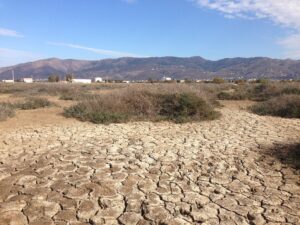
Why water is becoming the world’s most valuable resource
For most of modern history, economic growth ran into three walls: not enough capital, not enough labor, or not enough energy. Solve any one of those and output climbed. Water was never part of that calculation. It was assumed, the way air is assumed. You did not budget for it. You just turned the tap.
That assumption is breaking down, not because the planet is running out of water in any absolute sense. The same volume of water has cycled through the atmosphere, oceans, and rivers for millions of years. What is disappearing is something narrower: cheap, reliable, nearby water in the specific places the modern economy needs it. A chip fab in Taiwan, an AI data center in Arizona, and a wheat farm in Kansas are drawing on the same shrinking pool of dependable freshwater, often from the same river basin.
Call it the water premium. It is not the price printed on a utility bill. It is the extra cost, delay, and risk a business now has to absorb to secure water that used to be free for the asking.
What the premium is actually made of
It helps to be specific about what that premium contains, because it is easy to wave at and hard to picture.
It includes the legal cost of acquiring water rights in basins where every drop is already allocated to someone else. It includes insurance pricing, since underwriters are starting to charge more for facilities in water stressed regions the same way they price flood or wildfire risk. It includes financing cost, since lenders are beginning to ask whether a thirty year facility has a credible thirty year water plan before extending credit on the same terms as one that does. It includes relocation cost, when a company chooses a less convenient site because the obvious one no longer has enough water to spare. It includes the infrastructure cost of the deeper well, the desalination unit, or the recycling loop a facility now has to build that it would once have skipped entirely. It includes an opportunity cost that rarely gets counted, projects that were never proposed because the water math did not work before anyone got far enough to write a permit application. And it includes a political cost, since every one of these decisions eventually runs into a fight over who gets water first when a farm, a city, and a factory are all drawing from the same river.
Labor has wages, automation, and migration. Energy has fuel prices, grid capacity, and carbon policy. Water has all of the categories above, and until recently almost nobody totaled them up as a single economic input the way they do for labor or energy.
Where the demand is concentrating
Agriculture is still the largest single draw on freshwater. The figure most commonly cited by the UN and the World Bank puts agriculture at roughly 70 percent of global freshwater withdrawals, climbing above 80 percent in many low income countries and falling closer to 40 percent in wealthier ones, where industry takes a larger share. Some hydrology research has questioned how precisely that 70 percent figure was ever measured, arguing the true range could run anywhere from 45 to 90 percent depending on methodology. Even accounting for that uncertainty, agriculture’s dominance of water withdrawal is not in dispute. What has changed is the depth and reliability of the aquifers irrigation depends on, and the number of other industries now bidding for the same water.
The Ogallala Aquifer, which underlies eight states from South Dakota to Texas, supplies close to 30 percent of the groundwater used for US irrigation and supports roughly a fifth of the country’s agricultural output, according to US Geological Survey data. In parts of the Texas Panhandle, groundwater levels have fallen more than 200 feet since large scale irrigation began, and natural recharge, once that water is gone, is measured in thousands of years. The North China Plain tells a more complicated version of the same story. Decades of pumping drew groundwater down by about a meter a year in places that grow most of China’s wheat and corn. A large scale diversion of water from the wetter south, paired with strict pumping limits, actually reversed the decline, and a 2025 study in Nature Communications found groundwater levels across the plain rising again since 2020. It is one of the only documented cases of large scale aquifer recovery anywhere in the world, and the price of that recovery was a national infrastructure project on the scale of rerouting a river basin hundreds of miles.
Semiconductor manufacturing draws far less water than agriculture in absolute terms, but the industry is disproportionately exposed because fabs need ultrapure water, cannot easily relocate, and often sit in places with limited natural supply. TSMC’s Taiwan operations used about 156,000 metric tons of water a day in 2019, more than a tenth of the daily water supply in the northern region where several of its plants sit. When Taiwan hit its worst drought in decades in 2021, the government cut water to farms first, then ordered chipmakers to trim usage by 15 percent, while TSMC trucked in water to keep production running.
AI infrastructure is the newest entrant, and it changes the shape of this story rather than just adding another line to it. For most of the last century, agriculture was the dominant claimant on freshwater and every other user negotiated around it. Now data centers, the chip fabs that supply them, and the power plants that run them are bidding for the same water at the same time, often in the same arid regions chosen precisely for cheap land and reliable sun. That is a genuinely new kind of competition, not simply a bigger version of the old one. A United Nations University report published in June 2026 projects that data centers powering AI will carry a water footprint of 9.3 trillion liters by 2030, enough to cover the basic domestic water needs of Sub-Saharan Africa’s roughly 1.3 billion people for a year. That figure is a modeled footprint tied to a specific scenario, in which AI reaches 40 percent of global data center electricity use by 2030, and the report’s own authors are clear it is a projection built on assumptions rather than a measurement of water already used. A separate, earlier estimate offers a useful point of comparison rather than a clean trend line. In 2023, a team at UC Riverside led by Shaolei Ren, later peer reviewed in Communications of the ACM, projected that global AI water withdrawal would reach 4.2 to 6.6 trillion liters by 2027. That is a different year and a somewhat different measure, withdrawal rather than footprint, so it should not be read as a precise before-and-after. But even allowing for that, the UN University’s 2030 number sits well above what a credible 2023 estimate expected only three years earlier, which is itself a sign of how fast the underlying growth assumptions have been revised upward.
The new geography of growth
Put those threads together and a pattern emerges that is easy to miss while reading about aquifers and chip fabs one at a time. Where a factory, a data center, or a farm can be built is no longer decided primarily by labor cost, land price, or tax incentive. Increasingly it is decided by whether there is enough water nearby, reliably enough, for long enough, and whether the company doing the building can afford the premium if there is not. That is a new axis of industrial geography, sitting alongside the older ones, and it explains why the rest of this piece keeps returning to the same handful of places. Singapore is investing in desalination because it has nowhere else to grow. Arizona keeps attracting data centers precisely because operators there can already afford the premium everyone else is starting to feel. Taiwan cannot move its fabs, so it manages the premium instead of escaping it. The question that used to only apply to farmers, where is there enough water, now applies to a much larger share of the industrial map.
Where the money follows
Once water becomes uncertain, it starts showing up in the same decisions that used to hinge only on labor costs, tax incentives, and electricity. Companies choosing where to build a fab, a data center, or a processing plant are increasingly running a water availability check alongside the power and workforce questions, and a site that fails it gets dropped regardless of how attractive it looks on every other measure. That is a new line item in industrial site selection that did not used to exist in any serious way.
The clearest evidence of this is where the growth is landing and where it is being pulled back. Singapore is spending heavily to more than double its recycled and desalinated water supply by 2060 specifically to keep hosting a semiconductor industry that has nowhere else to grow within its borders, a state level bet that water infrastructure is now as strategically important as port capacity or airspace once was. Chip fabs in Taiwan and data centers in the US Southwest keep expanding in places that are structurally short on water, but only because the companies operating there are willing to pay for trucked in supply, private wells, and long term recycling infrastructure that a smaller operator could not afford. That is the premium made visible: the water itself has not gotten much more expensive at the tap in most of these places, but the cost of guaranteeing it has, and that cost now functions as a real barrier to entry against anyone who cannot absorb it.
Lenders are starting to price the same uncertainty. Corporate water risk disclosure is tracing a path similar to where carbon disclosure stood roughly a decade ago. Investors and regulators are increasingly asking companies to report water withdrawal, water intensity per unit of output, and exposure to water stressed regions, the same questions lenders are starting to ask before extending long term credit to a facility that assumes thirty years of reliable water. A factory or data center that cannot produce a credible water plan is beginning to look, from a lender’s perspective, like one that could not produce a credible carbon plan five years ago. That comparison matters because of what happened next in the carbon case: disclosure requirements hardened into underwriting standards within a few years, and companies that had ignored the shift found themselves facing higher borrowing costs almost overnight once it did.
Insurance is following a similar path, more quietly. Underwriters covering industrial and agricultural property are beginning to treat water stress the way they already treat flood zones and wildfire exposure, as a rated risk rather than a background condition. A facility in a basin already approaching its allocation limit is a different underwriting proposition than an identical facility somewhere water is still abundant, even if nothing has gone wrong yet at either site.
Australia’s Murray-Darling Basin shows what happens once that uncertainty gets formalized into a full market rather than priced informally through lending and insurance. Irrigators there can buy and sell water access entitlements and annual allocations much like any other tradeable asset, and irrigated agriculture in the basin consumes around 60 percent of the country’s available water. The market has pushed water toward higher value uses, but building it took two decades of regulatory reform, including a 2023 amendment tightening oversight of trading, and new rules taking effect in mid 2026 that require sellers to record the price and reason behind every trade. That is what a mature water market looks like once the theory gives way to practice: expensive to build, politically contested, and still being adjusted twenty years in. It is also the clearest evidence available that water can behave like a fully priced, tradeable input once a government commits to building the plumbing for it, which is exactly the direction credit markets and insurers are now nudging water toward everywhere else, informally and much more slowly.
Where the supply is failing
The visible part of the world’s water, sitting in rivers, lakes, and reservoirs, is a small fraction of total freshwater. Most of it is underground or frozen, which is part of why depletion is easy to miss until it shows up as a dry well or an empty reservoir.
The Colorado River is the clearest example of a supply system running past its limits in real time. The river serves more than 40 million people across seven states and Mexico, under a set of interim operating rules from 2007 that expire at the end of 2026. As of July 2026, Lake Powell sat at roughly 23 percent of capacity and Lake Mead at 27 percent, and researchers tracking the basin confirmed the two reservoirs’ combined storage had dropped to its lowest point since May 1957, before Lake Powell even existed, breaking the previous record set in March 2023. Ninety five percent of the basin is currently in drought. Whatever replaces the 2007 guidelines will decide how water is rationed across some of the fastest growing cities and most productive farmland in the American Southwest, and increasingly that rationing question, who gets water first when there is not enough for everyone, cities, farms, or industry, is the real politics of water, not the older and more speculative fear of outright water wars.
Cities without a system as large as the Colorado River behind them face a version of the same problem on a shorter fuse. Cape Town came within weeks of shutting off municipal taps in 2018 before rain and rationing pulled it back. That pattern, a major city discovering its water supply has a hard ceiling, has repeated in different forms in cities from Chennai to Mexico City, each with its own local causes but a common thread: water infrastructure sized for twentieth century rainfall and twentieth century populations is increasingly mismatched to both.
The hidden water inside everything
Most people never see the water behind what they buy, because it was used long before the product reached them. This is usually called virtual water. A cup of coffee carries roughly 130 liters of virtual water once you count what it took to grow, process, and ship the beans. A cotton T-shirt runs above 1,000 liters depending on where it was grown. A kilogram of beef requires around 15,000 liters, most of it from the grain and feed the animal consumed.
None of that water shows up on a price tag, but it does show up in the price eventually. When water gets more expensive to guarantee, that cost moves through the same supply chains as any other input, into the price of feed, then meat, into the price of cotton, then clothing. It rarely gets called a water cost by the time it reaches a shelf. It just shows up as ordinary inflation with a cause that inflation reports do not usually track.
Winners, doing more with less
Losing access to cheap water is not the only way a country or company responds. The more interesting long term shift is that some of them are learning to produce far more economic output per liter than everyone else, which is a competitive advantage in its own right, not just a defensive one, and it is a broader pattern than any single country’s story can capture.
Israel is the clearest example. Water recycling, drip irrigation, and heavy investment in desalination have let the country decouple its agricultural output from its water use since the 1980s. Israel now reuses more than 87 percent of its wastewater effluent for agriculture, the highest rate among OECD members, and its five desalination plants supply more than 80 percent of the country’s domestic urban water. Israel’s total water consumption per capita is about a fifth of the OECD average. None of that happened because Israel has more water than its neighbors. It happened because the country spent decades building the infrastructure and pricing signals to get more value out of the water it has.
Singapore is running the same experiment from a different starting point, aiming to source the majority of its water from recycling and desalination rather than imports within the next few decades, specifically so its water hungry semiconductor sector has room to keep growing. Beyond these two, the same logic is starting to show up in industrial water recycling more broadly, where manufacturers are closing loops that used to run once through and discharge, and in a smaller but growing set of cities designing new development around water budgets rather than treating water as an afterthought once the zoning is settled. The pattern across all of these cases is the same. The competitive question shifts from who has the most water to who creates the most value from each liter of it, and that reframing is likely to matter more over the next decade than any single scarcity headline.
Technology helps, but it is not catching up on its own
Desalination costs have fallen substantially over recent decades. The cost of multi-stage flash distillation has dropped roughly tenfold since the 1960s, from around 10 dollars per cubic meter to under 1 dollar by 2010, and reverse osmosis costs are projected to fall further as membrane technology and energy recovery keep improving. That trend is real and will matter more each year. But it is mostly a coastal solution to a problem that is often inland, and it does not change the fact that pumping and desalinating water still takes energy that has to come from somewhere, usually a plant that needs water of its own to run. The North China Plain recovery makes a related point from the other direction. Reversing a groundwater decline of that scale required not just better technology but a multi decade infrastructure project and strict enforcement behind it. Efficiency alone rarely closes a gap that size. It has to be paired with real reductions in withdrawal, which is a harder political sell than a more efficient irrigation nozzle.
Who absorbs the shortage
Companies and wealthier households can buy their way around scarcity for a while. TSMC trucking water into its Taiwan fabs during the 2021 drought is one version of this. Cities that can afford emergency desalination or long distance water transfers are another.
The clearest documented case of who absorbs the cost instead sits in California’s Central Valley. Decades of agricultural groundwater pumping have lowered water tables across the region, and during the 2012 to 2016 drought, more than 2,000 domestic wells went dry there, with the impact concentrated in Latino and low income communities. California passed a law in 2014 requiring groundwater basins to reach sustainability by 2040. A 2023 study analyzing the local plans submitted under that law estimated that even under those plans, roughly a third of the nearly 30,000 domestic wells examined remain at risk of failure, a burden expected to fall disproportionately on rural, disadvantaged communities that rely on shallow wells because they cannot afford to drill deeper ones. Residents in one affected community were reportedly quoted 20,000 to 30,000 dollars for a new well, a cost few of them could absorb without a loan they did not qualify for.
That is the shape the water premium tends to take in practice. It rarely arrives as a single dramatic shutoff. It arrives as a well that runs dry for a family that cannot afford to drill deeper, in the same valley where the largest operations can adapt.
What this looks like going forward
None of the pressures above resolve on their own, and none of them are likely to produce one clean turning point the way an oil embargo did for energy. What is more likely is a slower accumulation of decisions, each one small on its own. Over the next decade, expect more site selection decisions where water availability quietly rules out an otherwise attractive location before the public ever hears about it. Expect water disclosure requirements for large facilities to harden from voluntary reporting into a real underwriting standard, following the same path carbon disclosure took roughly ten years earlier. Expect more regions to attempt some version of what Australia built in the Murray-Darling Basin, a formal market for water rights, and expect most of those attempts to take longer and cost more than planners initially expect, because that is what happened even in the one place that has actually finished building one. And expect the Colorado River negotiations concluding around 2026 to set a template, for better or worse, that other stressed basins around the world will study closely, since a system serving 40 million people forced to renegotiate its own rules under real scarcity is not a situation many other basins have had to face yet, but likely will.
The quiet constraint
Economies are usually described as running on capital, labor, technology, and energy. Water rarely makes that list, because for most of industrial history it did not need to. It was abundant enough, in enough places, that nobody had to think about it.
That is changing sector by sector and basin by basin, without a single dramatic turning point to mark the shift. The companies and countries that come out ahead over the next few decades will not necessarily be the ones sitting on the most water. They will be the ones that worked out, earliest and most seriously, how to keep building when the water they used to take for granted no longer showed up for free.
