
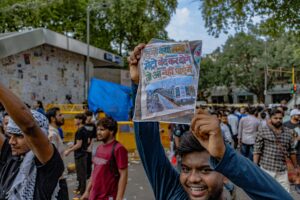
How the CJP Protest Exposed India’s Growing Media Trust Crisis
At Jantar Mantar in July 2026, something happened that had little to do with the protest’s politics and everything to do with how information now moves. As police broke up the Cockroach Janata Party’s march toward Parliament, several television reporters covering the scene were heckled, and some were chased off by crowds chanting against what they called “Godi media.” A number of protesters later alleged that certain reporters had covered their channel logos and muted their microphone branding before approaching the crowd, hoping to report without being identified as television press. That specific allegation hasn’t been independently confirmed, but the heckling and the chants were real, documented, and part of a pattern that has been building at protests across India for several years now.
What’s worth asking isn’t whether that one detail is literally true. It’s why, in 2026, a young person filming a protest on their own phone trusts that footage more than the version a national broadcaster airs an hour later, even when both are showing the same event.
The honest answer isn’t just that trust moved from institutions to individuals, though it has. It’s that the monopoly institutions once held over firsthand evidence has collapsed, and journalism is simply the place where that collapse is currently most visible. For as long as broadcasting existed, the public had no independent way to check a channel’s account of an event against the event itself. Now they do, and that single capability, more than any particular channel’s bias, is what is rewriting the relationship between citizens and the institutions that used to speak for events on their behalf.
Television owned the only camera in the room
For most of the broadcast era, edited and raw were the same thing to a viewer, because nobody outside a newsroom had access to unedited footage. Doordarshan’s monopoly gave way to private news channels through the 1990s and 2000s, and for a generation, television decided what counted as an event. If a channel cut a clip a certain way, or ran forty minutes of a shouting match instead of two minutes of ground reporting, viewers had no independent way to check that choice against reality. The broadcast was the record, not because it was always accurate, but because it was uncheckable.
That arrangement gave television its authority. It also meant nobody could catch television making a bad edit, because there was nothing to compare it against.
Smartphones made the record checkable
The correction came from hardware, not from journalism. Once ordinary people carried phones capable of recording and uploading in real time, viewers gained something they never had before: an independent copy of the same event a broadcaster was covering. For the first time, a citizen watching the nine o’clock bulletin could open a second screen and check whether the footage matched what people on the ground were posting.
At the CJP protest, this comparison happened almost instantly rather than days later. According to India Today correspondents Preeti Chowdhury and Mausami Singh, who were physically present, the protest was organic and spontaneous, a characterization ThePrint reported both journalists gave on air. By evening, ThePrint reported, several channels had shifted their primetime coverage toward the Congress-led dharna and the detention of opposition leaders including Rahul Gandhi, Akhilesh Yadav, and Priyanka Gandhi, a storyline with more familiar political weight than the original student protest. Viewers who had been at Jantar Mantar, or who had watched livestreams from people who were, could see that gap between the ground report and the primetime edit within hours, not months.
Smartphones did the same thing to policing
This isn’t unique to India, and it isn’t new. In May 2020, the Minneapolis Police Department’s first public statement on the death of George Floyd described a man who “physically resisted” arrest and was later found to be suffering “medical distress,” with no mention of an officer’s knee on his neck. That account held for a matter of hours. A bystander’s cellphone video, filmed by a then 17-year-old named Darnella Frazier, showed a different sequence of events entirely, and it was the video, not the police statement, that shaped the criminal case and the public reckoning that followed.
The mechanism at Jantar Mantar and the mechanism outside Cup Foods in Minneapolis are the same one: an institution’s account met a citizen’s footage, and the footage held up. What changed wasn’t policing, or journalism. What changed is that both now operate in front of an audience that can check their account against a competing one, in something close to real time.
Comparing coverage side by side, many viewers could reasonably come away with the impression that international outlets, including the BBC, gave more sustained attention to the scale of the crowd and the police response than much of domestic primetime did. That comparison is now available to anyone willing to watch both.
Why raw footage feels true
It’s worth pausing on why unedited footage carries this weight in the first place, because the answer isn’t simply that people have become more skeptical. Human judgment tends to give extra credibility to direct, first-person observation over someone else’s retelling of it. That’s an old instinct, not a new one, sharpened over a lifetime of trusting our own eyes more than a secondhand account. A shaky ten-second clip filmed from inside a crowd carries the texture of having been there. A polished studio package, however accurate, carries the texture of having been assembled somewhere else, by someone who wasn’t.
Smartphones didn’t invent that instinct. They just gave a few billion people a way to produce the kind of evidence that instinct responds to, and a way to distribute it before an institution can offer its version first. Once a citizen can see the raw material for themselves, an institution’s interpretation stops functioning as the record and starts functioning as one more argument competing for belief, alongside footage that feels, rightly or wrongly, like it needs no argument at all.
What the data confirms
The Reuters Institute’s 2026 Digital News Report gives this shift a number. Trust in news in India stood at 39 percent, a four-point drop from the previous year, against a global figure of 37 percent, the lowest the institute has recorded since it began tracking the measure in 2015. Fifty-eight percent of Indian respondents said they now get news through YouTube. The same report found that audiences rate independent creators as more relatable and easier to understand than legacy broadcasters, but lower on impartiality and trustworthiness.
That combination only makes sense once you separate trust in a source’s honesty from trust in a source’s proximity to the event. People are migrating to creators in large numbers, but not because they believe creators are more honest. They’re migrating because a creator standing at the scene, holding a phone, feels closer to the truth than a studio broadcast does, whether or not that feeling is justified.
Raw footage has its own hidden edit
That feeling deserves scrutiny, because raw footage isn’t actually unedited in any meaningful sense. Someone chose where to point the camera. Someone chose which thirty seconds to upload out of twenty minutes of recording. The selection has simply moved from a newsroom editor to an individual with a phone, and that person answers to no editorial standard at all.
This is the part of the shift that gets missed most often. A broadcaster’s edit could be checked against other broadcasters, official records, and eventually, corrections. A single phone clip, once it spreads, often faces no equivalent check. The audience that walked away from television for feeling curated may simply be trading one invisible edit for a less accountable one, mistaking rawness for reliability because rawness is what their instincts respond to.
Trust and accuracy are answering different questions
It helps to keep two questions separate here. Whether a report is accurate is a factual question, answerable by checking it against other evidence. Whether a report is trusted is a question about the audience’s relationship to the source, shaped by history and identity as much as by any single story’s factual content. A channel can be careful and largely accurate and still be distrusted because of a decade of prior framing choices. A single phone clip can be unrepresentative of an entire event and still be believed completely, because it arrived first and felt unverified by anyone but its own camera.
Closing the gap between these two questions, not simply producing more accurate journalism, is the actual work ahead for any institution trying to rebuild credibility.
The collapse isn’t only journalism’s
Once you see the mechanism this way, television stops being the whole story, and so does policing. In April 2017, a United Airlines passenger named David Dao was forcibly dragged down the aisle of an overbooked flight after refusing to give up his seat, and the incident was filmed by several other passengers on their phones. United’s first public response apologized only for having to “re-accommodate” customers, and an internal memo from the airline’s CEO described Dao as “disruptive and belligerent.” Neither statement survived contact with the footage, which showed a bloodied, unconscious man being pulled from his seat. The airline reversed its position within days, and its CEO later called the video a watershed moment for the company.
A protest, a police killing, and an overbooked flight have almost nothing in common except this: in each case, an institution issued an account of what happened, and a citizen’s camera was already circulating a competing one before the institution finished speaking. That is the actual shape of the shift. It is not that people trust television less, or police less, or corporations less, in isolation. It is that any institution whose authority once rested on being the only source of the record is now negotiating that authority against footage it did not produce and cannot retract.
What this means for what comes next
Elections are the clearest place to watch this play out next. A government or a candidate used to control the sequence of a story: statement, press conference, coverage, public reaction, roughly in that order. That sequence let institutions get ahead of a narrative before it hardened. Now a clip from a rally or a counting center can reach millions of phones before any official has said a word, and by the time the press conference happens, it is responding to a version of events the public has already seen and formed an opinion on. The institution isn’t losing the argument. It’s losing the ability to go first.
The CJP protest will fade from the news cycle soon enough. What it revealed will not, because it wasn’t really about one broadcaster’s choices on one afternoon. For most of the last century, a small number of institutions, newsrooms, police departments, corporations, decided what the public record of an event would say, simply because they were the only ones holding a camera. That arrangement is over. What replaces it isn’t yet clear, but it will not be built by institutions trying to out-shout the footage. It will be built by whichever of them learns to compete honestly with evidence they no longer control.
