

How Climate, Disease, and Economics Are Rewriting the World’s Favorite Treat
I. The Chocolate Shock
In the early months of 2024, the international cocoa market breached price levels rarely seen in its modern history. On the commodity trading floors of the Intercontinental Exchange in New York and London, futures contracts began a relentless, vertical ascent. Before the 2024 shock, cocoa prices had spent much of the preceding period far below the extraordinary levels reached that year. By February, prices had broken all-time records, and by March they crossed $8,000. On 19 April 2024, the nearby contract reached $12,567 per metric ton in London and $11,878 per metric ton in New York.[1]
The velocity of the surge strained the financial plumbing of the confectionery trade. Cocoa processors and grinders came under severe financial pressure as bean prices surged and previously contracted supplies became increasingly expensive to replace. In Europe, grinders faced liquidity strain as rising futures prices increased the margin requirements on their hedges.[15] Major confectionery companies warned that cocoa costs were putting significant pressure on margins. On retail shelves across the globe, the cost of chocolate rose sharply.
Yet by early 2026, the market delivered a reversal that left casual observers profoundly disoriented. Driven by an 8.5% rebound in global production during the 2024/25 crop cycle and weaker cocoa usage by manufacturers, cocoa futures experienced a historic sell-off.[2] In some trading sessions, spot contracts tumbled below $3,000 per metric ton. By late September 2026, prices stood far below the 2024 peak, though the market remained volatile.
The retreat can easily be mistaken for evidence that the cocoa crisis was merely a speculative fever dream, a temporary dislocation of supply and demand that has resolved itself. The longer-term picture is more complicated. The central paradox of modern chocolate is that cocoa can simultaneously undergo a brutal cyclical price collapse and become structurally more difficult, hazardous, and costly to cultivate. The era of cheap chocolate is not ending because Theobroma cacao is vanishing tomorrow; it is ending because the conditions that once made abundant cocoa appear inexpensive and predictable are becoming less reliable.
II. The Bean Inside the Bar
To understand why the chocolate industry has become so acutely fragile, one must first recognize the profound disconnect between the industrialized confectionery bar and the botanical reality of the tree that generates it. Modern consumers treat chocolate as an engineered industrial commodity, continuous with candy wafers or corn-syrup confections. In truth, it is the product of an extraordinarily sensitive, recalcitrant perennial tree: Theobroma cacao.
Indigenous to the understory of the Amazon basin, the cacao tree evolved in a narrow ecological niche. It does best with consistent warmth, shade from a canopy that filters direct sunlight, high humidity, and plentiful rainfall spread through the year. The tree is sensitive to both waterlogging and drought. Unlike annual cash crops such as soybeans, corn, or wheat, which can be planted across millions of contiguous hectares, mechanically fertilized, and harvested with computer-guided combines, cocoa remains far less amenable to large-scale mechanization.
This biological fragility is evident in the tree’s reproductive cycle. Cacao flowers are small and structurally complex, and pollination depends on tiny insects, particularly biting midges, rather than on honeybees or wind.[37] The abundance of those midges is influenced by the shaded, moist conditions found in suitable cocoa-growing systems.
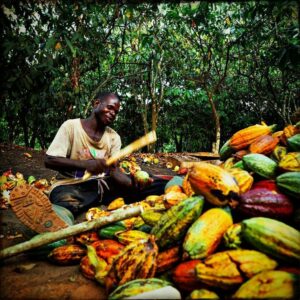
Every cocoa pod that survives must be individually harvested by hand. The pods do not drop when ripe; they must be severed from the trunk and principal scaffold branches using machetes or specialized curved sickles mounted on long poles, with a clean cut through the stalk.[35] The worker must strike with surgical accuracy, because slicing too deeply destroys the “cushion,” the delicate floral tissue embedded in the bark that generates future blossoms. If the cushion is mutilated, the tree can lose its capacity to fruit at that site.
Once harvested, the thick wooden pods must be cracked open and the wet beans extracted by hand. Each pod holds dozens of seeds, each encased in a sweet white pulp. What follows is not a mechanical assembly process, but a microbial fermentation that commonly lasts several days.[36] Heaped under plantain leaves or placed in wooden sweatboxes, wild yeasts and bacteria consume the pulp sugars, and the heat they generate raises the mass to roughly 40 to 45°C during the early stages.[35] That heat helps kill the seed embryo and drives the chemical changes that create the precursors of chocolate aroma. The beans are then spread under equatorial sunlight to dry, a process whose length varies with weather and method.[35] A single bar of dark chocolate represents not a sterile manufacturing output, but an exhausting sequence of manual agricultural labor carried out thousands of miles away in an increasingly volatile tropical climate.
III. The West African Dependency
The botanical sensitivity of Theobroma cacao is compounded by an extreme geopolitical vulnerability: the world’s supply is funneled through a remarkably small geographic corridor. According to the International Cocoa Organization, global cocoa production in the 2024/25 crop year reached approximately 4.733 million metric tons.[2] Of that aggregate volume, the African continent produced roughly 69%.[3]
More crucially, ICCO figures show that two contiguous nations, Côte d’Ivoire at 1.681 million metric tons and Ghana at 0.600 million metric tons, account for roughly 48% of total global supply.[3] Beyond these two giants, the global supply ledger falls off steeply into secondary producers: Ecuador at 0.57 million metric tons, Nigeria at 0.33 million metric tons, Cameroon at 0.31 million metric tons, and Indonesia at 0.20 million metric tons.[3]
This geographic hyper-concentration establishes an acute operational asymmetry across the chocolate industry. Demand for chocolate is geographically broad and diversified: consumers around the globe purchase confection on impulse, and multinational brands can alter marketing campaigns overnight. Supply, by contrast, is highly constrained in the medium term. A cacao tree cannot be switched on or accelerated like an automotive assembly line. When a farmer plants a newly grafted seedling, the farm must wait several years before harvesting its first pods, and longer before the tree reaches full commercial yield; with good care, most trees begin yielding within about five years.[46]
Consequently, whenever climatic disruptions, viral pathogens, or political instability strike the narrow forest belt running from the Ivorian border with Liberia eastward to the Volta Basin of Ghana, the global market has limited room to compensate. Other producing countries can partially compensate for a West African shortfall, but their combined capacity cannot rapidly replace a large simultaneous loss from Côte d’Ivoire and Ghana. For decades, the global confectionery trade built a multi-billion-dollar industry around the expectation that West Africa would continue providing large volumes of relatively inexpensive cocoa. That assumption is becoming increasingly difficult to sustain.
IV. The Heat Is Coming
A major environmental pressure on the West African cocoa belt is the growing number of days on which temperatures exceed the range in which cacao performs best. Temperatures above 32°C expose cacao to conditions outside its optimal range and can increase heat and water stress.[4]
The extent of this exposure was quantified in an analysis by Climate Central. The study found that human-induced climate change has added at least three full weeks of days exceeding 32°C annually during the main cocoa-growing season in Côte d’Ivoire and Ghana over the past decade.[4] In 2024, climate change added approximately six weeks’ worth of days above 32°C across 71% of the cocoa-producing areas analyzed in Côte d’Ivoire, Ghana, Cameroon, and Nigeria.[4]
The relevant issue is not warming alone, but the increasing frequency and duration of days during which the cacao tree is forced to operate outside its optimal range. Heat stress of this kind can reduce the quantity and quality of the harvest.[4]
V. Too Dry, Too Wet
The disruption of the cocoa belt’s atmosphere extends beyond temperature into the rhythm of precipitation. Cacao does not merely require water; it requires temporal stability. A tree that is vulnerable to both drought and waterlogging is exposed whenever rainfall turns erratic, not only when it turns scarce.
A 2025 agricultural study archived in the FAO AGRIS system found structural shifts in rainfall patterns across Côte d’Ivoire and Ghana. The data showed that Ghana in particular has suffered a drying trend, with annual precipitation declining by up to 15%, an average loss of roughly 200 millimeters of rainfall per year, over the most recent decade evaluated.[5] This decline was accompanied by a marked reduction in total rainy days and an increase in consecutive dry days during historically wet months.[5]
The volatility has carried into current production cycles. On September 21, 2026, Reuters reported that cocoa farmers across major growing belts in Côte d’Ivoire were raising urgent alarms over prolonged dry spells during what should have been critical rainy weeks for main-crop development.[47] Farmers documented premature pod drop, stunted bean sizes, and drying canopies. The episode illustrates how rainfall variability can add another layer of risk to production. A market commentary published on September 28 likewise described rainfall in Côte d’Ivoire and southwestern Ghana as light enough to raise concerns about main-crop production.[43]
VI. The Invisible Killer
While unstable skies assault the trees from above, a persistent virus is damaging orchards from within. Cocoa swollen shoot virus disease (CSSVD) is among the most serious plant health threats facing cocoa in West Africa, and FAO treats it as a major threat to production in Côte d’Ivoire and Ghana.[6]
The virus is transmitted by mealybugs, and an infected tree cannot be cured.[6] Because there is no curative treatment for an infected tree, disease management has relied heavily on removing infected trees, while researchers continue to investigate resistant planting material and other integrated approaches.[6] Research on mild-strain cross-protection, in which plants are inoculated with a weak virus isolate to protect them against severe strains, has shown partial effects but also important limitations.[7]
The operational reality in West Africa is serious. FAO documents that Ghana’s production fell from 1.048 million metric tons in 2020/21 to approximately 600,000 metric tons in 2023, and identifies swollen shoot disease among the factors contributing to that decline.[6] Côte d’Ivoire and Ghana have adopted a 2026–2031 regional strategy to roll back the disease.[6] Yet for a smallholder household, the removal of mature trees can mean the immediate loss of income.
VII. The Trees Are Getting Old
The pressure from disease is compounded by an underlying demographic issue: the age of West African cocoa orchards. Like all perennial fruit trees, Theobroma cacao follows a life cycle. Cacao productivity generally declines as orchards age, with older trees often becoming less productive and more difficult to maintain.
A significant share of the cocoa acreage in both countries consists of older trees, many planted during the clearing booms of the 1970s and 1980s. An older World Bank assessment reported that more than 40% of Ghana’s existing cocoa trees were over 30 years old.[8] A recent study of Côte d’Ivoire found that more than 45% of plantations in one major production area were over 30 years old, while other areas were considerably younger.[9]
This demographic stagnation is linked to what this article calls the “forest rent”: the fertility boost that first-cycle clearing of rainforest once gave to new cocoa plantings.[48] The concept also helps explain why replanting can become more difficult after the initial fertility advantage of forest-derived soils has faded.[48] Farmers in a 2026 Ivorian survey reported declining soil fertility as a major constraint.[44]
Replacing an aging orchard on less fertile soil presents a major economic hurdle for the smallholder farmer. Commercial plantations can spread orchard replacement across successive planting cycles, whereas many West African smallholders operating on only a few hectares may lack comparable financial reserves.
If a farmer cuts down an aging, low-yielding tree today, the farm forfeits that tree’s meager income immediately. The newly planted sapling requires several years of intensive weeding, watering, and protection before it yields a single pod, and longer still before reaching full commercial yield.[46] Constraints on financing and on access to planting material can make replanting difficult, and many smallholders may struggle to endure several years of reduced income.[49] Economic constraints can make farmers reluctant or unable to remove aging or diseased trees, even as yields decline, and they may keep harvesting whatever pods those trees still bear.
VIII. The Farmer’s Impossible Equation
This brings the cocoa crisis to its fundamental structural contradiction: the economic gulf that separates global commodity markets from the farmers who cultivate the crop. When retail chocolate prices rise sharply, it is easy to assume that smallholders in West Africa benefit directly. The real-world mechanics of the cocoa value chain reveal the opposite.
Between the cocoa smallholder and the consumer sits an extensive chain of intermediaries: village pisteurs (middlemen), licensed buying companies, state marketing boards, international trade houses, maritime shipping conglomerates, industrial processors, confectionery brand owners, and retail grocers. In both Côte d’Ivoire and Ghana, cocoa marketing is governed by state-administered systems: the Conseil du Café-Cacao (CCC) and the Ghana Cocoa Board (COCOBOD).
The CCC and COCOBOD sell a large share of anticipated national production forward, helping establish farmgate pricing before the crop is delivered.[10][11] Farmgate prices are then fixed for the duration of the season. As futures climbed toward the April 2024 peak, West African boards had already sold much of the crop forward at earlier, lower prices. During the 2024 price spike, farmers in the two major West African systems did not capture the full increase in international spot prices because much of the crop had already been committed through forward-sale mechanisms.[10][11]
The gap between farmgate prices and a living income becomes clear when evaluated against Fairtrade International’s Living Income Reference Prices (LIRP). These are voluntary benchmarks, published in April 2026 to apply from the 2026/27 harvest season, that estimate the farmgate price at which a farm of average size among Fairtrade farmers could earn a proportional share of a living income from cocoa.[29] Fairtrade set the benchmark at 1,758 CFA francs per kilogram (about $3.11, at Fairtrade’s conversion) in Côte d’Ivoire and 45.40 Ghanaian cedis per kilogram (about $3.95) in Ghana.[29]
The subsequent price decline of 2025/26 created another wave of economic shocks. In Côte d’Ivoire, the government raised the guaranteed farmgate price to 2,800 FCFA per kilogram for the 2025/26 main crop. Following the global price decline, it reduced the 2026/27 main crop farmgate price to 1,200 FCFA per kilogram, which is below the 1,758 FCFA benchmark and represents a nominal farmgate-price reduction of approximately 57%.[12]
Ghana adopted a different policy framework. In late September 2026, COCOBOD reviewed its producer prices and established a guaranteed rate of GH¢42,400 per metric ton (GH¢2,650 per 64-kg bag) for the 2026/27 season, representing approximately 71.18% of the realized gross FOB value:[13]
$$\text{Producer Price}_{\text{Ghana, 2026/27}} = \text{Gross FOB Realized} \times 71.18% = \text{GH¢}42{,}400\text{ / MT}$$
While this provided a higher nominal farmgate price, Ghanaian farmers also faced local production costs that could erode its value. The price differential between the two countries also increased incentives for cross-border cocoa smuggling, a longstanding problem in the region.[13] The farmer remains caught in an impossible equation: when global prices soar, forward sales limit the farmer’s share of the windfall; when global prices fall, farmgate prices can be cut, and inflation can erode nominal gains.
IX. The Cocoa Crash
The sell-off that gripped the cocoa market between late 2024 and mid-2026 illustrates how physical supply shocks can interact with financialized commodity markets. Following two consecutive years of global deficits, including a shortfall approaching 500,000 metric tons in 2023/24, the market underwent a sharp physical and financial adjustment.
According to ICCO data, global cocoa production expanded by 8.5% in the 2024/25 crop season to approximately 4.733 million metric tons.[2] The recovery reflected improved production conditions, particularly in West Africa, alongside stronger output from other producing regions. At the same time, the historic price peaks of 2024 coincided with weaker demand and lower cocoa usage by manufacturers: global cocoa grindings contracted by 3.3% to 4.649 million metric tons as manufacturers raised prices and adjusted recipes.[2]
This combination of recovering supply and depressed processing demand produced a net global surplus of approximately 37,000 metric tons for the 2024/25 season, lifting global end-of-season stocks to 1.309 million metric tons.[2] In commodity derivatives markets, where hedge funds and other financial participants had built large positions during the ascent, Reuters documented a hedge-fund exodus that reshaped liquidity in the cocoa market.[14] Futures prices subsequently fell, dropping below $3,000 per metric ton in some sessions in early 2026. In its April 2026 Commodity Markets Outlook, the World Bank projected that the 2026 average cocoa price would be more than 50% below the 2025 average before stabilizing in 2027.[38]
Yet the statistical surplus should not be interpreted as evidence that the structural risks have disappeared. The reported 37,000-tonne surplus was equivalent to roughly three days of global grindings, illustrating how small the annual balance was relative to total processing demand. Furthermore, structural threats have immediately resurfaced. COCOBOD announced that it expects Ghanaian cocoa production to fall by at least 16% in the 2026/27 season, citing weather effects, disease, and the natural alternate-bearing cycle of cacao trees.[28] The surplus improved the short-term balance but did not resolve the longer-term production risks discussed elsewhere in the article.
X. Why Chocolate Didn’t Get Cheap Again
Why did chocolate bars on supermarket shelves not become dramatically cheaper when cocoa futures fell? The expectation that a 50% decline in commodity futures should translate into an immediate 50% reduction in consumer chocolate prices ignores the fundamental mechanics of confectionery manufacturing and price transmission.
The retail price of a chocolate bar can be formalized as an aggregate cost stack:
$$\text{Retail Price} = C_{\text{cocoa}} + C_{\text{ingredients}} + C_{\text{energy}} + C_{\text{labor}} + C_{\text{packaging}} + C_{\text{logistics}} + M_{\text{manufacturer}} + M_{\text{retailer}}$$
Raw cocoa beans ($C_{\text{cocoa}}$) represent only one component of this equation. An ordinary mass-market chocolate product represents an intricate blend of cocoa liquor, cocoa butter, refined sugar, milk powders, specialty vegetable oils, emulsifiers such as soy lecithin, flavorings, aluminum-foil packaging, and cardboard boxing. Beyond raw materials lie the substantial costs of industrial energy to run conching and tempering machinery, factory labor, long-distance freight, regulatory compliance, corporate marketing campaigns, and retailer profit margins. In recent years, higher energy, packaging and logistics costs have likely raised the cost base of food manufacturing as well.
Second, large confectionery manufacturers typically combine forward physical purchases, inventories and financial hedging rather than relying exclusively on spot-market purchases. To maintain uninterrupted factory operations, they operate under long-term hedging structures and forward-purchase contracts. Barry Callebaut itself describes a cycle of 12 to 18 months between sourcing beans and selling the resulting chocolate, and its hedging program creates significant margin requirements.[15] Because manufacturers buy ahead, a decline in futures prices reaches products on store shelves only after a lag. Some chocolate reaching consumers in 2026 could therefore still reflect cocoa purchased during the elevated pricing environment of 2024 and 2025.
Finally, consumer price sensitivity has begun interacting with climate anomalies at the retail level. In September 2026, Swiss luxury chocolatier Lindt & Sprüngli reported that European consumers had grown distinctly price-sensitive following cumulative retail price hikes. Lindt noted that record-breaking European summer heatwaves had simultaneously depressed consumer appetite for confectionery, illustrating that extreme heat can affect confectionery demand at the retail level as well as cocoa production in growing regions.[39]
XI. The Smaller Bar
To survive the historic raw-material price spike without passing the full increase in cocoa costs directly through to consumers, the confectionery industry used several familiar responses, including price increases, shrinkflation and recipe reformulation.
Shrinkflation, the reduction of package volume while the nominal retail price is maintained, is one form such a response can take. Manufacturers responded to high cocoa costs through combinations of price increases, smaller formats and recipe changes.[16]
Simultaneously, food companies reformulated products to reduce their reliance on cocoa. Because cocoa butter and cocoa liquor had become among the most expensive ingredients on the corporate balance sheet, some brands reformulated products to reduce cocoa content and substitute lower-cost ingredients. Some manufacturers reformulated products around wafers, aerated fillings, nuts, grains and other lower-cocoa components. Confections that historically featured a thick, solid chocolate bar were re-engineered into multi-layered snack bars where chocolate served merely as a thin outer enrobing coat.
In May 2026, Reuters reported that, as cocoa prices fell, some manufacturers were moving back toward more traditional recipes.[16] Some reformulations may persist because companies have already invested in products that use less cocoa, but the extent to which these changes become permanent remains uncertain.
XII. Chocolate Without Cocoa
One potentially radical long-term response to the cocoa crisis is emerging in food biotechnology: the development of cocoa-free chocolate alternatives. Several food-technology companies and ingredient producers are developing alternative ingredient systems intended to reproduce some of chocolate’s flavor and texture characteristics without conventional cacao.
One corporate example is the partnership between Barry Callebaut, a major industrial chocolate processor, and German food-tech startup Planet A Foods around ChoViva. Barry Callebaut says ChoViva is made without cocoa and uses sunflower seeds, and the two companies have entered an exclusive commercial partnership.[17][18]
In the United States, Voyage Foods makes NextCoa, a cocoa-free chocolate alternative built from grape and sunflower-derived ingredients through proprietary processing. In 2026, Cargill announced that it would bring NextCoa to North America, describing itself as the exclusive global B2B distributor.[19]
Cellular-agriculture and fermentation companies such as California Cultured are developing cocoa-related ingredients without conventional cacao orchards. California Cultured currently describes its approach as fermentation-grown cocoa, and Puratos has announced plans for a cultured-cocoa professional product toward the end of 2026.[20][45] These technologies are emerging commercial options, and their cost and scale remain to be demonstrated. Plant-based and upcycled alternatives such as ChoViva and NextCoa have begun to enter commercial supply chains.
XIII. Can Science Rescue the Cocoa Tree?
While food technologists construct a post-cocoa future in laboratories, agricultural scientists and forestry researchers are racing to stabilize Theobroma cacao in its native environment. One major strategy for improving climate resilience is the expansion of managed agroforestry.
Across major West African cocoa-growing regions, average shade-tree cover is now only about 13%.[21] Lower-shade production systems can generate high yields under some conditions, but they also reduce the buffering effects of tree cover and leave trees more exposed to solar radiation, wind and heat.[33]
Modern agroforestry seeks to reconstruct this multi-strata forest architecture by interplanting cacao beneath carefully selected native timber, legume, and fruit trees, such as Terminalia superba, Albizia adianthifolia, and Persea americana. A 2025 study of Ghanaian cocoa farms in Agricultural Systems found that agroforestry adopters were, on average, less severely affected by reduced rainfall: each millimeter of lost rainfall reduced yields by about 2.17 kilograms per hectare for adopters and 2.84 for non-adopters. The effect held only in climatically suitable regions and was not significant in drier, less suitable ones.[32] Shade trees can also buffer sub-canopy temperature and vapor pressure deficit, one mechanism through which agroforestry may help cacao cope with heat and drought.[33]
The broader ecological potential was quantified in a comprehensive study published in Nature Sustainability. Examining major West African cocoa-growing regions, the authors worked from that 13% baseline. Through bioclimatic and carbon modeling, the researchers modeled the effect of increasing shade-tree cover to a minimum of 30% across the region and estimated that it could sequester an additional 307 million metric tons of CO2 equivalent without reducing cocoa yields under the study’s modeling assumptions.[21] The 30% figure is a regional modeling scenario, not a universal agronomic target for every farm.
However, agronomists caution that shade is not an uncritical panacea. Dense, poorly managed shade can create a humid, stagnant microclimate beneath the canopy that favors Phytophthora megakarya, the pathogen responsible for black pod rot. A 2026 study published in Scientific Reports evaluating 158 smallholder farms in Côte d’Ivoire found that higher cocoa yields were associated with mineral fertilization, aligned tree planting, and the use of identified planting material, while farmers reported insect pests, black pod disease, and declining soil fertility as major constraints.[44] Resilience therefore depends on managing tree density, balancing solar exposure with airflow, and restoring depleted soil nutrients.
XIV. The Amazon Gamble
As West Africa’s production system faces pressure from disease and soil depletion, Latin America is gaining importance in global cocoa supply. Ecuador is one of the clearest examples, having expanded its cocoa sector rapidly.
According to ICCO data, Ecuadorian cocoa output reached roughly 570,000 metric tons in 2024/25, compared with 600,000 metric tons for Ghana.[3] The national exporter association Anecacao has projected that Ecuador’s exports will exceed 623,000 metric tons in 2026,[30] and its chairman has said that production could exceed 650,000 metric tons in 2026/27, a projection from the exporters’ association rather than an independent estimate.[31] Ecuador is approaching Ghana’s production scale and is increasingly important to global cocoa supply.
The contrast with West Africa is real, though Ecuador’s production structure is mixed, with smallholders operating alongside larger commercial estates. West African production relies largely on rain-fed, low-input smallholder plots. Ecuadorian growers use clonal varieties, most notably CCN-51 (Colección Castro Naranjal 51), a robust hybrid widely planted in the country.[34] Managed plantations that combine clonal planting material, irrigation, pruning, and fertilizer can achieve higher yields than rain-fed, low-input plots, although yields vary widely by farm and system. Anecacao’s chairman has put typical Ecuadorian yields at about 800 kilograms per hectare, against just under 500 in West Africa,[31] and an analysis of production systems in Ecuador found that CCN-51 yields ranged widely between systems, with the most productive reaching roughly 1,500 kilograms per hectare alongside higher input spending.[34]
Ecuador also differs on pricing. Anecacao’s chairman told Reuters in 2025 that Ecuadorian farmers receive around 90% of the world price, against 60% to 70% at best in Côte d’Ivoire and Ghana.[31] This is an industry association’s own estimate and should be read as such, but it points to producers who are more directly exposed to movements in international prices.
In Brazil, an equally fascinating agricultural experiment is underway. Historically devastated by Witches’ Broom disease (Moniliophthora perniciosa) in the late 1980s, the Brazilian cocoa sector is engineering a dramatic revival. In September 2026, Reuters reported on initiatives in the Amazon basin and Bahia aimed at planting disease-resistant cocoa agroforestry systems on degraded cattle pastures, while also weighing the risk that cocoa expansion could itself become a new threat to forest.[40] Brazil is testing whether cocoa agroforestry on degraded pasture can combine agricultural production with ecological restoration.
Yet, shifting production geographically does not eliminate biological vulnerability. Studies in affected Ecuadorian production areas have documented substantial losses from Witches’ Broom disease. Cadmium uptake is also a significant constraint in some Latin American cocoa-producing soils and supply chains. The tree absorbs this toxic heavy metal, and it faces strict maximum threshold limits under European Union food safety laws (Regulation (EU) No 488/2014, setting limits as low as 0.10 to 0.80 mg/kg in finished chocolate products).[50] Moving the farm across the globe does not erase ecological reality; it simply exchanges one set of environmental and regulatory constraints for another.
XV. The European Traceability Revolution
The transformation of the global cocoa value chain is being accelerated by a sweeping regulatory overhaul from one of the world’s largest chocolate-consuming markets: the European Union Deforestation Regulation (EUDR). Formally adopted as Regulation (EU) 2023/1115, the legislation prohibits the entry of seven key commodities into the EU single market, namely cocoa, coffee, cattle, palm oil, soy, rubber, and wood, unless operators can prove with verifiable digital evidence that the goods were not grown on land deforested or degraded after December 31, 2020.[22]
The compliance core of the EUDR centers on geolocational traceability. For plots over four hectares, geolocation must be provided as polygons. Smaller plots generally use point geolocation, while the amended rules allow certain micro and small primary operators, established in countries classified as low risk, to use the postal addresses of their plots instead.[22][41][42] The relevant location information is submitted through the EU information system as part of the applicable compliance process, including the due-diligence statement for operators subject to that requirement, while qualifying micro and small primary operators file a one-time simplified declaration instead.[22][41][42]
Recognizing the severe technical and infrastructural hurdles facing producer nations, the European Commission formally delayed the enforcement calendar. Large and medium operators must comply by December 30, 2026, while micro and small operators have until June 30, 2027, with those already covered by the EU Timber Regulation due on December 30, 2026.[24] Despite this timeline adjustment, the operational demands of the regulation have triggered massive supply-chain friction.
In Ghana, COCOBOD deployed the Ghana Cocoa Traceability System (GCTS), an ambitious nationwide initiative to map every cocoa plot and issue barcoded tracking sacks. However, mapping a large number of dispersed smallholder farms in remote rural areas can be costly and logistically difficult.
This technical bottleneck creates a structural risk of smallholder exclusion. Multinational trading houses face penalties for non-compliance under the regulation, with the maximum level of fines required to be set at no less than 4% of annual EU-wide turnover.[23] The compliance burden creates a risk that buyers could favor suppliers with easier-to-document traceability, potentially disadvantaging poorly mapped smallholders. Smallholders whose production cannot be adequately documented under the EUDR could find it harder to sell into European markets and might rely more heavily on markets with less demanding traceability requirements.
XVI. India’s Cocoa Problem
The restructuring of global cocoa supply is occurring against a backdrop of shifting international demand. India provides a useful example of how rising consumption and changing retail patterns could affect future cocoa demand.
India relies substantially on imported cocoa and cocoa preparations.
According to World Bank trade data compiled in the World Integrated Trade Solution (WITS), India’s imports of cocoa and cocoa preparations reached approximately $1.10 billion in 2025. Demonstrating the interconnectedness of global supply lines, Indonesia served as India’s dominant supplier, accounting for roughly $681 million of that total.[25]
This heavy import reliance creates acute vulnerabilities for India’s domestic confectionery industry. Spikes in global cocoa futures or a weaker Indian rupee can increase costs for domestic processors, which may be difficult to pass along to price-sensitive consumers. While agricultural extension programs in southern states such as Kerala, Karnataka, and Tamil Nadu have promoted cocoa intercropping beneath coconut and areca nut palms, India continues to depend substantially on imports.
StoneX, a financial analytics firm, has put forward the interpretation in its regional commodity reviews that the long-term expansion of cocoa grinding and confectionery consumption across India and China could become a major structural source of demand. Because these populations have low per capita consumption baselines that are only beginning to rise, even modest shifts toward chocolate consumption could add meaningfully to competition for a globally constrained supply of beans.
XVII. Who Will Grow Cocoa in 2040?
Behind every agronomic statistic, meteorological model, and financial derivatives chart lies the most intractable crisis of all: the demographic challenge facing cocoa farming. The global chocolate industry is fundamentally reliant on a generational cohort that is aging.
Studies of cocoa farmers in Ghana describe an aging farming population, with many surveyed farmers around or above 50.[26] Cocoa farming is physically demanding work, including clearing vegetation, spraying, harvesting pods from tall canopies, and carrying heavy sacks of beans, and it becomes harder with age.
Whether younger people will take up cocoa farming is an open question, because it depends on whether the work can offer a decent income. COCOBOD has also cited the spread of illegal gold mining (galamsey) among the factors aggravating the outlook in Ghana’s western cocoa regions, which together account for more than half of the country’s output.[28]
Child labor in cocoa is linked to these pressures. Low farm income can increase household vulnerability to child labor, alongside factors such as access to education, household structure and local labor conditions.[27]
The International Labour Organization (ILO) identifies poverty, low income, declining productivity, and limited livelihood opportunities as interconnected drivers of child labor in cocoa.[27] If cultivating cocoa cannot provide a farming family with a living income that supports paid adult labor, decent housing, and school costs, the sector risks losing younger workers. The industry faces an existential question: if these trends persist without structural economic reform, who will be left to harvest the world’s cocoa in 2040?
XVIII. The New Chocolate
The convergence of biological disease, climatic volatility, regulatory friction, and shifting labor demographics may be reshaping the global chocolate confectionery market. The historical expectation that an ordinary consumer could walk into any corner shop and purchase a thick, solid chocolate bar made from rich cocoa mass for a nominal price is becoming harder to sustain.
In its place, the global confectionery aisle could increasingly divide into four broad categories, distinguished by formulation and positioning. The four-part division below is this article’s own analytical framework, not an established industry taxonomy.
The first category is Traditional Premium Chocolate. This tier preserves the classical composition of chocolate: high concentrations of cocoa liquor and traceable single-origin beans sourced from certified agroforestry plantations. Premium traceable cocoa products are likely to face greater cost pressure as they absorb the costs of climate-resilient farming, living-income farmgate premiums, and EUDR-compliant geolocation mapping. Whether those costs translate into a distinct luxury tier will depend on consumer willingness to pay.
The second category is Reformulated Mass-Market Chocolate. This category maintains the visual branding and familiar shape of conventional chocolate bars while reducing the concentration of cocoa. Reuters documented in 2026 that manufacturers had reformulated products in response to high cocoa costs and that some were moving back toward more traditional recipes as prices fell.[16]
The third category is Vegetable Compound Confectionery. In this product class, expensive cocoa butter is replaced with refined vegetable fats, predominantly fractionated palm kernel oil, shea stearin, or coconut oil. In some jurisdictions, products that replace cocoa butter or cocoa solids with other fats or ingredients cannot be marketed under the same legal designation as conventional chocolate, and appear instead under designations such as “chocolatey coating,” “confectionery bar,” or “fudge enrobed.” While these products lack the sharp snap and clean, cooling melt of authentic cocoa butter, they offer long shelf-life stability and resistance to melting in warm climates.
The fourth category is Cocoa-Free Alternative Confectionery. Produced through food biotechnology, this tier uses ingredients such as sunflower-derived and grape-derived inputs and fermentation-based processes to mimic chocolate without tropical cacao. Partnerships between startups and global ingredient companies, including Barry Callebaut with Planet A Foods and Cargill with Voyage Foods, show commercial interest in the category.[17][19] Cocoa-free alternatives could gain market share in selected industrial applications if they achieve competitive cost, taste, and consumer acceptance.
XIX. What Happens Next?
As the global confectionery industry navigates this transformation over the next decade, the market may not settle into a tranquil new equilibrium. Three scenarios illustrate the range of futures that could shape the world’s favorite treat. They are illustrative scenarios and are not forecasts.
In the first scenario, Managed Ecological Adaptation, origin governments, multilateral development banks, and multinational chocolate companies mobilize capital for a coordinated agricultural transition. Under this illustrative scenario, smallholders receive subsidized, disease-resistant clonal seedlings, compensation for uprooting CSSVD-infected trees, and technical support to install irrigation and shade agroforestry. In this scenario, governments and industry succeed in raising farmer incomes, replacing diseased trees, improving traceability and financing climate adaptation. Cocoa yields stabilize, West African production recovers toward sustainable baselines, and cocoa-based chocolate remains broadly accessible, albeit at retail prices that stay above their pre-2024 levels.
In the second scenario, Chronic Volatility and Supply Cycles, industry investment remains focused primarily on short-term commodity conditions. Confectionery companies respond to commodity price declines by scaling back sustainability investments, while origin governments do not fund disease control at the scale required. Eventually, the next severe climate shock, such as an intense El Niño, an extended Harmattan, or an unseasonal monsoon, collides with aging, disease-affected orchards, triggering another severe harvest shortfall. Futures prices spike again, setting off renewed margin calls, retail price increases, and emergency recipe reformulation. The cocoa market becomes defined by structural instability, lurching continuously from glut to shortage.
In the third scenario, the Bifurcated Luxury Matrix, the compounding pressures of climate change, persistent viral disease pressure, and smallholder demographic decline strain the West African production model. Unable to overcome CSSVD and extreme heat, West African production contracts substantially and remains below historical levels. The mass-market confectionery industry completes its pivot away from cacao, transitioning everyday consumer candy to compound coatings, upcycled biomass, and precision-fermented alternatives. In the most extreme version of this scenario, premium cocoa-based chocolate could become increasingly concentrated in higher-priced specialty markets, supplied in part by smaller, more intensively managed estates in Latin America.
The central insight that emerges from the turbulent markets of 2024 to 2026 is that the era in which abundant, inexpensive cocoa could be treated as an almost automatic input to chocolate is becoming harder to sustain. The fall in commodity futures in 2026 left the underlying production risks in place and showed how volatile the market can be. The world will not run out of sweet treats, and chocolate will not vanish from human culture. But the quiet bargain that underpinned the 20th-century candy bar, built on abundant tropical land, relatively predictable growing conditions and persistently low-cost smallholder production, is becoming harder to sustain. The true cost of chocolate is finally coming due.
Sources
[1] International Cocoa Organization, Cocoa Market Report for April 2024. https://www.icco.org/cocoa-market-report-for-april-2024/
[2] International Cocoa Organization, August 2026 Quarterly Bulletin of Cocoa Statistics. https://www.icco.org/august-2026-quarterly-bulletin-of-cocoa-statistics/
[3] International Cocoa Organization, Annual Report 2024/2025. https://www.icco.org/wp-content/uploads/ICCO-Annual-Report-2024-2025-EN.pdf
[4] Climate Central, Climate change is heating up West Africa’s cocoa belt (February 2025). https://www.climatecentral.org/report/analysis-climate-and-cocoa-2025
[5] FAO AGRIS, Implications of changes in water stress and precipitation extremes for cocoa production in Côte d’Ivoire and Ghana. https://agris.fao.org/search/en/providers/123818/records/682f3bf09d0aa4165340bfa9
[6] FAO Investment Centre, Five Years and Five Levers to Roll Back Cocoa Swollen Shoot Disease in Côte d’Ivoire and Ghana. https://www.fao.org/investment-centre/latest/news/detail/five-years-and-five-levers-to-roll-back-cocoa-swollen-shoot-disease-in-cote-d-ivoire-and-ghana/en
[7] Appraisal of Cocoa swollen shoot virus (CSSV) Mild Isolates for Cross Protection of Cocoa Against Severe Strains in Ghana, PubMed. https://pubmed.ncbi.nlm.nih.gov/30688605/
[8] World Bank, curated document on Ghana’s cocoa sector. https://documents1.worldbank.org/curated/en/600141468030659466/pdf/multi-page.pdf
[9] Agronomic and Structural Characterization of Cocoa Orchards and Growers in Main Production Area of Côte d’Ivoire, Journal of Experimental Agriculture International. https://www.journaljeai.com/index.php/JEAI/article/view/4271
[10] Kaestner, Pass-Through of Cocoa Prices Along the Supply Chain: What’s Left for Farmers in Côte d’Ivoire?, Journal of Agricultural Economics (2026). https://onlinelibrary.wiley.com/doi/full/10.1111/1477-9552.70021
[11] IMF, Ghana: Third Review Under the Arrangement Under the Extended Credit Facility, IMF Staff Country Reports 2024/334. https://www.elibrary.imf.org/abstract/journals/002/2024/334/article-A001-en.xml
[12] PWIC, Cocoa and coffee. https://pwic.ci/en/filiere-cacao
[13] COCOBOD, Review of the Producer Price of Cocoa for the 2026/27 Cocoa Season (25 September 2026). https://cocobod.gh/news/review-of-the-producer-price-of-cocoa-for-the-202627-cocoa-season
[14] Reuters, How a hedge fund exodus reshaped global cocoa markets (20 December 2024). https://www.reuters.com/markets/commodities/how-hedge-fund-exodus-reshaped-global-cocoa-markets-2024-12-20/
[15] S&P Global Ratings, Research Update: Barry Callebaut Lowered To ‘BBB-‘. https://www.spglobal.com/ratings/en/regulatory/article/-/view/sourceId/101607853
[16] Reuters, As cocoa prices melt down, real chocolate is making a comeback (20 May 2026). https://www.reuters.com/business/cocoa-prices-melt-down-real-chocolate-is-making-comeback-2026-05-20/
[17] Barry Callebaut, Barry Callebaut and Planet A Foods Partner to Pioneer Sustainable Chocolate Alternatives Without Cocoa. https://www.barry-callebaut.com/en/about-us/media/news-stories/barry-callebaut-and-planet-foods-partner-pioneer-sustainable-chocolate
[18] Barry Callebaut, Sweets & Snacks Expo 2026. https://www.barry-callebaut.com/fr-CA/news-events/sweets-snacks-expo-2026
[19] Cargill, Cargill and Voyage Foods to bring NextCoa cocoa-free confectionery alternatives to North America. https://www.cargill.com/2026/cargill-and-voyage-foods-to-bring-nextcoa-cocoa-free
[20] California Cultured, The Future of Chocolate. https://www.cacultured.com/
[21] The unrealized potential of agroforestry for an emissions-intensive agricultural commodity, Nature Sustainability. https://www.nature.com/articles/s41893-025-01608-7
[22] Regulation (EU) 2023/1115, consolidated text. https://eur-lex.europa.eu/eli/reg/2023/1115/2026-09-18/eng/pdf
[23] Regulation (EU) 2023/1115, Official Journal text. https://eur-lex.europa.eu/legal-content/EN/LSU/?uri=uriserv%3AOJ.L_.2023.150.01.0206.01.ENG
[24] European Commission, Regulation on Deforestation-free Products. https://environment.ec.europa.eu/topics/forests/deforestation/regulation-deforestation-free-products_en
[25] World Integrated Trade Solution, India Cocoa and cocoa preparations imports by country, 2025. https://wits.worldbank.org/trade/comtrade/en/country/IND/year/2025/tradeflow/Imports/partner/ALL/product/18
[26] Do smallholder farmers prefer commitment or flexibility in pension savings accounts? A randomised experiment of cocoa farmers in Ghana, Journal of Pension Economics & Finance. https://www.cambridge.org/core/journals/journal-of-pension-economics-and-finance/article/do-smallholder-farmers-prefer-commitment-or-flexibility-in-pension-savings-accounts-a-randomised-experiment-of-cocoa-farmers-in-ghana/A9CB2E2B4CB7D791EF9DC310D635C670
[27] International Labour Organization, Climate Cocoa Project: Results at a Glance. https://www.ilo.org/publications/climate-cocoa-project-results-glance
[28] Reuters, Ghana’s cocoa production is expected to fall 16% next season (30 July 2026). https://www.reuters.com/world/africa/ghanas-cocoa-production-is-expected-fall-16-next-season-2026-07-30/
[29] Fairtrade International, Living Income Reference Prices for Cocoa from Ghana and Côte d’Ivoire, Explanatory Note 2026. https://www.fairtrade.net/content/dam/fairtrade/fairtrade-international/library/2026/west-africa-cocoa-living-income-reference-prices-2026/Living-income-reference-price-cocoa-ghana-cote-divoire-explanatory-note-2026.pdf
[30] Reuters, Ecuador cocoa exports to exceed 623,000 metric tons in 2026, Anecacao estimates (2025), via TradingView. https://www.tradingview.com/news/reuters.com,2025:newsml_L6N3X1178:0-ecuador-cocoa-exports-to-exceed-623-000-metric-tons-in-2026-anecacao-estimates/
[31] Reuters, Ecuador set to become world’s No. 2 cocoa grower, industry head says (22 September 2025). https://www.reuters.com/world/americas/ecuador-set-become-worlds-no-2-cocoa-grower-industry-head-says-2025-09-22/
[32] Agroforestry as a climate change adaptation strategy: Evidence from Ghana’s cocoa sector, Agricultural Systems (2025). https://www.sciencedirect.com/science/article/pii/S0308521X25002598
[33] The effectiveness of cocoa agroforests depends on shade-tree canopy height, ScienceDirect. https://www.sciencedirect.com/science/article/abs/pii/S0167880921003807
[34] The bittersweet economics of different cacao production systems in Colombia, Ecuador and Peru, ScienceDirect. https://www.sciencedirect.com/science/article/pii/S0308521X24003858
[35] International Cocoa Organization, Harvesting and Post-harvest Processing. https://www.icco.org/harvesting-post-harvest-new/
[36] International Cocoa Organization, A Global Review of Cocoa Farming Systems. https://www.icco.org/wp-content/uploads/Global-Review-of-Cocoa-Farming-Systems_Final.pdf
[37] VECO, Pathways Towards Sustainability: Private Sector in the Driver’s Seat (2011), case study on cocoa in Indonesia. https://ei-ado.aciar.gov.au/sites/default/files/VECO(2011)PathwaysTowardsSustainabilityCaseCocoaIndonesia.pdf
[38] World Bank, Commodity Markets Outlook, April 2026. https://thedocs.worldbank.org/en/doc/f3138644a1e8e2bb631399ae11d6c408-0050012026/original/CMO-April-2026.pdf
[39] Reuters, Lindt cuts sales forecast as heatwaves dampen demand for chocolate (29 September 2026), via Euronext. https://live.euronext.com/en/financial-news/lindt-cuts-sales-forecast-heatwaves-dampen-demand-chocolate
[40] Reuters, Sweet spot or new threat? Brazil bets on cocoa to save the Amazon (28 September 2026). https://www.reuters.com/sustainability/land-use-biodiversity/sweet-spot-or-new-threat-brazil-bets-cocoa-save-amazon-%2Decmii-2026-09-28/
[41] Regulation (EU) 2023/1115, consolidated text in force from 26 December 2025, EUR-Lex. https://eur-lex.europa.eu/eli/reg/2023/1115/2025-12-26/eng
[42] European Commission, EUDR Information System, Operator FAQ. https://eudr.webcloud.ec.europa.eu/tracesnt/help/eudr-documentation/operator/faq.html
[43] ADM Investor Services, Cocoa Main Crop Faces Dry Spell (28 September 2026). https://www.admis.com/cocoa-main-crop-faces-dry-spell/
[44] Yéo et al., Socioeconomic and biophysical drivers of cocoa yield variability in smallholder farms in Côte d’Ivoire, Scientific Reports 16, 15958 (2026). https://www.nature.com/articles/s41598-026-42681-y
[45] Puratos, Puratos to Launch First Professional Chocolate Product with Cultured Cocoa (24 February 2026). https://www.puratos.com/news/puratos-to-launch-first-professional-chocolate-product-with-cult
[46] International Institute of Tropical Agriculture, Cocoa (Theobroma cacao). https://www.iita.org/cropsnew/cocoa/
[47] Reuters, Poor rains in Ivory Coast raise concerns over cocoa quality and supply, farmers say (21 September 2026). https://www.reuters.com/world/africa/poor-rains-ivory-coast-raise-concerns-over-cocoa-quality-supply-farmers-say-2026-09-21/
[48] Improving soil health and closing the yield gap of cocoa production in Ghana: A review, Scientific African. https://doi.org/10.1016/j.sciaf.2021.e01075
[49] World Bank, Forest and Climate Smart Cocoa (2017). https://documents1.worldbank.org/curated/en/317701513577699790/pdf/122086-15-12-2017-14-53-54-ForestandClimateSmartCocoaFinal.pdf
[50] Commission Regulation (EU) No 488/2014 of 12 May 2014, maximum levels of cadmium in foodstuffs. https://eur-lex.europa.eu/eli/reg/2014/488/oj/eng
