

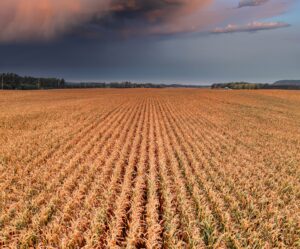
The era of abundant, affordable food may be giving way to a more expensive and unstable future.
For most of human history, a bad harvest meant hunger. Grain reserves were thin, transport was slow, and a single failed season in one region could not be offset by a surplus somewhere else. Famine was not a distant memory for most societies. It was a recurring event, sometimes only a few years apart.
That changed in the twentieth century, and it changed fast. New wheat and rice varieties bred to resist disease and respond to fertilizer pushed yields up several times over across Asia and Latin America. Synthetic nitrogen, first produced at industrial scale in the years after the First World War, gave farmers a way to feed soil that would otherwise have limited how much a field could grow. Tractors replaced draft animals. Diesel and cheap natural gas ran the machinery, the irrigation pumps, and eventually the fertilizer plants themselves. Trucks, railways, and later container ships turned food from a local matter into a global one, so a drought in one country no longer had to mean scarcity for its people.
The result was the cheapest, most abundant food supply in history. A shrinking share of income went to groceries in country after country. Shelves stayed full. Governments came to treat this as a background condition of modern life, something to be managed rather than worried about.
None of that was a natural state of affairs, though it came to feel like one. It depended on a specific set of resources all being cheap and available at the same time, fossil energy, fertile soil, open farmland, stable rainfall, and a trading system in which exporting countries kept exporting even in a lean year, and on nobody having to think much about any of them. For most of the twentieth century, these pressures took turns rather than arriving together, and even when several did coincide, as they briefly did in the oil shocks and grain shortages of the 1970s, the system had more slack in reserve to absorb the hit and recover. What’s different now is less that the pressures are showing up together for the first time and more that the slack itself has been used up. What follows is an account of a year, 2026, in which fertilizer, water, soil, labor, climate, and trade are each strained on their own terms, with less reserve left in any of them than the last time this happened.
The fertilizer problem
Modern yields do not exist without fertilizer, and fertilizer does not exist without energy. Nitrogen fertilizer in particular is a chemical translation of natural gas, since ammonia synthesis fixes gas-derived hydrogen into a form plants can use. Phosphate and potash add a second point of exposure, because their production is concentrated in a small number of countries, which means a disruption almost anywhere in that short list ripples through fertilizer markets everywhere else.
That structural fragility is not theoretical this year. Urea, the world’s most widely used nitrogen fertilizer, jumped 53.7 percent in a single month in March 2026, hitting $725.60 a ton, its highest level in four years, after conflict in the Middle East disrupted a shipping corridor that normally carries about a third of the world’s seaborne fertilizer trade. The World Bank’s April outlook projected urea closing out the year nearly 60 percent above 2025 levels and its broader fertilizer price index rising more than 30 percent for 2026 overall, with prices in some months since running even higher than that forecast anticipated. Because fertilizer purchasing decisions are made months before planting and can’t be reversed once a crop is in the ground, a price shock in the spring shows up in grocery aisles the following winter.
Energy runs underneath everything else
Fertilizer gets most of the attention because the link to natural gas is easy to explain, but it’s only one line item on a longer energy bill. Diesel runs the tractors and combines. Electricity or diesel runs the irrigation pumps, and pumping water from deeper wells takes more of it every year as water tables fall, as a rough rule of thumb, tripling the depth a pump has to lift water roughly triples the energy cost per gallon, all else equal. Refrigeration keeps produce and meat from spoiling between farm and store. Processing plants, packaging lines, and freight trucks all draw on the same energy markets that are becoming less predictable.
A 2026 industry analysis by the Consumer Energy Alliance, a trade group representing energy producers, put the range at 19 to 37 percent of total operating costs on American family farms depending on the crop and region, a figure worth treating as directional rather than precise, given who’s doing the counting, but broadly consistent with older USDA estimates that put energy-related expenses at a quarter or more of variable costs for field crops. On that basis, a two-dollar rise in diesel and natural gas prices can add tens of thousands of dollars a year to a single mid-sized farm’s bill, at a scale where most family farms operate on profit margins in the single digits. An expense that size doesn’t get absorbed quietly on a margin that thin. It gets passed forward, to the price on the shelf, or backward, into a farmer’s decision about whether planting a marginal field is even worth the diesel it would take.
Water running out from under the fields
Fertilizer can be a season’s problem, and energy prices eventually ease. Water is a harder case, because aquifers do not refill on a human timescale, and because farms are no longer the only ones drawing from them.
Punjab, one of the regions that made India self-sufficient in grain during the Green Revolution, shows what decades of intensive irrigation can do to groundwater. NASA’s GRACE satellite mission found that the region spanning Punjab, Haryana, and Rajasthan lost about 109 cubic kilometers of groundwater between 2002 and 2008 alone, a rate of roughly 18 cubic kilometers a year, more than double the estimated recharge from rainfall and irrigation return flow. India’s own Central Ground Water Board classifies close to four in five of Punjab’s assessment blocks as over-exploited, and a block-level assessment found that at current extraction rates, usable groundwater in the state’s hardest-hit districts could be gone within about two decades.
Punjab is not an outlier. It is a preview. Northern China, the American Great Plains, and parts of the Middle East are drawing down aquifers that took thousands of years to fill and won’t fill again within any farmer’s working life. And agriculture is no longer competing only against drought for that water. It is competing against growing cities, against industry, and against power generation, all of which have more political leverage in a shortage than a farm does. Groundwater has functioned as a savings account that agriculture has been overdrawing for decades. The bill does not come due gradually. It comes due when a well runs dry, or when a city upstream decides its taps matter more than a downstream farmer’s field.
The ground itself is wearing out
Two percent doesn’t sound like much. That’s roughly how much wider the gap gets between what farmland actually produces and what it could produce, for every 10 percent increase in land degradation, according to a University of Bonn-led study published in Nature Food this year, and in hotspots like northern India, northeastern China, and the American Midwest, that damage runs as high as 6 percent. Erosion, salt buildup, compaction from heavy machinery, the slow loss of organic matter: none of it makes headlines the way a drought or a war does, which is probably why soil gets less attention than water even though the underlying story is similar. Run the study’s math the other way and reversing degradation by that same 10 percent globally could, in principle, feed roughly 70 million more people without farming a single new acre. Separate FAO projections put the erosion toll alone at close to a 10 percent cut in global crop production by 2050 if nothing changes.
That reversibility cuts against a purely grim reading. Unlike a depleted aquifer, degraded soil isn’t gone for good, cover cropping, reduced tillage, and better nutrient management can rebuild it over years rather than centuries. The catch is that restoration takes sustained investment and time that a farmer already squeezed by thin margins doesn’t necessarily have, so the soil problem is less a fixed loss than a bill that keeps growing the longer it goes unpaid.
None of this happens through some dramatic event. It happens through erosion, compaction from heavy machinery, salt buildup in irrigated fields, and the slow loss of organic matter that once let soil hold water and nutrients on its own. Farmland that degrades doesn’t disappear. It just needs more fertilizer, more water, and more machinery to produce the same harvest it used to produce for less, which quietly raises the cost of every bushel grown on it.
A climate that no longer holds still
Farming has always depended on weather being predictable enough to plan around, even when any single year could go wrong. What’s changed is not just the average temperature but the reliability of the pattern itself. Heat arriving during flowering can cut a wheat crop’s yield even if the season’s total rainfall looks normal on paper, because crops are timed around an expected sequence of conditions rather than an expected total. A monsoon that shifts by two weeks can do as much damage as one that fails outright.
The economics of that instability are straightforward, if easy to overlook. Less certainty about yield means farmers, banks, and insurers all price in more risk. Crop insurance premiums rise. So does the cost of the irrigation backup, flood barriers, and heat-tolerant seed varieties farmers now need just to keep a bad year from becoming a ruinous one, money spent defending against a bad season rather than growing more in a good one, which is itself a quiet tax on every harvest whether or not the weather actually turns.
Layer that onto regions already under fertilizer or water stress and the damage compounds. The World Bank’s food security updates have tracked conflict and climate together as the primary drivers behind acute hunger: as of its most recent count, up to 67 million people are in need of food assistance in East and Southern Africa, and close to 53 million are projected to be acutely food insecure in West and Central Africa during the June-to-August 2026 lean season. Those aren’t abstract totals. They’re the visible edge of the same mechanism playing out everywhere else at a smaller scale, yield uncertainty translating into real cost, absorbed first by the households with the least room to absorb anything. What makes the current period different from past droughts or past floods isn’t any single event. It’s that regions are absorbing several of these pressures in the same growing season, with none of them held stable long enough to plan around.
Farming is running out of farmers
A fertilizer spike makes headlines. A demographic shift doesn’t, because nothing happens on any single day that you could point to. But the numbers, once you look, are hard to ignore.
In the United States, the world’s largest food exporter, the average age of farm producers reached 58.1 years in the most recent Census of Agriculture, and nearly four in ten farmers were over 65, up sharply from about one in three just five years earlier. In Japan, the average age in the sector has climbed past 66, and the workforce is shrinking as older farmers retire without anyone stepping in behind them. The pattern holds, with local variation, across most of the countries that anchor global food exports.
Farming is capital-intensive, physically demanding, and, for most people doing it, not especially profitable, so younger workers with other options are taking them. That has a direct cost mechanism: fewer entrants mean tighter labor markets and rising wages for the workers who remain, and it means land increasingly changes hands through consolidation rather than succession, with the buyer needing to finance both the purchase and the equipment at once.
It would be too simple to call this pure loss. The farms absorbing that land tend to be larger, more mechanized, and more productive per worker than the small operations they replace, which is part of why aggregate output hasn’t collapsed even as the number of farmers has. The real risk isn’t that food stops getting grown, it’s the erosion of redundancy: fewer, larger, more specialized operations mean a regional weather shock or a single farm’s financial failure has a bigger proportional effect on total supply than it would in a landscape of many smaller, more varied farms. Consolidation trades resilience for efficiency, and efficiency is easier to measure than resilience is to miss until the year you need it. Technology can offset some of this too. It cannot fully replace the accumulated, often unwritten knowledge of how a specific field behaves in a bad year, the kind of knowledge that disappears when a farmer retires and nobody has spent a decade learning that land alongside them.
When countries stop trading and start hoarding
A drought in one country used to more or less guarantee hunger there, back before global trade gave food a way to travel to wherever it was short. Grain grown in one place can reach a shortfall in another within weeks now. But that only works if exporting countries keep exporting even when their own harvest is tight, and that’s a political choice, not a natural feature of the market.
It’s a choice governments have shown they are willing to abandon under pressure. In May 2022, with global wheat markets already unsettled by Russia’s invasion of Ukraine, India banned wheat exports outright, citing food security concerns at home. A little over a year later, facing a domestic price increase of more than 30 percent, India restricted exports of non-basmati rice as well, cutting off a country that supplied around 40 percent of the world’s rice trade. Global rice prices jumped roughly 15 percent in the weeks that followed, and countries across Africa and Asia that depended on Indian rice had to scramble for alternatives. The ban wasn’t lifted until September 2024.
The logic is easy to understand from inside any one country: keep the harvest at home, protect voters from price spikes, worry about global consequences later. The problem is that every country making that choice during a shortage makes the shortage worse for everyone downstream who depends on trade rather than domestic production, which in turn makes the next exporting country more likely to restrict its own exports too. Importing countries aren’t passive in this either, many hold strategic grain reserves specifically to smooth over a bad year without panic-buying on the open market, and some, including several in the Gulf and North Africa, have leaned harder into long-term supply contracts and overseas farmland investment since 2022 precisely because they no longer trust the open market to deliver in a crunch. That kind of self-insurance works for countries that can afford it. It leaves the ones that can’t more exposed whenever a major exporter decides to close its own doors.
Cheap calories, expensive nutrition
One of the least intuitive facts about the current food system is that staple calories and healthy food are not moving in the same direction. Wheat, corn, and rice can often stay relatively cheap because decades of breeding and subsidy have gone into maximizing yield per acre for exactly those crops. Fruits, vegetables, fish, and high-quality protein haven’t had less investment so much as a harder set of constraints: they’re more perishable, more labor-intensive, and more exposed to the water and climate pressures already described, and they’re much less forgiving to store and transport across long distances. A field of wheat can sit in a silo for a year. A crate of strawberries has days.
The result is a widening gap between having enough calories to avoid hunger and being able to afford a nutritionally adequate diet. That gap falls hardest on lower-income households, who already spend a larger share of their income on food and have the least room to absorb price increases in exactly the items, like fresh produce, that matter most for long-term health. It’s possible, in other words, for a country to report falling hunger numbers by the calorie count and rising diet-related disease at the same time, because the two are being measured against very different baselines.
Can technology outrun the constraints
Precision agriculture, drought-resistant seed varieties, drip irrigation, and AI-assisted farm management are all real and are all helping at the margins. Gene-edited crops that tolerate heat or salt better than their predecessors are moving out of research stations and into commercial fields, a drought-tolerant maize variety can hold onto meaningful yield in a season that would have wiped out an older strain entirely. Some of this technology is aimed squarely at the soil problem too: cover cropping, reduced tillage, and better nutrient management can slow degradation, though restoring land that’s already worn out costs real money and takes years to pay off.
None of it is free, and none of it arrives instantly. New seed varieties take years of breeding and field trials before reaching a commercial farm. Precision irrigation systems cost money that a smallholder in a water-stressed region often doesn’t have. Technology has historically been very good at raising the ceiling on how much food a well-resourced farm can produce. It has been much less effective at protecting the floor for farmers who are already managing debt, aging equipment, and thin margins. The same smallholder in Punjab who can’t afford drip irrigation is the one with the least buffer against the aquifer running dry, the technology gap and the resource gap are hitting the same farms.
The grain is spoken for before it’s grown
So far this has mostly been a story about supply getting harder to produce. There’s a demand-side version too, and it’s easy to miss because it doesn’t show up as a shock. It shows up as a standing claim on the harvest before anyone eats a bite of it.
Livestock is the biggest piece. Somewhere between a third and just under half of the world’s cereal harvest is fed to animals rather than eaten directly, and as incomes rise and diets shift toward more meat and dairy, that share tends to grow rather than shrink, since it takes several pounds of grain to produce a single pound of beef. Biofuel policy adds a second claim, though the way it does is more specific than “biofuels are eating the corn crop.” Close to 40 percent of the US corn crop already goes into ethanol, and under EPA’s finalized 2026-2027 Renewable Fuel Standard, that specific number isn’t going up, the corn-ethanol mandate is being held flat at 15 billion gallons in both years, the same level as before. What’s actually growing is the total renewable fuel requirement around it, from 26.81 billion RINs in 2026 to 27.02 billion in 2027, and nearly all of that growth is aimed at biomass-based diesel and other advanced biofuels running on soybean oil and waste feedstocks rather than corn. The corn story here isn’t one of a mandate pulling in more grain each year. It’s that roughly 40 percent of the crop has been locked into fuel production for two decades running, at a scale large enough that it doesn’t need to grow further to keep pressure on the corn available for feed and export. A steady claim, once it’s large enough, doesn’t need to keep expanding to matter.
None of this is a hidden conspiracy. It’s a set of standing policy and market commitments that predate any given year’s harvest, which means that when a bad season does arrive, less of the crop is actually free to absorb the shock.
There’s a third claim on the harvest that’s harder to see because it never touches a silo: financial positioning in grain and fertilizer futures markets. Those markets exist to let farmers and buyers lock in prices ahead of a harvest, which is genuinely useful, but they also attract capital with no interest in eating or selling the underlying crop, just in trading the price swings. In a tight physical market, the kind fertilizer disruptions and drought create, that positioning can amplify a real shortage into a sharper price spike than the physical numbers alone would justify, then unwind just as fast once sentiment shifts. It’s a real contributor to volatility, though a genuinely difficult one to size precisely, since separating “the market pricing in a real risk” from “the market overreacting to it” is hard to do in real time and easier to see in hindsight.
A higher floor, not necessarily a higher ceiling
None of this points to global famine. Food supplies remain, by most measures, adequate in aggregate, and prices will still fall after a good harvest, the way they always have. What’s changing is the floor underneath those prices and the size of the swings above it.
2025 was already the third-most expensive year for food since the FAO started tracking its Food Price Index in the early 1990s, averaging 4.3 percent higher than 2024 and trailing only the price spikes of 2022 and 2011, and that was before this year’s fertilizer shock. The picture underneath that headline number is more mixed than it looks, though: FAO’s own data shows cereal prices actually ran about 5 percent below 2024 levels through 2025, with the overall index pulled up mainly by vegetable oils and dairy. That’s worth sitting with, because it means 2025’s story wasn’t yet one of broad staple-food inflation, it was a warning sign in specific categories, not a full-blown crisis in the grain that most people actually eat. Whether that holds through 2026 is close to the central question this article has been circling. As of the World Bank’s April 2026 outlook, urea prices were projected to close the year nearly 60 percent above 2025 levels, and that forecast assumed the Strait of Hormuz disruption wouldn’t drag on through the main planting seasons in the Southern Hemisphere and South and Southeast Asia. If it does, or if a comparable shock hits water, soil, or labor at the same time, next year’s Cereal Price Index, not just the broader food index, is the number to watch. That’s the one that would confirm whether the volatility has finally reached the staples, rather than circling around them.
Canada’s most recent food price forecast, for what it’s worth, still projects a further 4 to 6 percent increase in grocery costs between 2025 and 2026, which works out to close to a thousand extra dollars a year for an average family of four. Figures like that vary by country, currency, and local harvest, and shouldn’t be read as a universal law. What travels across all of them is the underlying tendency: fertilizer, water, soil, labor, climate, and trade all used to have enough give in them to absorb a bad year without permanently resetting the baseline. That give is narrowing, and the shocks hitting the system are becoming more frequent and more expensive to absorb, whether or not any single year’s grocery bill proves it.
