

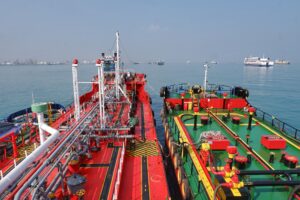
The Shadow Tanker Network Moving Sanctioned Oil Across the World
Lede: An Operational Composite at Sea
Maritime surveillance logs and regulatory enforcement reports document recurrent operational practices by which unmonitored crude transfers take place beyond territorial limits. In international waters, tankers maneuver into proximity, deactivating Automatic Identification System (AIS) transponders and connecting flexible hoses across cargo manifolds to transfer oil between shuttle vessels and larger ocean-going carriers before uncoupling to proceed along separate headings (OFAC Sanctions Advisory; DFAT). Regulatory enforcement reports have also documented cases in which accompanying shipping manifests were altered to obscure or misstate the cargo’s actual origin.
This offshore sequence reflects an operational composite drawn from enforcement actions on record rather than a single voyage. It illustrates the logistical mechanisms through which vintage tankers and commercial intermediaries transport sanctioned hydrocarbons across international waterways (Chatham House).
The composite also underscores an enduring dilemma for maritime governance: economic restrictions concentrated at Western financial and service chokepoints can incentivize the growth of an alternative shipping infrastructure that operates with diminished regulatory transparency and uncertain liability coverage.
I. Defining the Parallel Ecosystem: Regulatory Behavior Versus Criminality
The international maritime community maintains no single statutory definition or universal register for the dark fleet. In multilateral governance, the primary reference point is International Maritime Organization (IMO) Resolution A.1192(33), adopted in December 2023. The resolution defines the “dark fleet” or “shadow fleet” specifically as ships engaged in illegal operations to circumvent sanctions, evade safety or environmental regulations, avoid legitimate insurance costs, or conduct other unlawful maritime activities.
In commercial market analysis and energy trade monitoring, some commercial and analytical sources apply the terminology more broadly, using “shadow fleet” to encompass tankers transporting oil from sanctioned origins outside Western price-cap mechanisms, irrespective of whether a particular voyage breaches international law (see, e.g., analysis by Chatham House).
To maintain analytical rigor, shipping operations are best understood across distinct behavioral and compliance dimensions:
Table 1: Analytical Indicators in Maritime Energy Transport (Analytical categories based on documented industry reporting; not an official IMO classification)
Operational Dimension Conventional / Established Infrastructure Transitional / Mixed Infrastructure Opaque / Sanctions-Evasion Indicators
Ownership and Management Transparent corporate ownership; publicly listed or established private shipowners; verifiable beneficial ownership. Restructured or newly incorporated corporate entities operating in non-sanctioning commercial hubs. Single-vessel special purpose vehicles; shell entities; frequent alterations of registered managers and nominal corporate officers.
Flag Administration Traditional national flags and established open registries balancing regulatory compliance with commercial oversight. Open national registries offering commercial flexibility under varying degrees of international audit scrutiny. Frequent reflagging, rapid registry turnover, or repeated de-flagging across open registries following regulatory scrutiny.
Insurance Arrangements Mutual third-party liability cover through the International Group of P&I Clubs or established commercial marine insurers. Mixed non-Western underwriters, domestic commercial insurers, or state-backed guarantee mechanisms. Absence of verifiable P&I coverage; unrated underwriters; non-standard guarantees; or invalid insurance certificates.
Navigational Transparency Continuous AIS broadcasting; consistent voyage reporting; transparent port calls and verifiable cargo documentation. Periodic AIS interruptions attributable to verifiable technical faults or safety considerations; formal cargo documentation. Systematic AIS transponder deactivation; GNSS coordinate spoofing; repetitive offshore ship-to-ship transfers; altered cargo manifests.
No single indicator establishes illicit conduct or sanctions evasion in isolation; rather, maritime analysts and regulators evaluate patterns across corporate, flag, insurance, and navigational dimensions. In this analytical framework, certain indicators primarily signal corporate opacity or commercial counterparty risk, whereas specific deceptive practices constitute evidence of a regulatory or legal violation only when substantiated by verified operational and documentary evidence. A merchant vessel carrying crude oil is not inherently unlawful simply because it operates outside the jurisdiction of the United States, the European Union, or other G7 members. Sovereign states operating outside these regimes are generally not required under public international law to enforce foreign trade measures, absent a binding Chapter VII resolution from the United Nations Security Council or specific treaty commitments.
Violating a unilateral sanctions regime and violating international maritime law remain distinct legal concepts. Lawful trade conducted outside Western service networks becomes sanctions evasion when accompanied by specific deceptive or prohibited acts, such as falsifying cargo documentation, transmitting deceptive position coordinates, or using invalid insurance instruments in circumstances covered by applicable sanctions or maritime regulations.
II. The Architecture of Global Sanctions: Extraterritoriality and the Dollar
The growth of an alternative tanker fleet is rooted in the structural leverage of Western economic statecraft. Historically, much of the international tanker trade depended on maritime insurance, brokerage, and financial services concentrated in Western markets (DFAT; British Yearbook of International Law).
Western sanctions regimes have operated through several overlapping regulatory channels:
- Jurisdiction Over Domestic Persons: Prohibiting domestic citizens and corporations from financing, brokering, insuring, or facilitating designated commodity trades.
- Access to Domestic Financial Infrastructure: Restricting foreign banking institutions from accessing US dollar clearing facilities if they handle unauthorized transactions.
- Access to Covered Maritime Services: Conditioning access to Western marine insurance and reinsurance on compliance with regulatory price caps, alongside a separate pattern of reliance on Western vessel classification societies that is not itself contingent on price-cap compliance.
- Secondary-Sanctions Exposure: Threatening access restrictions against third-country enterprises that conduct substantial commercial transactions with designated entities.
Under secondary sanctions programs administered by the United States Department of the Treasury, foreign companies risk exclusion from US financial networks if they engage in transactions with designated targets, depending on the governing statutory authority and executive orders, even when transactions involve no US citizens, territory, or currency.
Sovereign Pushback and the European Blocking Statute
Secondary economic measures have generated persistent jurisdictional friction under international law. International legal scholars writing in the British Yearbook of International Law argue that conditioning access to international financial infrastructure to penalize third-party commerce conducted abroad tests customary jurisdictional principles and territorial sovereignty.
This friction is not confined to geopolitical rivals. The European Union maintains a dedicated legal mechanism to resist foreign extraterritorial jurisdiction: the EU Blocking Statute (Council Regulation (EC) No 2271/96). Enacted in 1996 and updated in 2018 following the US withdrawal from the Joint Comprehensive Plan of Action (JCPOA) with Iran, the regulation prohibits EU operators from complying with specified extraterritorial US measures listed in its Annex unless granted specific authorization by the European Commission under Article 5. Under Article 4 of the regulation, no judgment of a court or tribunal and no decision of an administrative authority located outside the Community giving effect to the listed extraterritorial measures is recognized or enforceable in the European Union. Furthermore, under Article 6, European operators are entitled to recover damages caused by the application of the specified extraterritorial laws from the entities or persons causing them.
Scholarly analyses in the British Yearbook of International Law observe that while states possess broad discretion to determine access to their domestic markets, secondary sanctions test the customary limits of extraterritorial jurisdiction by regulating foreign actors engaged in non-domestic conduct. Former United States Treasury officials have acknowledged that secondary sanctions operate as powerful economic tools precisely because foreign firms prioritize access to the US financial system over individual commercial opportunities abroad (Remarks of Secretary Jacob J. Lew).
III. Genesis and Evolution: From Regional Evasion to Industrial Scale
The operational practices characterizing the contemporary shadow fleet developed across distinct historical phases, evolving from regional sanctions evasion into an organized maritime trade.
Phase 1: The Iranian and Venezuelan Foundations
Prior to 2022, Iran and Venezuela developed logistics networks to counter comprehensive trade restrictions:
• The Iranian Precedent: To maintain crude exports following trade restrictions, documented patterns of maritime sanctions evasion emerged over several decades. Regulatory enforcement advisories describe recurrent practices that included disabling vessel transponders, conducting ship-to-ship cargo transfers in regional waters, and routing commercial documentation through intermediary entities in third-country trading hubs (OFAC Sanctions Advisory; DFAT). • The Venezuelan Precedent: Similarly, Venezuela’s state energy enterprise, Petroleos de Venezuela, S.A. (PDVSA), developed alternative marketing channels relying on debt-settlement and swap transactions, blending heavy crude grades, and engaging third-party commercial intermediaries to reach buyers abroad (U.S. Department of the Treasury). The physical enforcement of maritime sanctions was highlighted in early 2026 when US authorities seized two sanctioned tankers, Era (previously known as Marinera) and Lileo (previously known as Galileo), which subsequently received judicial authorization for scrap disposal, as reported by Reuters.
Phase 2: The 2022 Sanctions Shock and the Price-Cap Mechanism
The scale of alternative shipping shifted following Russia’s military intervention in Ukraine in February 2022. Prior to the conflict, Russia exported roughly 5 million barrels per day of crude oil and condensate, according to the International Energy Agency (IEA). European destinations were primary markets, receiving approximately 2.4 million barrels per day of Russian crude oil exports via pipeline and seaborne routes in 2021, out of Russia’s 4.7 million barrels per day of total crude exports, according to data from the International Energy Agency (IEA).
When European import bans and the G7-led Price Cap Coalition framework took effect in late 2022, covered Western maritime services were restricted for Russian seaborne crude shipments above the applicable price cap, subject to coalition rules.
The coalition framework underwent multiple regulatory revisions:
• December 2022: Initial crude price cap set at $60.00 per barrel by the G7 and EU coalition (European Commission). • July 2025: Under its 18th sanctions package, the European Union lowered the ceiling to $47.60 per barrel and introduced an automatic adjustment formula set 15 percent below prevailing market prices (European Commission). • February 1, 2026: The formula reduced the ceiling to $44.10 per barrel (European Commission). • July 2026: Under its 21st sanctions package, the European Union suspended the automatic adjustment mechanism until July 2027, with the stated objective of maintaining downward pressure on Russian crude export revenues and preventing Russia from benefiting from the exceptional market conditions caused by the closure of the Strait of Hormuz; the package also introduces an interim review to confirm that the suspension remains necessary and proportionate in light of market developments, as detailed in European Council and European Commission regulatory updates.
Because seaborne crude had to travel vastly longer maritime distances to reach alternative buyers in Asia, ton-mile demand expanded substantially. Commercial networks responded by acquiring aging second-hand tankers from the international sale-and-purchase market. Maritime researchers at Chatham House estimated in September 2026 that tankers operating outside Western service networks expanded to more than 1,300 vessels, representing roughly 18 percent of global tanker capacity, reflecting the scale of tonnage mobilized to handle re-routed energy flows.
IV. The Anatomy of a Dark Voyage: A Branching Composite Model
The journey of an oil cargo through shadow logistics channels involves multiple operational stages. While specific voyages vary considerably, an illustrative composite model shows how logistical pathways diverge:
Figure 1: Branching Composite Model of Alternative Crude Logistics (Analytical composite model based on documented maritime investigations; not all voyages utilize every technique)
                    [1. Wellhead Extraction & Terminal Loading]
                                         │
                   ┌─────────────────────┴─────────────────────┐
                   ▼                                           ▼
       [Conventional Route Option]                 [Alternative Route Option]
                   │                                           │
  - Direct commercial charter                 - Layered SPV corporate ownership
  - Standard national or open flag            - Flag migration across open registries
  - Continuous AIS transponder broadcast      - Conditional transponder deactivation / spoofing
  - Standard port-to-port voyage               - Offshore ship-to-ship lightering transfer
  - Standard origin cargo documentation       - Modified or alternative commercial paperwork
                   │                                           │
                   └─────────────────────┬─────────────────────┘
                                         │
                                         ▼
                     [2. Oceanic Transit & Coastal Discharge]
                                         │
                                         ▼
                     [3. Refining & Petroleum Distribution]
- Extraction and Dispatch: Crude oil is extracted and transported via pipeline networks to coastal export terminals.
- Terminal Loading: Tankers load cargo directly at maritime berths.
- Corporate Structuring (Documented in Some Cases): Vessel ownership is assigned to single-ship corporate entities incorporated in offshore jurisdictions, with technical operations managed from regional commercial hubs.
- Flag Alteration (Conditional): Vessel operators may transfer registration across other open registries, separating regulatory administration from beneficial ownership.
- Signal Obfuscation (Documented in Some Cases): Crews have, in some cases, turned off transponders or transmitted synthetic coordinates when loading in sensitive coastal zones.
- Offshore STS Lightering (Conditional): While ship-to-ship lightering serves standard commercial purposes such as cargo consolidation and draft management for deep-water transit, in sanctions-evasion operations it is utilized to obscure the continuous chain of custody or cargo provenance.
- Documentary Modification (Documented in Some Cases): Commercial intermediaries have, in some cases, issued shipping documentation that obscures or alters the stated cargo provenance.
- Long-Distance Oceanic Transit: The loaded carrier completes voyages through international sea lanes.
- Coastal Terminal Offloading: Tankers discharge at receiving refineries.
- Refining and Transformation: Chemical distillation converts crude into refined petroleum products. Substantial transformation principles are applied across many national customs systems to determine product origin; however, specific legal standards vary by jurisdiction and remain legally distinct from sanctions-origin compliance frameworks.
V. Digital and Physical Obfuscation: Tracking and Counter-Tracking
Documented sanctions-evasion operations employ practices designed to reduce digital maritime visibility.
AIS Disabling and GNSS Coordinate Manipulation
Under Chapter V, Regulation 19 of the International Convention for the Safety of Life at Sea (SOLAS, 1974), commercial vessels of 300 gross tonnage and upward on international voyages must maintain AIS in operation, subject to the safety/security exception under Regulation 19.2.4, which permits masters to suspend transmission when continuous operation would compromise vessel safety or security.
Two widely used methods of transponder manipulation are:
• Dark Operations: Turning off the transponder entirely during loading or transshipment, an evasion tactic highlighted in IMO Resolution A.1192(33) and advisories by the Australian Department of Foreign Affairs and Trade (DFAT). Signal gaps can create temporal anomalies in tracking datasets and trigger additional scrutiny from maritime analysts. • GNSS Coordinate Spoofing: Transmitting synthetic location data using specialized hardware. Enforcement advisories published by maritime regulators and intelligence analysts document vessels transmitting synthetic coordinates that place them loitering in open waters while physical observations confirm them loading at export berths (OFAC Sanctions Advisory; DFAT).
Analysts have reported using satellite tracking and imagery to identify discrepancies between digital transmissions and physical ship locations, though specific detection methodologies are not uniformly documented in public sources.
Offshore Ship-to-Ship Transfer Loci
In known sanctions-evasion cases, STS transfers can be used to obscure a cargo’s origin, destination, or chain of custody. While ship-to-ship (STS) lightering is a routine commercial practice used for cargo consolidation and draft management, transfer activity has been identified in several maritime regions cited in sanctions advisories, including waters off Southeast Asian transit straits and the Gulf of Oman (DFAT).
Because STS transfers are routine in legitimate commercial shipping, STS transfer itself does not establish unlawful behavior; establishing an infraction requires demonstrating underlying cargo provenance, financial illegality, or regulatory non-compliance.
VI. The Corporate Maze and Flag Registry Arbitrage
The resilience of parallel shipping networks relies on corporate fragmentation across multiple legal jurisdictions.
Figure 2: Illustrative Ownership Structure Observed in Shadow Tanker Operations (Analytical composite drawn from case investigations; not a universal ownership structure)
[Beneficial Owner / State-Linked or Private Intermediary]
                         │
                         ▼
        [Offshore Holding Entity / Nominee Trust]
                         │
                         ▼
     [Single-Ship Special Purpose Vehicle (SPV)]
         (Offshore Corporate Registry)
                         │
                         ▼
    [Technical and Commercial Ship Manager]
      (Regional Commercial Management Hub)
                         │
                         ▼
     [Operating Asset: Vintage Crude Tanker]
         (Registered under an Open Flag)
By registering individual hulls to separate special purpose vehicles, operators seek to separate assets across corporate entities. Analysts have suggested that when regulatory authorities designate a specific vessel, the underlying corporate structure may complicate wider enforcement actions against related corporate holdings, although the degree to which such fragmentation actually impedes enforcement outcomes in practice is not independently documented here.
Flag-State Mobility
Under the United Nations Convention on the Law of the Sea (UNCLOS), flag states exercise primary jurisdiction over the administrative, technical, and social aspects of ships flying their flag. Open registries allow foreign owners to register vessels regardless of their underlying nationality.
In documented cases, established registries have de-flagged vessels following regulatory or diplomatic pressure, prompting operators to seek registration with other open registries, including jurisdictions such as Gabon, the Cook Islands, and Palau, which have been noted in maritime compliance advisories (DFAT).
Among smaller open registries, Cameroon emerged as a notable flag for older tonnage. Maritime intelligence firm Windward reported that in early 2026, Cameroon-flagged ships represented approximately 13 percent of sanctioned tankers actively broadcasting an AIS flag by vessel count, before local authorities initiated regulatory reviews.
Flag changes do not in themselves violate maritime regulations; open registries are standard fixtures of global shipping. However, rapid and repeated reflagging across other open registries, especially when paired with changes in registered management, can be an indicator used by compliance monitors to flag potential sanctions circumvention.
VII. Competing Geopolitical Perspectives: Sovereignty, Security, and Coercion
Understanding alternative oil logistics requires analyzing the distinct legal, political, and strategic frameworks that shape state policies across competing capitals.
External and Economic Analysis of Russian Export Behavior
No direct official Russian statement is cited here; the following separates economic analysis, legal commentary, and sanctions-effectiveness research:
• External Legal Commentary: Legal scholarship in the British Yearbook of International Law observes that secondary sanctions test customary principles of extraterritorial jurisdiction and third-state sovereignty. • Macroeconomic Analysis: IEA data show the continuing importance of hydrocarbon exports to Russian revenues under external trade measures, reflecting general market data rather than a specific Russian fiscal disclosure. • Sanctions-Effectiveness Analysis: Separately, research published by the Brookings Institution in September 2026 examines the comparative effectiveness of US, EU, and UK shadow-fleet sanctions enforcement and secondary-sanctions deterrence. • International Legal Context (UN Position): The institutional position of the United Nations is codified in official records. On February 24, 2022, the United Nations Secretary-General declared that Russia’s military action violated the territorial integrity and sovereignty of Ukraine and conflicted with the principles of the UN Charter, a position reaffirmed in subsequent UN General Assembly resolutions.
Iranian Position and Regional Context
No primary Iranian diplomatic statement is cited here; the following reflects academic legal scholarship and regional-security analysis:
• Legal Objections to Unilateral Sanctions (Academic Characterization): Academic analyses, including scholarship in the British Yearbook of International Law, characterize Iranian objections to unilateral sanctions as framing oil export activities as responses to economic restrictions reimposed following the US withdrawal from the JCPOA, rather than under Chapter VII mandates from the UN Security Council. • Regional Security Environment: Maritime logistics operate within a regional environment characterized by security friction and military strikes, as analyzed by the UK Parliament, House of Commons Library, demonstrating that export operations face tangible security risks.
Western Policy Objectives and Critical Scholarship
Western governments justify sanctions regimes through distinct security and foreign policy objectives:
• Limiting Sovereign Military Revenues: Constraining fiscal resources available to finance military operations in Ukraine, as articulated in official coalition declarations (European Council). • Non-Proliferation and Regional Security: Restricting financial and technical resources supporting Iranian nuclear enrichment programs, disrupting procurement networks for ballistic missiles and unmanned aerial vehicles, and restricting funding channels for regional non-state armed groups (OFAC Sanctions Advisory, April 2025).
Legal scholarship in the British Yearbook of International Law and economic analyses from energy-importing economies highlight systemic friction generated by economic enforcement:
• Extraterritorial Jurisdiction: Secondary sanctions penalize third-country commercial actors that have no direct involvement in underlying geopolitical conflicts. • Logistical Friction: Longer shipping routes can increase transport costs and expose energy-importing economies to additional price volatility (UNCTAD). • Incentives for Financial Fragmentation: Financial exclusion can encourage affected states and commercial actors to develop alternative payment, insurance, and trading arrangements, reducing dependence on Western financial infrastructure (British Yearbook of International Law; RBA).
VIII. The Geography of Absorption: Refiners, Blenders, and Chokepoints
Alternative shipping networks persist because major industrial economies continue to purchase and process seaborne crude.
Major Absorption Markets
The People’s Republic of China
China remains a primary destination for crude originating in Russia and Iran:
• Independent Refineries: Located primarily in Shandong province, independent “teapot” refiners cater largely to the domestic market. Independent refiners themselves generally operate with limited direct commercial exposure to Western financial networks; this characterization reflects the structure of their domestic-facing business rather than a documented figure for Western-service dependence. Specific trading intermediaries and logistics entities supporting them, by contrast, have been subject to targeted designations by the Office of Foreign Assets Control (OFAC). • Bilateral Currency Settlement: RMB and local-currency settlement has expanded in bilateral trade involving China and sanctioned oil suppliers, particularly Russia and Iran, reducing reliance on dollar-based settlement in those transactions, though research by the Reserve Bank of Australia (RBA) observes that evidence for broad RMB settlement across global commodity markets remains largely concentrated in these bilateral exchanges.
The Republic of India
India’s crude procurement shifted considerably post-2022:
• Import Volumes: Reuters reported that in August 2026, Indian imports of Russian crude averaged approximately 2.1 million barrels per day, reflecting a 16.5 percent decline from July levels while keeping Russia as India’s top oil supplier during that period. • Commercial and Legal Frameworks: Indian refiners receive imported crude through a varied mix of commercial vessels (Reuters). When transactions avoid covered Western maritime services, they may fall outside the specific price-cap service restriction, though separate statutory measures may apply depending on transaction specifics. • Refined Product Trade: Indian refining complexes process imported crude into finished fuels for both domestic consumption and international export. Destination markets nonetheless enforce separate origin rules and sanctions compliance checks for finished fuels.
Critical Maritime Chokepoints
Tankers carrying restricted crude must navigate some of the world’s most heavily constrained waterways. Passages through shallow Baltic exits in the Danish Straits, congested traffic through the Turkish Straits, and high-density transits across the Strait of Malacca present ongoing navigational challenges.
The most critical maritime artery remains the Strait of Hormuz. According to the International Energy Agency (IEA), approximately 20 million barrels per day, representing roughly one-quarter of global seaborne oil trade, transited the strait in early 2026. Operating in these constrained corridors with disabled transponders or aging mechanical systems can increase safety and environmental exposure across shared maritime routes.
IX. The Insurance Deficit and Ecological Vulnerabilities
A major physical hazard associated with shadow tanker operations is structural: the decoupling of tanker operations from established maritime safety and liability regimes.
The Breakdown of Mutual P&I Insurance
For more than a century, maritime third-party liability risks have been managed by the International Group of P&I Clubs. Comprising 12 principal mutual underwriting associations, the International Group historically provided marine third-party liability cover for approximately 87 percent of global ocean-going tonnage, as noted in maritime guidance from the Australian Department of Foreign Affairs and Trade (DFAT). These clubs maintain pooled multi-layered reinsurance arrangements to cover substantial maritime liabilities, oil spill remediation, environmental clean-up, and wreck removal (DFAT).
Because International Group clubs operating under participating jurisdictions cannot provide covered maritime services for Russian crude sold above the applicable price cap, some operators rely on alternative, untested insurance arrangements:
• State-Backed Guarantees: Domestic underwriters such as the Russian National Reinsurance Company (RNRC) or Russian commercial insurers such as Ingosstrakh. • Commercial Non-IG Underwriters: Newly established underwriting entities incorporated in jurisdictions with untested claims-settlement capacity. • Potentially Fraudulent Documentation: Risks involving invalid or potentially fraudulent certificates of financial responsibility (Blue Cards) presented to maritime administrations to simulate compliance with IMO conventions (DFAT; IMO Resolution A.1192(33)).
Government bodies, including DFAT in its official maritime advisories, have warned that shadow-fleet tankers frequently carry unknown, untested, sporadic, or fraudulent insurance. In the event of a major marine casualty, coastal states face significant uncertainty over claims recoverability and liability limits, potentially complicating remediation and cleanup financing.
Technical Deterioration of Tonnage
Data published by the United Nations Conference on Trade and Development (UNCTAD) in its Review of Maritime Transport 2024 indicated that the shadow tanker fleet represented approximately 7.4 percent of the active global tanker fleet by vessel count, with an average vessel age of roughly 21 years, older than the general tanker fleet (UNCTAD).
While age alone does not establish unseaworthiness, older tonnage involves heightened maintenance, inspection, and structural survey requirements. Where vessels operate outside established classification societies or defer required drydock servicing, authorities face increased operational risks related to mechanical reliability, navigation safety, and casualty response.
The Environmental Reality: The Caroline Bezengi Incident
The environmental hazard of parallel shipping operations was demonstrated in 2026. The sanctioned crude tanker Caroline Bezengi, carrying an estimated cargo of Russian crude, reported difficulties off Yemen on June 8, with maritime security sources indicating an initial assessment of a blast, before subsequently grounding off the southern coast of Oman, as reported by Reuters.
At the time of Reuters’ August 10 report, the government of Oman reported that the resulting oil slick extended over nearly 400 square kilometers, threatening sensitive coastal marine ecosystems and artisanal fisheries. Reporting by Reuters noted that active salvage operations had not commenced weeks after the grounding, while questions surrounding the vessel’s insurance coverage and liability limits remained unresolved. The episode illustrated the additional complications that can arise when casualty response involves an opaque ownership structure and uncertain insurance coverage.
In a related modeling analysis, the Centre for Research on Energy and Clean Air (CREA) evaluated potential damage scenarios, estimating that a hypothetical major oil discharge from a laden shadow-fleet tanker transiting delicate maritime passages, such as the Baltic Sea or Danish Straits, could generate clean-up, environmental remediation, and economic liability costs reaching up to USD 1.6 billion.
X. Enforcement Evolution: From Administrative Blacklisting to Physical Interdiction
Western regulatory authorities have adapted their enforcement strategies from publishing administrative entity lists to targeting supporting maritime infrastructure and executing physical boardings.
Expanding the Regulatory Perimeter: The EU 20th and 21st Sanctions Packages
By April 2026, the European Union had designated 632 individual vessels under its shadow-fleet criteria. Under its 20th sanctions package, adopted April 23, 2026, the EU introduced mandatory due diligence requirements on tanker sales by European owners to third-country operators, including a mandatory contractual clause prohibiting onward transfer to Russia, to prevent commercial tonnage from migrating into unregulated trades (Council of the European Union). In July 2026, the Council of the European Union adopted its 21st sanctions package, adding 41 vessels to reach over 670 designated ships, and extending targeted measures to auxiliary service craft, including specialized bunkering vessels, tugs, and lightering support ships that facilitate offshore transfers, as detailed in official Council statements.
Physical Maritime Interdiction: The SMYRTOS Operation
On June 14, 2026, maritime enforcement expanded into physical interdiction. United Kingdom military and border forces boarded the tanker SMYRTOS, which the UK government classified as a sanctioned Russian shadow-fleet vessel, as it transited the English Channel, in an action confirmed by official UK government announcements.
The British government described the operation as the first UK-led boarding of an active Russian shadow-fleet vessel. The boarding represented an instance of physical maritime interdiction in European transit waters, marking a move from administrative designation toward physical interdiction.
Transatlantic Policy Divergence
Policy execution across Western capitals has exhibited notable divergence. An analysis published by the Brookings Institution on September 3, 2026, observed that while European nations and the United Kingdom substantially expanded individual vessel designations (with the EU sanctioning 671 ships and the UK listing 627 as of early September 2026), the United States administration had not sanctioned additional Russian shadow-fleet tankers since the prior administration. Brookings researchers characterized the US posture toward Russian shadow tankers as “substantially less aggressive” than European measures during that period, reflecting differing sanctions policy approaches across administrations.
XI. The Legal Framework: UNCLOS Jurisdictions and Coastal State Powers
Enforcement efforts against the dark fleet operate within the established framework of public international maritime law, primarily codified in the 1982 United Nations Convention on the Law of the Sea (UNCLOS). The convention establishes distinct legal regimes depending on the maritime zone and the nature of the vessel.
High Seas Jurisdiction and the Right of Visit
On the high seas, the foundational principle is codified in UNCLOS Article 92: ships are subject to the exclusive jurisdiction of the flag state, save in exceptional cases expressly provided for in international treaties (UNCLOS Article 92). A warship cannot lawfully stop or board a foreign merchant ship on the high seas simply on suspicion that the ship is carrying oil in contravention of unilateral economic sanctions, because unilateral sanctions do not themselves create a high-seas right of visit under general international law.
The exceptions permitting a warship to board a foreign merchant ship on the high seas are strictly circumscribed under UNCLOS Article 110 (the Right of Visit) (UNCLOS Article 110):
- Universal Treaty Crimes: Acts of piracy, slave trade, or unauthorized broadcasting.
- Nationality and Flag Irregularities: A ship flying a foreign flag or refusing to show its flag, but in reality being of the same nationality as the inspecting warship.
- Stateless Vessels: A vessel reasonably suspected of being without nationality may be subject to the Article 110 right of visit, allowing an inspecting warship to send a boat to verify the ship’s documents.
Territorial Waters and the Scope of Innocent Passage
Within territorial seas (up to 12 nautical miles from the baseline), coastal state sovereignty is qualified by the Right of Innocent Passage under UNCLOS Article 17 (UNCLOS Article 17). Foreign merchant vessels enjoy the right of continuous and expeditious transit through territorial waters.
Under UNCLOS Article 19, passage remains innocent so long as it is not prejudicial to the peace, good order, or security of the coastal state (UNCLOS Article 19). While Article 19 identifies willful and serious pollution contrary to the convention as non-innocent, coastal states face legal constraints under international law in detaining vessels on the prospective concern that advanced vessel age, unrated insurance, or opaque ownership might cause an accident in the future.
Port State Control and Coastal Enforcement Powers
Coastal and port states exercise distinct statutory authorities under separate articles of UNCLOS:
• Port State Enforcement (UNCLOS Article 218): When a vessel is voluntarily within a port or at an offshore terminal of a state, that state may undertake investigations and institute proceedings in respect of any discharge from that vessel outside the internal waters, territorial sea, or exclusive economic zone of that state in violation of applicable international rules established through the competent international organization. • Coastal State Enforcement in Territorial Waters (UNCLOS Article 220(2)): Where there are clear grounds for believing that a vessel navigating in the territorial sea has violated national environmental laws or international discharge standards, the coastal state may undertake physical inspection and, where warranted by evidence, institute proceedings including vessel detention. • Coastal State Enforcement in the EEZ (UNCLOS Article 220(3), (5), and (6)): In the exclusive economic zone, the enforcement threshold is graduated: – Under Article 220(3), clear grounds of a violation allow the coastal state to require the vessel to provide identity, port of registry, and voyage information. – Under Article 220(5), if the vessel refuses information or gives false information, and the violation resulted in a substantial discharge causing significant pollution, the coastal state may undertake physical inspection. – Under Article 220(6), only where there is clear objective evidence that a vessel committed a violation resulting in a discharge causing major damage or threat of major damage to the coastline or related resources may the coastal state institute proceedings, including detention. • Coastal State Intervention Following a Casualty (UNCLOS Article 221): Coastal states possess the explicit right under international law to take and enforce measures beyond the territorial sea proportionate to actual or threatened damage to protect their coastline or related interests from pollution following upon a maritime casualty or acts relating to such a casualty. • Enforcement Safeguards (UNCLOS Articles 224–226): UNCLOS requires that enforcement powers against foreign vessels may only be exercised by warships or authorized government craft (Article 224), must not endanger navigation or expose vessels to safety risks (Article 225), and must not unduly delay foreign vessels during physical inspections (Article 226).
Legal scholars in the British Yearbook of International Law note that whether Article 221 permits preemptive interdictions before a physical casualty or distress incident occurs remains an active debate. Outside established treaty exceptions, flag-state consent, binding Security Council mandates, or demonstrable discharge violations within covered waters, offshore interdictions require separate justification under international law.
XII. The Dimensions of Economic Spillover
When trade restrictions constrain established supply corridors without extinguishing global demand, economic statecraft produces measurable commercial incentives. Analytically, these developments are best understood by distinguishing between underlying economic mechanisms, their potential market consequences, and independently observed macroeconomic movements.
Economic Mechanisms and Potential Market Effects
- The Asset Residual Mechanism:
- Economic Mechanism: Older crude tankers that might otherwise face demolition at shipbreaking facilities can retain or gain commercial value in the second-hand sale-and-purchase market, extending the operating life of vintage tonnage (UNCTAD).
- Potential Market Effect: Increased acquisition demand for older tonnage can elevate valuations for older tanker tonnage, deferring vessel demolition cycles (UNCTAD).
- The Freight and Ton-Mile Mechanism:
- Economic Mechanism: Re-routing crude over substantially longer maritime corridors, such as shifting Baltic exports from European ports to Asian refiners, expands global ton-mile transport requirements (IEA).
- Potential Market Effect: Expanded ton-mile demand absorbs commercial carrying capacity, which can influence charter rates and shipping freight costs across wider tanker segments.
- The Intermediary Arbitrage Spread:
- Economic Mechanism: The pricing discount on crude acquired from sanctioned producers relative to prevailing international benchmarks creates commercial margin differentials.
- Potential Market Effect: Those spreads can provide intermediaries and logistics operators with additional margins to compensate for the transactional, financing, insurance and sanctions-related risks of serving restricted trades.
Independently Observed Market Movements and Geopolitical Expenditures
Economic restrictions and maritime disruptions also coincide with broader financial movements across energy markets and government expenditures:
• Global Benchmark Volatility: Geopolitical tensions and maritime friction in key transit areas influence international crude pricing. In September 2026, Reuters reported Brent crude trading near $100 per barrel amidst tensions in the Middle East and tight transportation logistics, though benchmark movements reflect wide macroeconomic variables rather than discrete sanctions enforcement. • Domestic Refining and Transportation Costs: Broader energy-market and transportation disruptions also fed through to retail fuel prices. In late 2026, Reuters reported that United States retail diesel prices exceeded $6.00 per gallon, elevating freight and logistical costs across the domestic economy. • Broader Regional Defense Expenditures: Broader regional military operations also involve substantial public expenditure. In September 2026, Reuters reported that the Congressional Budget Office (CBO) estimated Department of Defense military operations associated with regional armed conflict in the Middle East theater had cost approximately $38 billion through August 1, 2026, with costs projected to rise by roughly $3 billion per month. These figures demonstrate broader regional defense expenditures, not costs attributable solely to shadow-fleet sanctions enforcement.
XIII. The Structural Feedback Loop: Sanctions and Parallel System Creation
The extensive use of financial sanctions can create incentives for market participants to construct alternative trading infrastructure designed to operate independently of Western regulatory control.
When access to the US dollar and Western maritime services is conditioned on compliance with foreign policy objectives, targeted states and non-aligned commercial actors may seek to insulate their commerce against external regulatory vulnerability. Over time, this adaptation process fosters alternative commercial channels:
Figure 3: One Possible Adaptation Pathway (Analytical adaptation pathway; market conditions, enforcement intensity, buyer preferences, available insurance, and geopolitical developments can interrupt or alter the sequence)
[Imposition of Trade and Financial Sanctions]
                     │
                     ▼
[Exclusion from Western Tankers, Insurers, and Currencies]
                     │
                     ▼
[Commercial Adaptation: Alternative Fleets, Reinsurance, and Non-Dollar Clearing]
                     │
                     ▼
[Buyer Demand from Energy-Intensive Developing Markets]
                     │
                     ▼
[Diminished Regulatory Visibility for Enforcing States]
                     │
                     ▼
[Regulatory Escalation: Auxiliary Sanctions and Physical Interdictions]
This structural dynamic was recognized by senior policymakers during the development of modern sanctions tools. In an address at the Carnegie Endowment for International Peace on March 30, 2016, former United States Treasury Secretary Jacob J. Lew cautioned that if sanctions make the international business environment overly complicated or legally uncertain, foreign enterprises and financial institutions will seek alternatives outside the US financial system, warning that overusing sanctions could ultimately erode American financial reach (Remarks of Secretary Jacob J. Lew).
While Secretary Lew was addressing broader economic statecraft rather than predicting the modern dark fleet, his warning identified the underlying vulnerability of chokepoint-based economic enforcement. In maritime energy transport, commercial adaptation has manifested through non-dollar settlement channels, domestic reinsurance arrangements, and other open registries, enabling alternative commercial networks to transport large volumes outside covered Western maritime and financial service networks.
XIV. Conclusion: The Emergence of a Fragmented Maritime Order
The growth of the shadow tanker fleet signals an observable structural fragmentation of international maritime energy transport. Observed market patterns point to increasing segmentation within parts of global seaborne oil transport, particularly in trades exposed to sanctions, rather than the complete dissolution of the integrated maritime order.
International oil shipping operates along an evolving spectrum of compliance, ownership transparency, and dependence on Western services: ranging from established operators utilizing traditional flags and International Group insurance, to commercial intermediaries navigating mixed regulatory frameworks, to highly compartmentalized vessels frequently used in sanctioned trades with reduced dependence on Western maritime and financial services.
Analysis suggests that the shadow fleet represents a market adaptation by state-linked actors and private commercial intermediaries navigating an increasingly fragmented geopolitical landscape. The central unresolved policy challenge is no longer simply whether sanctions can stop sanctioned oil from moving. It is whether enforcement can remain effective without encouraging a maritime infrastructure that operates with reduced dependence on established safety, insurance, and compliance standards, potentially increasing physical and environmental risks across shared waterways.
Reference and Documented Source Register
- Multilateral Governance and Legal Treaties:
- International Maritime Organization: Resolution A.1192(33): Urging Member States and All Relevant Stakeholders to Promote Actions to Prevent Illegal Operations in the Maritime Sector by the “Dark Fleet” or “Shadow Fleet” (December 6, 2023)
- International Maritime Organization: International Convention for the Safety of Life at Sea (SOLAS), 1974
- United Nations: United Nations Convention on the Law of the Sea (UNCLOS) Full Treaty Text (1982)
- United Nations: Statement by the Secretary-General Regarding Ukraine (February 24, 2022)
- United Nations Conference on Trade and Development: Review of Maritime Transport 2024: Navigating maritime chokepoints
- Official Government Records and Legal Statutes:
- Council of the European Union: EU adopts 20th package of sanctions against Russia (April 2026)
- Council of the European Union: EU adopts 21st package of sanctions against Russia (July 2026)
- European Commission: Council Regulation (EC) No 2271/96: Protecting against the effects of the extra-territorial application of legislation adopted by a third country (EU Blocking Statute)
- European Commission: Oil price cap: Questions and Answers on restrictive measures (2026)
- United States Department of the Treasury, Office of Foreign Assets Control: Sanctions Advisory: Guidance for Shipping and Maritime Stakeholders (April 16, 2025)
- United States Department of the Treasury, Office of Foreign Assets Control: Alert: Sanctions Risk of Dealing with Teapot Oil Refineries (April 28, 2026)
- United States Department of the Treasury: Treasury Dismantles Key Elements of Iran’s Energy Export Machine (October 9, 2025)
- United States Department of the Treasury: Remarks of Secretary Jacob J. Lew at the Carnegie Endowment for International Peace (March 30, 2016)
- United Kingdom Government: UK forces board sanctioned tanker SMYRTOS in English Channel (June 14, 2026)
- Australian Department of Foreign Affairs and Trade (DFAT): Maritime Advisory: Mitigating Risks Associated with Shadow Tanker Operations (2024)
- United Kingdom Parliament, House of Commons Library: Middle East strikes and retaliation: Timeline and legal context (Research Briefing CBP-10292, 2025)
- Quantitative Maritime and Energy Datasets:
- International Energy Agency (IEA): Russian Supplies to Global Energy Markets (2024)
- International Energy Agency (IEA): The Strait of Hormuz in the Global Energy Market (Factsheet, February 2026)
- Reserve Bank of Australia (RBA): Developments in RMB Internationalisation (Bulletin, August 2026)
- Centre for Research on Energy and Clean Air (CREA): Ensuring an Ecological Disaster: How Shadow Tankers Threaten Coastal States (2024)
- Windward Maritime AI: Cameroon pledges crackdown on ship registry flagging 13% of dark fleet tankers (2026)
- Investigative Journalism and Industry Reporting:
- Reuters: Oil steady near $100 a barrel as Middle East tensions simmer (September 22, 2026)
- Reuters: Record diesel prices could be Trump’s Achilles’ heel (September 18, 2026)
- Reuters: US military operations in Middle East cost $38 billion through August, CBO says (September 15, 2026)
- Reuters: India’s Russian oil imports drop 16.5% in August to 2.1 mln bpd, data shows (September 22, 2026)
- Reuters: Oil slick off Oman grows to 400 sq km from damaged tanker Caroline Bezengi (August 10, 2026)
- Reuters: US seizes sanctioned tankers Marinera and Galileo, court documents show (August 10, 2026)
- Academic Research and Policy Scholarship:
- British Yearbook of International Law: Secondary Sanctions: A Weapon Out of Control? The Legality of Extraterritorial Measures in International Law (2020)
- Chatham House: Will the oil-tanker shadow fleet ever be brought back into line? (September 2026)
- Brookings Institution: The fading efficacy of US shadow fleet sanctions (September 3, 2026)
