

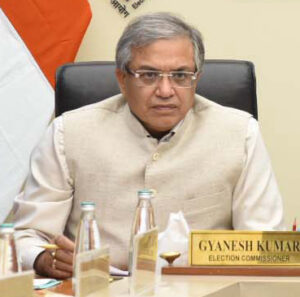
Fourteen objections by two Election Commissioners raise a deeper question about who really controls India’s electoral watchdog.
I. Fourteen Objections. One Commission.
On September 23, 2026, The Indian Express published an investigation based on internal file notings and correspondence of the Election Commission of India (ECI). According to the records the newspaper examined, Election Commissioners Dr. Sukhbir Singh Sandhu and Vivek Joshi recorded written objections at least 14 times over ten months to decisions, directives and administrative orders issued under Chief Election Commissioner (CEC) Gyanesh Kumar. On one day, four objections were placed on record.
The objections covered the mechanics of fresh voter registration, the criteria for deletions and restorations, the centralised software that manages the national electoral roll, the allocation of work within Nirvachan Sadan, and the authorisation of legal appeals arising from the Special Intensive Revision (SIR). In several notes, the two Commissioners recorded that circulars and operational steps had gone ahead without their knowledge or approval. Some notes were marked to Kumar. On July 29, 2026, both wrote separate letters to Cabinet Secretary T. V. Somanathan, citing violations of statutory governance. Between May and August, the report says, the three-member Commission held no formal meeting. It met as a full bench next on September 9.
In its September 23 statement, the Commission said differing views and observations are a normal part of deliberation before policy is finalised. It said many of the notes were drafting-stage exchanges, and that decisions of the past year, including decisions relating to the SIR, were unanimous decisions of the full Commission.
When two members of a three-member constitutional body repeatedly record that consequential steps were taken without their knowledge or approval, and the institution says its final decisions were unanimous, the dispute is about how power is exercised inside the Commission. The article contains three separate questions. The first is personal allegiance: does the CEC act for the ruling party? The second is structural independence: does the law that selects Commissioners insulate them from the executive? The third is collective governance: does the Commission decide as a body, as the law requires? The documents bear most directly on the third. They do not establish the first, and the second is now before the Supreme Court. One episode in Goa makes the institutional issue concrete: local Electoral Registration Officers (EROs) found 97 voters eligible, the state election machinery sent eight communications seeking the means to reverse their earlier deletions, and all 97 remained absent from the final roll when checked months later. The article therefore asks how power is actually exercised within India’s electoral watchdog, and whether its operational machinery is consistent with the collective decision-making framework established by law.
II. What the Law Actually Requires
Article 324 vests the superintendence, direction and control of electoral rolls and the conduct of elections in the Election Commission. Article 324(2) provides for a Chief Election Commissioner and such other Election Commissioners as the President may fix. Under Article 324(3), when other Commissioners are appointed, the CEC acts as Chairman. The Constitution therefore gives the CEC the chairmanship of a multi-member Commission, while Parliament’s statutory framework determines how the Commission’s business is transacted.
The Supreme Court addressed this in T.N. Seshan v. Union of India (1995), a challenge brought by a sitting CEC who contested the appointment of two additional Commissioners. The Court upheld the multi-member Commission and recognised that the CEC has a distinct position within it, including special protection of tenure and the role of Chairman. But it also made clear that the CEC cannot eclipse the Commission: the other Commissioners form part of the constitutional body and must have a say in its decision-making, and the CEC’s individual view does not become the decision of the Commission merely because he is Chairman.
Parliament restated the working rules in the Chief Election Commissioner and other Election Commissioners (Appointment, Conditions of Service and Term of Office) Act, 2023. Section 18 provides three things:
- The Commission may regulate its own procedure and allocate business among its members by unanimous decision.
- Its business shall, as far as possible, be transacted unanimously.
- Where the CEC and other Commissioners differ in opinion on a matter, the matter is decided according to the opinion of the majority.
Section 18 makes a distinction that matters here. A written objection by two Commissioners does not by itself amount to a formal majority decision. But if the Commission differs in opinion on a matter, the Act provides that the matter is to be decided according to the majority. And allocation of business among the members itself requires unanimous decision. The significance of the 14 objections therefore depends on a factual question that the documents and the Commission’s response leave contested: were the disputed actions merely draft-stage administrative steps, as the ECI says, or were they operative exercises of Commission business undertaken without the required collective approval?
III. Where the Objections Landed
Form 6. In May 2026, according to the investigation, Joshi red-flagged changes linked to Form 6, the prescribed application for new voter registration. He recorded that Form 6 could not be altered in this manner without amending the Registration of Electors Rules, 1960, a position Sandhu later supported. The report says an additional declaration tied to the SIR was built into the digital registration workflow, asking applicants to indicate whether their own name, a parent’s or grandparent’s name, or neither appeared in electoral rolls from the earlier SIR period; applicants could not proceed without answering it. Sandhu recorded that the change was “unauthorised” and “illegal” and directed that it be rescinded immediately.
The ECI disputes the characterisation. Officials say the statutory Form 6 was not amended, and that the declaration is a separate requirement issued under the SIR order, within the Commission’s power to verify eligibility. The disagreement therefore turns on whether imposing the supplementary declaration through the digital registration process amounted to changing the legal conditions for enrolment without the formal rule amendment that Joshi and Sandhu said was required. The reporting does not cite a court ruling that has resolved that question.
The Cabinet Secretary. On July 28, 2026, an internal order reallocated work portfolios across the Commission’s administrative and information technology divisions. The next day, Sandhu and Joshi wrote separately to Cabinet Secretary Somanathan, recording that the order violated Section 18 of the 2023 Act. On July 30, the two jointly issued an order rescinding the reallocation and directing that the earlier arrangement continue until the full Commission could deliberate. The sequence shows that the dispute moved beyond internal file notes to direct correspondence with the Cabinet Secretary and a subsequent order by the two Commissioners restoring the previous arrangement until the full Commission could deliberate.
West Bengal. The SIR in West Bengal produced extensive litigation. According to the report, Sandhu asked three questions in writing. Who authorised appeals in the ECI’s name against orders that had upheld voter inclusions? Who drafted and executed the petitions? Why had neither the full Commission nor West Bengal’s Chief Electoral Officer been informed? The Commission says its legal filings followed established operational protocols. The record as reported leaves open who authorised them.
IV. When Software Becomes Authority
The ECI manages electoral rolls through centralised software platforms, including ERONet and ECINet. In his notings, Joshi cautioned against what he called the “gradual centralisation” of the electoral database under the Commission’s IT division in New Delhi. EROs exercise statutory functions in preparing and revising rolls under the Representation of the People Act, 1950, within the Commission’s broader supervisory framework under Article 324. In practice, that work involves issuing notices, examining documents, hearing claims and passing reasoned orders. Sandhu recorded that field officers had reported their access to ERONet being constrained or overridden by central configurations, and asked what authority the central IT leadership had to limit those officers’ discretion.
The dispute does not concern the Commission’s supervisory authority over the rolls. It concerns how central IT controls interact with the functions the statute assigns to EROs. The Goa rollout, as reported, shows what that interaction can look like:
- Goa’s EROs examined the cases of 97 voters marked for deletion and found all 97 eligible for inclusion in the final electoral roll.
- Between February 11 and 17, Goa’s Chief Electoral Officer sent eight communications to ECI headquarters seeking the technical facility to reverse the earlier deletions. In the eighth communication, sent four days before publication of the final roll, the state office said the earlier decisions “have to be reversed”.
- The EROs could not reverse those decisions through ECINet because the permission to do so was controlled from Delhi. The next day, the ECI’s Deputy Election Commissioner directed its IT division to facilitate publication according to the decisions taken by the EROs and Assistant EROs.
- The final electoral roll was published on February 21. The Indian Express subsequently checked all 97 names and reported on September 24 that all 97 were still missing from the roll as of September 20. Goa’s Chief Electoral Officer said there had to be a mechanism in ECINet for EROs to re-include voters at their level.
The episode gives concrete form to the Commissioners’ concern. Local EROs had examined the cases and found the 97 voters eligible for inclusion; the state election machinery repeatedly sought the technical means to implement the earlier decisions; and the voters nevertheless remained absent from the final roll. The episode therefore raises a specific question about whether centrally administered digital systems can, in practice, constrain the implementation of decisions made by officials exercising statutory functions. One episode does not settle that question, and the Commission’s answer to it appears in Section VI. The record therefore shows an implementation gap; it does not by itself establish that the central software overruled a legally final ERO order.
V. The Appointment Problem
The strain inside Nirvachan Sadan sits within a contested framework for selecting Commissioners. In March 2023, a five-judge Constitution Bench in Anoop Baranwal v. Union of India observed that an election commission beholden to the executive undermines constitutional democracy. Until Parliament legislated, it directed that appointments be made by a committee of the Prime Minister, the Leader of the Opposition in the Lok Sabha and the Chief Justice of India.
In December 2023, Parliament enacted the 2023 Act. Under Section 7, the selection committee comprises the Prime Minister as chairperson, the Leader of the Opposition or leader of the largest opposition party in the Lok Sabha, and a Union Cabinet Minister nominated by the Prime Minister. The Chief Justice is no longer a member. The structure gives the Union government two representatives on the three-member selection committee. Whether that arrangement is consistent with the constitutional requirement of an independent Election Commission is now before the Supreme Court.
Gyanesh Kumar and Sukhbir Singh Sandhu were appointed Election Commissioners in March 2024. Kumar became CEC on February 19, 2025, after Rajiv Kumar retired, and Vivek Joshi joined the Commission in February 2025, all under the framework created by the 2023 Act.
On September 23, 2026, a two-judge bench of Justices Dipankar Datta and Satish Chandra Sharma split over whether the challenge to the 2023 law warranted reference to a larger bench. Justice Datta rejected the request, while Justice Sharma favoured it. The matter will now be placed before the Chief Justice of India for consideration of a bench of appropriate strength. Justice Datta wrote that the Commission must not only be independent but be seen to act independently. He considered the constitutional principles involved sufficiently settled to decide the challenge without a larger bench, while Justice Sharma regarded the validity of the new mechanism as a constitutional question warranting consideration by a larger bench. The Court has not decided the law’s validity.
Nothing in these facts establishes political bias by any individual Commissioner. The relevant institutional question is whether the appointment framework provides sufficient insulation from executive influence, an issue now before the Supreme Court.
VI. The Commission’s Defence
The Commission’s position, set out in its September 23 statement and reiterated in subsequent reporting, deserves its strongest form. It makes six arguments.
- Deliberation, not dissension. The ECI says file notes recording skepticism and reservations are a normal part of institutional deliberation and that robust debate precedes policy.
- Preliminary exchanges. The ECI says many of the 14 notes came during early drafting of technical manuals and circulars, not against finalised Commission orders.
- Unanimity. The ECI asserts that decisions of the full Commission over the past year, including decisions relating to the SIR, were unanimous.
- The wider record. The ECI says that focusing on 14 notes over ten months presents only part of the picture and points to around 40 new initiatives, along with other decisions, instructions and electoral reforms, saying these were the outcome of unanimous decisions of the full Commission.
- Security. The ECI says centralised controls, audit trails and automated safeguards on ECINet protect against unauthorised tampering, manipulation and database corruption.
- Statutory powers intact. The ECI says EROs and District Election Officers continue to exercise their statutory powers under the 1950 Act, while its IT systems provide the supporting infrastructure.
The Goa episode provides the most concrete test in this article of that defence. The ECI says its IT systems provide the supporting infrastructure and that statutory powers remain with the EROs. Yet the reported sequence is that the EROs examined the 97 cases and found the voters eligible, the state election machinery sent eight communications seeking the means to reverse the earlier deletions, and the voters remained absent from the final roll. The evidence does not establish that the software itself made the legal decision. It does establish a gap between the decisions reached by the field officers and their implementation in the electoral database.
The Commission’s position also rests on the Supreme Court’s May 27, 2026 judgment upholding the legality of the SIR undertaken in Bihar, and recognising the ECI’s authority under Article 324 and Section 21(3) of the Representation of the People Act, 1950. That ruling establishes the Commission’s legal authority to conduct the exercise. It does not by itself resolve the separate questions raised here about internal authorisation, software implementation, individual voter cases or how objections within the Commission were handled. On the scale of SIR removals, the Commission has said that draft-roll deletions include entries it classifies as absent, shifted, deceased or duplicate, subject to claims and objections.
VII. Who Controls the Watchdog?
The three questions from Section I can now be answered separately.
Personal allegiance. The available documents do not establish that Gyanesh Kumar acts on behalf of the ruling party. Administrative disagreement or centralisation of bureaucratic functions is not, by itself, evidence of partisan subservience.
Structural insulation. The 2023 Act gives the Union government two representatives on the three-member selection committee. The two Supreme Court judges hearing the challenge differed on whether a larger bench was warranted, but the matter has been placed before the Chief Justice for constitution of a bench of appropriate strength. Justice Datta has also said the ECI must not only be independent but appear to be independent.
Collective governance. Here the documentary record is most direct, and the Commission’s defence leaves several questions open:
- If the final decisions were unanimous, through what formal process were the disputed actions authorised during the period when, according to the report, the full Commission did not formally meet between May and August?
- Section 18 provides that allocation of business among the Commissioners may be made only by unanimous decision. On what basis was the July 28 order issued, which the two Commissioners say lacked their concurrence?
- Under whose authority were the West Bengal appeals filed in the Commission’s name, and why, on Sandhu’s account, were the other members not informed?
- Why did the Goa EROs’ findings that 97 voters were eligible for inclusion not result in their names appearing in the final roll, despite eight communications from the state election machinery seeking the facility to reverse the earlier deletions?
- How were the objections to the SIR-linked declaration resolved before the additional requirement was incorporated into the digital registration process?
The Commission’s answer is that the notes were part of ordinary deliberation and that the final decisions were unanimous. The available reporting establishes that the notes existed and records the concerns raised by the two Commissioners, but it does not independently establish how every objection was resolved or whether every disputed step was ultimately authorised through the Commission’s formal decision-making process. Former CEC S.Y. Quraishi observed in The Indian Express that the Election Commission is not another name for its chief.
The documents do not establish whether the Chief Election Commissioner serves the government of the day. They establish something narrower and more concrete: two of the three Commissioners repeatedly recorded objections about how important electoral decisions and systems were being handled. In Goa, 97 voters were found eligible by local officers, eight communications sought the means to reverse their earlier deletions, and all 97 remained absent from the final roll when checked months later. The ECI says the disagreements were part of normal deliberation and that final decisions were unanimous. The unresolved institutional questions are therefore concrete: how were the objections resolved, through what process were disputed actions authorised, and did that process provide all three Commissioners the collective role contemplated by the law? The available record does not resolve them conclusively. It establishes why the process by which those decisions were made remains an unresolved institutional question.
