
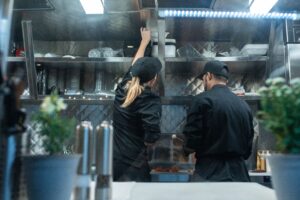
How virtual brands transformed a single cooking operation into a crowded marketplace of digital restaurants.
I. The Address Behind the Screen
The easiest way to understand how food delivery platforms transformed the restaurant business is not to read the menu. It is to check the address.
Open DoorDash, Uber Eats, or Grubhub in a dense commercial district, and the app presents an expansive list of dining choices. Within a two-mile delivery radius, search results display an artisan smash-burger counter, a specialty chicken tender brand, a late-night pasta kitchen, and a dessert shop. Each listing features its own logo, visual branding, menu categorizations, and pricing.
Checking the pickup address listed in the business details of those profiles, however, can reveal a different picture.
Multiple distinct restaurant listings can share a single physical address. Across major delivery markets, cloud-kitchen operators such as Kitopi have reported that some of their multi-brand kitchens have prepared food for more than 50 brands under one roof, while other commercial commissaries and host kitchens run dozens of virtual brands from shared kitchen facilities. In some commercial areas, that address belongs to a multi-tenant commercial commissary. In others, it is the kitchen of a suburban diner, an entertainment center, or a casual dining franchise. Behind some of those kitchen doors, staff prepare food for multiple digital brands using overlapping ingredients, equipment, and labor, tracking incoming orders across a consolidated dispatch screen.
For most customers, the brand name on the sign and the kitchen that prepared the food were straightforwardly associated with the same physical place.
The expansion of third-party delivery platforms altered that relationship. By turning restaurant concepts into digital listings that could be launched, renamed, and managed without opening a new dining room, virtual brand developers and commercial kitchens separated the brand a customer selects from the physical facility that cooks the meal.
That separation raises a fundamental question for the modern diner: when the brand name, menu, kitchen, cooking staff, and health permit may involve different entities, what exactly are you buying when you order from a restaurant on an app?
II. The Restaurant Was Disassembled
To understand how dozens of restaurants can operate from a single address, one must look at how the delivery ecosystem made it possible to separate the traditional restaurant into distinct components.
In the conventional restaurant model, many of those functions are concentrated in the same operating business. The business signs the commercial lease, purchases the cooking equipment, employs the kitchen staff, secures the municipal health permit, develops the menu, and serves the customer in the dining room.
In the delivery app ecosystem, those components have been unbundled:
┌─────────────────────────────────────────────────────────────────────────┐
│                 THE DISASSEMBLED RESTAURANT MODEL                       │
├───────────────────┬─────────────────────────────────────────────────────┤
│ Component Layer   │ Where Control Usually Sits                          │
├───────────────────┼─────────────────────────────────────────────────────┤
│ 1. Brand Identity │ Digital marketing company, creator, or parent chain │
│ 2. Menu & Recipes │ Brand licensor or third-party menu developer        │
│ 3. Physical Space │ Commercial landlord or host restaurant owner        │
│ 4. Kitchen Labor  │ Line cooks employed by the host facility            │
│ 5. Health Permit  │ Local operating corporation holding the license     │
│ 6. Distribution   │ Third-party delivery aggregator like DoorDash or Uber│
│ 7. Customer Data  │ Delivery platform and, at times, the merchant       │
└───────────────────┴─────────────────────────────────────────────────────┘
This unbundling explains an essential distinction that is often confused in public reporting:
- A Ghost Kitchen is a physical facility. It is a commercial cooking space designed for off-premise fulfillment, operating with no customer dining room.
- A Virtual Brand is a consumer-facing food brand. It is a commercial menu that may operate without its own dedicated customer-facing restaurant.
A ghost kitchen may host several virtual brands, but a virtual brand does not require a dedicated ghost kitchen. A virtual brand can just as easily be cooked in the backroom of a suburban diner, a bowling alley snack bar, or a franchise chain restaurant during quiet afternoon hours.
III. Four Ways to Share a Stove
The practical execution of virtual dining across the industry relies on distinct operating models:
- Dedicated Dark Kitchens: Standalone commercial facilities built solely for off-premise delivery, containing no dining rooms, order counters, or public customer entry.
- Multi-Tenant Commissaries: Large industrial properties, such as those operated by CloudKitchens, where a single warehouse is subdivided into individual kitchen units leased to separate operators, with a shared central dispatch area for gig couriers.
- Managed Multi-Brand Kitchens: Operators such as Kitopi run multiple food brands from shared production facilities and provide operational infrastructure, in some locations cooking food for dozens of partner brands under one roof.
- Host-Kitchen Virtual Brands: Digital-only menus licensed to existing, operating restaurants. In this model, an established diner, bar, or casual dining franchise uses its existing kitchen equipment and labor during slow periods to prepare food for third-party virtual brands.
The host-kitchen model gives operators a relatively simple way to multiply brands because it uses existing restaurant real estate and spare line capacity rather than requiring a dedicated new location.
Listing a single physical business gives an operator fewer distinct brand identities through which customers can discover the kitchen. An Italian trattoria only captures traffic from customers searching for pasta, pizza, or Italian food.
By contracting with virtual brand developers like Virtual Dining Concepts, Nextbite, or C3, that same kitchen can simultaneously list a smash burger brand, a chicken tender shop, and a grilled cheese concept. Depending on the commercial arrangement, the host kitchen may receive recipes, packaging specifications, ingredient requirements, and digital marketing assets, enabling operators to monetize idle griddle space and off-peak labor without taking on additional lease obligations.
Major casual dining chains adopted the host-kitchen model to reach delivery customers who might not order from their primary brands:
- Brinker International deployed It’s Just Wings across hundreds of its Chili’s and Maggiano’s kitchens.
- Chuck E. Cheese introduced Pasqually’s Pizza & Wings on delivery platforms in 2020.
- Other national chains, including Applebee’s with Cosmic Wings and Denny’s with The Burger Den, rolled out similar delivery-only menus from their existing kitchens.
By deploying multiple virtual brands, a single kitchen can populate several categories on an aggregator’s search feed, capturing customer orders across multiple food types without taking on new physical leases.
IV. Digital Shelf Space: Why Brands Multiply
The multiplication of virtual brands is driven by the mechanics of digital shelf space.
A physical restaurant on a busy commercial street has a fixed physical presence. It can only occupy one plot of land, display one sign, and serve one style of cuisine to pedestrians walking past.
On a smartphone screen, the cost of creating another storefront is far lower than the cost of opening another physical restaurant. Platform ranking systems can take factors such as distance, delivery time, ratings, and other performance signals into account.
For kitchen operators and brand developers, every additional digital brand gives the same kitchen another chance to appear in a relevant search category. If a consumer searches for burgers, the Italian restaurant is invisible. But if that same Italian kitchen also lists a virtual burger brand, it instantly enters the search results for a completely different customer base.
Imagine a merchant dashboard showing strong local demand for fried chicken or smash burgers in a suburban delivery zone after 9:00 PM. A virtual brand developer can pitch a turnkey concept to local operators with active fryers. The host kitchen can use existing ingredients, equipment, and labor to fulfill the additional menu, activating the digital storefront on the app within days.
In some cases, the virtual brand is designed less around a physical restaurant concept than around a perceived gap in local digital demand.
V. Who Actually Runs the Restaurant? The Fragmentation of Responsibility
When a restaurant’s brand is separated from its kitchen operations, accountability can become harder for consumers to trace.
In a conventional restaurant, many of these responsibilities are concentrated within the same operating organization. The operator who manages the brand also oversees the kitchen staff, cooking techniques, ingredient sourcing, and prep line sanitation.
In a distributed virtual brand network, the creator or licensing company may have limited direct control over the physical kitchens preparing the food.
┌─────────────────────────────────────────────────────────────────────────┐
│           WHO IS RESPONSIBLE FOR WHAT IN A HOST-KITCHEN MODEL?          │
├────────────────────────────┬────────────────────────────────────────────┤
│ Operational Question       │ Who Usually Performs or Controls It        │
├────────────────────────────┼────────────────────────────────────────────┤
│ Whose name did you order?  │ The Brand Licensor or Digital Creator      │
│ Who designed the menu?     │ Brand owner, licensor, or menu developer   │
│ Who owns the kitchen?      │ The Host Restaurant or Commissary Operator │
│ Who cooked the food?       │ Line Cooks at a Third-Party Host Kitchen   │
│ Who holds the permit?      │ The regulated operating entity for location│
│ Who dispatched the courier?│ The Delivery Aggregator like DoorDash      │
└────────────────────────────┴────────────────────────────────────────────┘
The practical consequences of this fragmentation became clear in the legal battle surrounding MrBeast Burger.
In late 2020, digital creator Jimmy Donaldson partnered with Virtual Dining Concepts to launch MrBeast Burger, expanding the brand across hundreds of host kitchen locations in North America.
In July 2023, Donaldson filed a lawsuit in federal court seeking to terminate the licensing agreement. The complaint alleged that Virtual Dining Concepts had expanded the brand too rapidly without adequate quality control, citing customer reviews reporting undercooked burgers, cold fries, missing items, and unbranded packaging that damaged Donaldson’s reputation.
Virtual Dining Concepts countersued weeks later, denying the allegations and claiming that Donaldson had failed to satisfy promotional commitments while attempting to renegotiate his contract. In May 2025, the New York State Supreme Court Appellate Division addressed certain counterclaims, affirming the dismissal of specified claims filed by Virtual Dining Concepts, while the appellate decision did not resolve every contractual issue in the broader dispute.
The dispute exposed the difficulty of maintaining consistent quality when a brand depends on a geographically dispersed network of independently operated kitchens with varying equipment, staff training, and line capacity.
VI. The Name on the App Isn’t the Name on the Permit
In the United States, food-service oversight generally attaches to the physical establishment and the permit or license held for that operation, although the exact system varies by jurisdiction.
On consumer delivery apps, diners often encounter the virtual brand name first, rather than the operating establishment behind it.
┌─────────────────────────────────────────────────────────────────────────┐

│                    THE FOUR-LAYER MAPPING PROBLEM                       │

├───────────────────────────────────┬─────────────────────────────────────┤

│ 1. Consumer App Listing           │ "Pasqually's Pizza & Wings"         │

├───────────────────────────────────┼─────────────────────────────────────┤

│ 2. Commercial Operating Entity    │ Entity operating the physical       │

│                                   │ restaurant                          │

├───────────────────────────────────┼─────────────────────────────────────┤

│ 3. Facility Permit Holder         │ Licensed Commercial Food Facility   │

├───────────────────────────────────┼─────────────────────────────────────┤

│ 4. Municipal Inspection Database  │ Record for regulated establishment  │

└───────────────────────────────────┴─────────────────────────────────────┘
When a consumer looks up a virtual restaurant name in a municipal health inspection portal, the virtual brand name may return no results. This does not mean the kitchen is unpermitted; rather, the virtual brand may operate under the food-service permit held by the physical establishment.
A consumer investigating a virtual brand could begin by checking the listed address, then search local business and health records for the food establishment operating at that location. In many jurisdictions, the inspection record will be associated with the regulated establishment rather than the consumer-facing virtual brand:
- The App Listing: The customer views a delivery listing for Pasqually’s Pizza & Wings.
- The Address Lookup: The customer checks the app’s information tab to locate the physical street address, finding a commercial suburban property.
- The Operating Entity: The customer identifies the operating entity associated with that address.
- The Health Record: Search the municipal health inspection database for the physical address or regulated establishment, rather than assuming the virtual brand has its own separate inspection record.
Their inspection records generally attach to the regulated food establishment rather than to every consumer-facing brand name displayed on third-party applications.
For consumers, the separation creates a practical barrier: the name on the screen may not match the name in the health department’s database.
- Inspection Traceability: Evaluating the sanitation history of a virtual storefront requires manually cross-referencing public property and business records.
- Allergen Management: Multiple menus can increase the operational complexity of allergen control, particularly when ingredients and preparation areas overlap for items including peanuts, shellfish, gluten, and dairy.
- Regulatory Patchwork: Local food-safety requirements vary, and many jurisdictions base their rules on different editions of the FDA Food Code, often with local modifications for shared-kitchen oversight.
The sources reviewed for this article do not establish a documented foodborne outbreak caused specifically by the multi-brand virtual-kitchen model. The primary issue remains one of administrative transparency rather than a documented public-health pattern.
VII. The Economics of a Delivery Order
The financial viability of virtual brands is defined by the interaction between platform commission rates and food service margins.
According to restaurant operations benchmark data from the National Restaurant Association, median pretax profit margins are narrow, hovering at 2.8 percent for full-service restaurants and 4.0 percent for limited-service operations.
Major delivery aggregators publish commission tiers that vary by service level and logistics. DoorDash Merchant Pricing lists delivery commission plans of 15 percent, 25 percent, and 30 percent depending on marketing reach and platform support, while Uber Eats provides comparable 20 percent, 25 percent, and 30 percent marketplace tiers in the United States.
For a restaurant earning only a few cents of pretax profit on each dollar of sales, a 20 to 30 percent commission can consume a large share of the revenue left after food and labor costs. Virtual brands can make commercial sense when they monetize otherwise idle kitchen capacity, existing prep labor, and bulk ingredients. However, once packaging, licensing royalties, and payment processing are factored in, the residual margin can narrow unless the operator achieves steady order volume or prices delivery items higher than in-store equivalents.
Those economics also put delivery platforms under legal scrutiny regarding price transparency. In November 2025, DoorDash agreed to an $18 million settlement with the City of Chicago resolving a lawsuit that included allegations over unauthorized restaurant listings, fee disclosures, and menu price markups, with the company maintaining that the settlement was reached without an admission of wrongdoing. In August 2026, the Federal Trade Commission began distributing more than 23.8 million dollars to drivers and diners, following a settlement addressing allegations that included deceptive driver earnings claims, blocked diner accounts, and unauthorized restaurant listings.
VIII. When Does a Virtual Restaurant Become Misleading?
The growth of virtual dining forced the industry to confront an ethical and regulatory distinction: where is the line between smart capacity utilization and consumer misrepresentation?
Operating multiple menus out of a single kitchen is not inherently deceptive. Catering halls, hotel kitchens, and diner lines have cooked diverse foods under one roof for decades. The commercial distinction lies in transparency and information asymmetry.
The problem begins when branding gives consumers materially false or misleading information about who operates the business, where the food is prepared, or whether apparently separate choices are actually separate operations.
When casual chains disguise their suburban locations under boutique aliases, or when apparently separate brands sell substantially overlapping products at different price points, the marketplace may give consumers an impression of greater variety than the underlying operation actually provides. The result can look less like genuine culinary variety and more like search optimization wearing restaurant branding.
IX. The Marketplace Correction
As delivery feeds became increasingly congested with duplicate virtual brands, platform operators introduced stricter listing policies to manage duplicate or low-performing listings and improve marketplace quality.
When multiple listings offered nearly identical menus from the same stove, users experienced search clutter and inconsistent food quality.
By early 2023, Uber Eats had more than 40,000 virtual storefronts in the United States and Canada, up from more than 10,000 in 2021. They accounted for about 8 percent of total storefronts on the app but generated less than 2 percent of gross bookings, with marketplace audits identifying extreme examples such as a New York deli operating 14 brands around the same sandwiches and a San Francisco restaurant that replicated its menu across 20 brands. In response to duplicate listings and inconsistent quality, Uber Eats announced listing standards in 2023 requiring 60 percent menu differentiation from parent menus, minimum photo requirements, and a baseline customer rating of 4.3 stars, initially targeting roughly 5,000 redundant storefronts and later reporting the removal of 8,000.
Under DoorDash Merchant Guidelines, a virtual brand must maintain at least 50 percent menu item differentiation in its main menu items from any other menu operating at the same physical address, list at least eight distinct food items including appetizers and sides while excluding drinks and sauces, maintain a 4.0 lifetime customer rating, and keep merchant cancellation rates below 5 percent. DoorDash also instituted a limit of ten virtual brands per physical address, subject to merchant performance exceptions.
These platform measures function primarily as marketplace-quality and listing controls rather than explicit consumer disclosure mandates. Some operators, however, adopted transparency as a competitive advantage. When Brinker International launched It’s Just Wings, company executives explicitly identified Chili’s and Maggiano’s as the parent kitchens, arguing that straightforward disclosure builds customer trust.
Different global markets have adapted the unbundled restaurant model along distinct structural lines:
- In India, Rebel Foods describes its network as more than 450 kitchens across its international operations in published company materials, running proprietary brands like Faasos and Behrouz Biryani alongside corporate partnerships with Wendy’s.
- In the United States, startups like Wonder operate hybrid food hall locations where walk-in customers can order from multiple branded menus prepared in a shared kitchen, combining delivery logistics with physical neighborhood presence.
- In the Middle East, Kitopi developed a centralized kitchen-as-a-service model, taking over food preparation for regional brands while gradually adding customer-facing dining spaces to its delivery locations.
The details differ by market, but the underlying separation is the same: the kitchen, brand, and customer relationship no longer have to occupy the same place.
X. Conclusion: The New Anatomy of a Restaurant
The rise of virtual brands has permanently altered how restaurants are conceived, built, and discovered.
Delivery platforms showed that a restaurant’s commercial identity can be uncoupled from physical real estate. That modularity gives kitchens the operational flexibility to adapt to changing consumer habits without the massive capital expense of opening a new dining room.
A brand can be launched on an app far faster than a physical restaurant can be opened, but food must still be cooked on a physical griddle, packaged by human hands, and delivered across town. When marketing outpaces the kitchen’s capacity to execute, customer trust quickly erodes.
┌─────────────────────────────────────────────────────────────────────────┐
│              READER GUIDE: HOW TO TRACE A VIRTUAL BRAND                 │
├─────────────────────────────────────────────────────────────────────────┤
│ 1. Check the Address: Tap the restaurant's "More Info" tab on the app.  │
│ 2. Map the Location: Search the address on satellite mapping tools.     │
│ 3. Identify the Permit: Search local health databases by address.       │
│ 4. Compare Menus: Check if multiple app listings share the same address.│
└─────────────────────────────────────────────────────────────────────────┘
The physical restaurant did not disappear. It was disassembled.
The customer sees one restaurant. The industry sees a modular system of brands, kitchens, software feeds, and operating permits.
Major delivery platforms are imposing stricter differentiation and listing requirements, pushing parts of the marketplace toward greater clarity. When you order dinner on an app, you are buying food from a physical kitchen, through a digital brand, under an operating structure that is often invisible on the screen.
The restaurant is still there. It is simply no longer where the app makes you think it is.
