

The hidden forces pushing up the cost of feeding the world
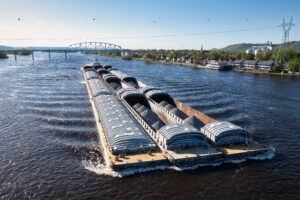
In early August 2026, the Rhine river at Kaub, Germany, fell to 21 centimeters, the lowest level since records at the gauge began in 1880. Barges can no longer travel fully loaded, so shipping companies are running more trips to carry the same cargo of grain, coal and chemicals, and adding surcharges to cover it. The Danube fell even further. In Budapest, the river dropped to around 10 centimeters, well below the previous all-time low of 33 centimeters set in 2018. Three years earlier, a separate drought had forced the Panama Canal to cut its daily ship crossings by more than a third, delaying grain shipments between the Americas and Asia for months. Two major water routes for moving food and industrial goods have suffered major disruptions within the same three-year window.
A low river sounds like weather, not economics. But the Rhine and the Panama Canal exist as trade routes because moving heavy cargo by water has always been unusually cheap, and cheap freight is one of the quiet pillars food prices are built on. When that pillar wobbles, the cost does not stay in the shipping industry. It moves into fertilizer bills, factory input costs, and eventually into a supermarket in a country that has nothing to do with the river itself.
The bill is already showing up
On August 7, 2026, the UN’s Food and Agriculture Organization reported that its global food price index had reached 131.1 points in July, its highest level in more than three years and the highest since January 2023. Wheat prices rose 5.8 percent in a single month and were up nearly 10 percent from a year earlier. The FAO’s cereal index climbed 3.4 percent month on month, and vegetable oils hit their highest level since June 2022. The agency’s chief economist described the current mix of wars affecting the Gulf and Ukraine, combined with a strengthening El Niño, as conditions likely to keep pushing costs higher into 2027.
One month of data does not prove a permanent structural shift, and it is worth saying so plainly. The index remains well below the peak it hit after Russia’s invasion of Ukraine in 2022, a useful reminder that food prices are volatile in both directions. What matters here is not a single reading. It is that the same upward pressure is now visible at multiple layers of the system at once, in shipping, in water, in energy, in weather and in war, rather than in one isolated commodity or one bad season. That convergence is what matters.
Why cheap food was never normal
A three-year price high only makes sense against how unusual cheap food actually was to begin with. For most of human history, food consumed the majority of a household’s income and a society’s labor. Cheap food, the kind where a family in a wealthy country spends a small share of its budget on groceries, is a recent and unusually engineered achievement, not a natural baseline the world can always return to.
It rested on water and energy first, because irrigation and synthetic fertilizer are what let modern farms produce far more from the same land than earlier generations could. It rested on a predictable climate next, since a farmer who can trust a growing season plans and invests differently than one who cannot. Cheap labor, on farms and in processing plants, made the human side of the system affordable. And two factors that rarely get mentioned alongside food did the rest of the work. Scale meant that production and distribution grew large enough for farms, grain terminals and supermarket chains to push costs down through sheer volume. Finance meant a farmer never had to fund a harvest alone, borrowing against a crop that would not pay them back for months and insuring against the season it never came in at all.
These pieces did not simply coexist. They reinforced each other, cheap energy made pumping and irrigating water more affordable, cheap finance made scale possible, scale made labor more productive per hour worked. Weaken one part of that reinforcement, water becoming harder to move, energy costing more, and the strain does not stay contained to the piece under direct pressure. It spreads into the parts that depended on it.
The first crack: heat is turning yield into a cost problem
The clearest place to watch that spread happen in real time is heat and yield. Climate change is usually discussed in terms too abstract to connect to a grocery bill. The connection runs through cost, not just yield. When heat stress, erratic rainfall and shifting growing seasons hit a farm, the farm does not simply produce less. It has to spend more to produce the same amount, through extra irrigation, additional pest control, replanted fields and pricier seed varieties bred to tolerate the new conditions. A wheat farmer who once budgeted for one irrigation cycle now budgets for two, and that additional water and power cost gets baked into the price of the grain before it ever leaves the farm.
That is the structural trend. The current trigger sitting on top of it is the El Niño pattern strengthening through the Pacific this year, which NOAA, Berkeley Earth and independent climate researchers currently expect to rank among the strongest on record. The last event of comparable strength, in 2015 and 2016, pushed roughly 60 million people into food insecurity within about a year. The World Food Programme and the FAO estimate this one could push acute hunger across forty five already vulnerable countries from around 225 million people to roughly 274 million by the end of 2027, concentrated in Southern Africa, Central America and parts of East Africa and South Asia. Timing is what makes it particularly dangerous. It is arriving while fertilizer and energy costs are already elevated, and the FAO’s own economists expect those input costs to reach consumer food prices only after a lag of several months. If that holds, the pressure sitting in commodity markets right now hasn’t fully reached supermarket shelves yet.
Water was never as abundant as cheap food assumed
Heat is only half of agriculture’s climate problem. Water is the other half. Agriculture accounts for roughly seventy percent of the world’s freshwater withdrawals. A World Bank report released in March 2026 found that current agricultural water management practices, marked by overuse in some regions and underuse in others, can sustainably support food production for only about 3.4 billion people, against a global population expected to reach 10 billion by 2050. The finding treats this as a management problem: current practices waste and misallocate water badly enough to cap food production well below demand, even though the World Bank’s own analysis shows that fixing the imbalance, through better irrigation, smarter allocation and real investment, could support the full 10 billion.
That imbalance is visible on the ground in specific places. Parts of South Asia are pumping groundwater faster than it can recharge, most visibly in Punjab, where decades of rice and wheat irrigation have pulled water tables down year after year. Parts of the North China Plain show a similar pattern, after becoming one of the most intensively irrigated farming regions on earth. Many parts of Sub-Saharan Africa sit at the opposite end, remaining underirrigated relative to their potential, leaving productive land dependent on rainfall that El Niño and other patterns make less reliable every year. Roughly eighty percent of global agriculture is still rainfed, and an estimated five hundred million smallholder farmers are exposed directly to whatever a given season’s rain happens to bring. Fixing this is possible. It is also expensive, slow and politically difficult, which helps explain why the gap persists.
Fertilizer and energy are the same problem wearing different names
Even the fix depends on energy. Pumping groundwater and running irrigation both draw from the same grid that fertilizer production depends on. Modern agriculture is an energy system with a green surface. Most of the world’s nitrogen fertilizer is made through the Haber-Bosch process, which converts natural gas into ammonia at industrial scale. Gas here is not just power. It is raw material. Machinery runs on diesel, and irrigation pumps, cold storage and refrigerated transport all depend on electricity, so when energy gets more expensive, the cost does not stop at a fuel bill. It travels through the fertilizer bag, the tractor, the cold chain and the delivery truck before it reaches a price tag.
Three point six percent. That is how much the International Energy Agency expects global electricity demand to grow this year, and 3.8 percent in 2027, up from 3 percent in 2025, driven by industrial activity, electric vehicles, air conditioning and data centers. Farms are not competing with data centers for the same electrons in any literal sense, but they operate on the same grids and pay into the same pricing systems, so rising demand from every direction raises the cost of the capacity that agriculture also depends on. At the same time, disruptions to liquefied natural gas flows through the Strait of Hormuz have pushed gas prices in Asia and Europe to their highest levels since the 2022 to 2023 energy crisis. That spike feeds into fertilizer economics too, because gas is the raw material nitrogen fertilizer is made from.
The farmer is squeezed in the middle
All of these costs land somewhere, and they land hardest on the people actually growing the food. Eleven point eight cents. That is what US farmers kept from every dollar spent on domestically produced food in 2024, down from 12.1 cents the year before. The remaining 88.2 cents covered processing, packaging, transport, wholesaling, retail and food service. At the same time, US farm debt is projected to reach a record 624.7 billion dollars in 2026, and Chapter 12 farm bankruptcies rose 46 percent in 2025.
This is one country’s data, but the mechanism it illustrates travels well beyond it. Rising fertilizer, water, energy and labor costs hit the farm first. Supermarket prices rise more slowly and unevenly, shaped by competition, contracts and consumer resistance to visible price increases. The gap between what a farm spends to grow food and what it earns selling it is where the real financial stress concentrates, long before it shows up as a headline about grocery inflation. In Vietnam, rice exporters proposed a minimum export price and a domestic purchase floor in 2026 specifically because falling prices were squeezing farmers, not raising them. The same lever gets pulled from the other direction too: governments step in just as readily when prices fall too low for the people growing food as when they climb too high for the people buying it, which points to a structural tension built into the system itself between cheap food and viable farming.
Governments stop behaving like free markets
That willingness to intervene rarely stays confined to one side of the price. Forty percent. That is roughly India’s share of global rice trade, which is why its decision in July 2023 to ban exports of non-basmati white rice, made to control domestic prices after a weak monsoon, immediately pushed international rice prices to their highest levels in over a decade. Import dependent countries across Africa and Asia also absorbed the resulting price shock, since the relief from India’s ban stayed largely domestic.
That was not a one-time event. In May 2026, India banned sugar exports entirely until the end of September, reversing an earlier decision that had allowed mills to ship 1.59 million tonnes abroad. The reversal came after domestic production fell short of consumption for the second consecutive year running, with output now projected at around 27.5 million tonnes. India is the world’s second largest sugar producer, so pulling its supply from global markets again tightens a commodity that was already trading near multi-year highs. Each restriction makes sense on its own terms and still tightens the market for every other importer, and the next exporting country faces pressure to restrict as well. Strategic grain reserves, fertilizer export controls and emergency subsidies are increasingly being treated as tools of food security rather than purely emergency measures. The same finance and scale that once let food move cheaply across borders now let a single government’s decision move prices for a dozen countries at once, a fifth crack in the alignment described at the start of this piece.
Cheap calories are not the same as affordable nutrition
That instinct to intervene rarely reaches the supermarket shelf directly. What reaches the shelf is something subtler. Supermarkets can still display remarkably cheap food because most of the real costs behind it never appear on the price tag. Groundwater depletion, soil degradation, farm debt and thin farm margins are all, in effect, hidden costs behind the number a shopper sees at checkout. Someone pays for it eventually, usually not the person standing at the register.
The FAO’s own July numbers show why this divide is real rather than assumed. Vegetable oil, a raw input to a huge share of packaged and processed food, hit its highest price level since June 2022. Packaged snacks and baked goods tend to absorb or delay that kind of increase through reformulation, smaller portions and ingredient substitution, because their supply chains have several stages where a manufacturer can soften the hit before it reaches a shelf price. Fresh produce and dairy face a different set of pressures, more direct exposure to refrigeration, spoilage and labor costs, and fewer stages in the chain able to quietly cushion an increase before it reaches the register. The practical result is that eating cheaply and eating well are drifting apart. Calories stay affordable. Nutrition becomes the premium good, and the households with the least room in their budget are pushed hardest toward the first option and away from the second.
A problem with a different shape on every continent
That divide over what people can afford to eat plays out differently depending on where in the world they live, largely shaped by what a country controls and what it has to import. India controls its own food policy, but the water underneath it is a different story. Falling water tables under Punjab’s grain belt feed into a government repeatedly caught between protecting farmers and controlling prices for more than a billion consumers, whether the commodity in question is rice or sugar. Sub-Saharan Africa sits closer to the opposite problem: underirrigated farmland overexposed to rainfall variability, even as the region accounts for a large share of the population growth the world will need to feed by 2050, which makes the missing piece investment rather than mismanagement of what already exists.
China’s pressure comes from a widening gap between what the country grows and what a wealthier, increasingly urban population wants to eat, particularly meat and dairy, a gap that has pushed Beijing to treat grain reserves and fertilizer supply as matters of national security. The Gulf states and Europe, despite having little else in common, share a version of the same exposure: both depend on systems neither can fully control, the Gulf on food imports financed by energy revenue tied to a global economy they cannot steer, Europe on rivers that no longer reliably move grain and industrial goods at the price its economy was built around. Four regions, four different weak points, none of them failing on the same timeline or for quite the same reason.
The productivity race
Given all of that, the honest question is whether anything can actually change the trajectory. Agricultural history is largely a history of productivity outrunning scarcity. Better seeds, mechanization, synthetic fertilizer, refrigeration and modern logistics repeatedly made food cheaper even as global population grew far faster than earlier centuries thought survivable. That trend has not stopped, though not every promising fix is equally ready to help. Precision irrigation and drought resistant crop varieties are already being deployed at meaningful scale in several regions. Reducing food waste is one of the largest and least expensive levers available, since it adds usable food to the system without farming a single additional acre. Other solutions, like large scale vertical farming or desalination for irrigation, remain real but expensive, useful in specific regions rather than as a global fix, at least for now.
Productivity has won this race for most of the last century. Whether it keeps winning by the same margin, or loses ground the way the recent evidence suggests, depends on decisions about investment and infrastructure that have not been made yet.
What is actually at stake
The FAO’s July index and the US farm bankruptcy data are not separate warning signs. They are the same pressure measured from two ends of the same supply chain, one at the commodity market and one at the farm gate, and both are currently moving in the same direction. Layer in the World Food Programme’s own hunger projection, up to 274 million people by the end of 2027, and the pressure is visible across the income spectrum, from subsistence farmers in the countries El Niño hits hardest to grocery shoppers in wealthy countries paying more for cereal and vegetable oil.
If that continues, the households who already spend the largest share of their income on food, and the farmers already carrying record debt, absorb the first and heaviest impact from every direction at once. Restaurants, running on margins that leave little room to absorb rising ingredient costs quietly, tend to pass them through fast, which is usually the first place a shopper notices food inflation outside their own kitchen. And because few things move voters as reliably as the cost of eating, the political pressure that follows tends to outlast whatever single event caused the price spike in the first place.
The bill has already arrived
Whether July’s number turns out to be the start of a longer climb or a peak nobody needed to prepare for will only be clear in hindsight. But the arithmetic underneath it does not wait for hindsight to start compounding. More people need feeding by 2050 than the current water system can sustainably support without reform. Energy that fertilizer and cold chains depend on is getting more expensive at the same time demand for it is accelerating from every other direction. Farmers are absorbing the early cost of both while keeping a shrinking share of what consumers pay, and governments are increasingly willing to override open markets the moment either side of that squeeze becomes politically painful.
Cheap food was never a law of nature. It was a temporary alignment of water, energy, labor, finance and stable weather, several of which are no longer aligned. Productivity has closed gaps like this before, and it could close this one too. What is not yet known is whether it can move fast enough this time, and that answer will come from investment decisions being made or delayed right now, long before it shows up in a price index.
