
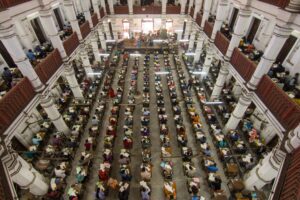
Why NEET, the Cockroach Janta Party, and a paper leak became a crisis of state legitimacy
On 3 May 2026, something over two million Indians sat NEET-UG, the country’s only real gateway into medical school. What followed quickly became one of the most consequential examination controversies in recent Indian history. A Rajasthan police investigation, later handed to the CBI, found that a “guess paper” circulating before the exam lined up with something like 120 of its roughly 410 questions, close enough that the whole exam got scrapped. That’s an investigator’s finding, not a court’s, a distinction most subsequent coverage has not preserved. Twelve days after the cancellation, on 15 May, Chief Justice of India Surya Kant, hearing a contempt petition over allegedly fraudulent law degrees, turned to the subject of the country’s unemployed youth. “There are youngsters like cockroaches, who don’t get any employment or have any place in the profession,” he said, adding that some of them “become media, some become social media, RTI activists and other activists, and they start attacking everyone.” He also called them parasites of society. He clarified his remarks the next day, saying he had been misquoted and that Indian youth were “the pillars of a developed India,” but the original line had already spread. A political communications strategist who had previously worked with the Aam Aadmi Party, Abhijeet Dipke, launched a satirical platform the following day, 16 May, calling it the Cockroach Janta Party. It stuck almost immediately.
Treated as an exam-security story, this should have been over weeks ago. A government apology, a re-test, a news cycle that moves on. It hasn’t moved on, because the exam-security framing was never really what this was about. The real question is why so much of a young Indian’s future still runs through one exam, and what happens once people quietly stop believing that exam is being run straight.
What the exam was built to replace
Every society needs some way to decide who gets the scarce seats and the good jobs. For most of history the answer was birth, or wealth, or who you knew. The competitive exam was supposed to be different, a referee whose ruling holds regardless of who’s asking.
India’s version of that referee has a specific, slightly awkward origin. British colonial administration ran largely on patronage until an 1854 parliamentary report, chaired by Thomas Macaulay, recommended open competitive examination instead of appointment by connection. The stated reason was efficiency. But it did something else too, whether anyone intended it or not. It let a colonial government claim its own hiring was fair, even while the empire running it plainly wasn’t. Whether UPSC directly inherited that institutional logic is difficult to establish, but the continuity provides a useful lens for understanding its modern role: using a clean process to paper over an unequal system, and to prove, over and over, that the state can deal with ordinary people honestly. For a huge number of young Indians the exam is still the most concrete evidence of that they ever get, which is why, when it looks rigged, the damage doesn’t stay inside the education ministry.
The one kind of “merit” that was never supposed to be for sale
People throw the word “merit” around as if everyone means the same thing by it. They don’t. Sometimes it means the strongest candidates rise to the top. Sometimes it means everyone starts from roughly the same position. And sometimes it just means the contest itself is run clean, no leaks, no bribes.
The protestors at Jantar Mantar aren’t really arguing about the first two. Nobody is claiming the toppers didn’t earn their ranks, and nobody is proposing outcomes get equalized regardless of preparation. The second one, unequal starting positions, is a known and tolerated feature of the system. Everyone already understands that a student whose family can afford Kota-style coaching has an edge over one who can’t, and that inequity has sat there for years without producing a national movement.
What broke is the third meaning. It broke for a specific reason: it was the one axis of unfairness the system had always sworn didn’t exist. Coaching-access inequality is baked into the race itself, and people have made an uneasy peace with that. A leaked paper is a different animal, because it suggests the finish line physically moved for whoever paid for it. Once that suspicion takes root, it doesn’t stay contained. It drags the other two questions back open, because if the contest can be bought, how sure can anyone really be that this year’s toppers weren’t just the ones closest to the money?
Why one exam gets to decide a whole life
Look at the UPSC Civil Services Examination if you want to see the stakes at their most extreme. A permanent government post still offers things India’s private sector increasingly can’t: a job that survives a bad quarter, a pension that doesn’t hinge on an employer staying solvent, a title that changes how your family gets treated in its own neighborhood for the rest of your life. Against that, something like 10 to 15 lakh people apply every year, competing for a final list of maybe 700 to 1,200 posts, with an overall success rate well under 1 percent. The ratio has been getting worse for a generation: around one selection per 365 applicants back in 2000, by widely cited figures, and closer to one in 1,215 by 2023, even as the number of vacancies barely moved.
There’s a clock attached to all of this too. General-category UPSC applicants get six attempts, inside a fixed age window. A leaked and cancelled exam doesn’t just cost someone a few months of studying. Stack it across cycles and it can eat into a meaningful fraction of a candidate’s total eligible tries, with no promise the next cycle gets run any cleaner. “Just wait and reapply” isn’t really an answer when the clock is doing what it’s doing.
Why the exam ended up carrying all this weight
Part of what happened is that the degree stopped doing its old job. India produces far more graduates than its formal economy can absorb, so a bachelor’s degree no longer tells an employer much on its own, and the sorting work that used to be split between “which degree” and “which job” has piled onto a single exam instead. The numbers behind that shift are worth sitting with before moving on, because they explain why the exam ended up carrying so much more than an exam normally would.
The State of Working India 2026 report, from Azim Premji University, found that graduates made up 46 percent of unemployed 20-to-29-year-olds in 2017. By 2023 that had risen to 67 percent. The same report puts the annual pipeline at roughly 5 million new graduates entering the workforce, of whom only about 2.8 million find any employment at all. The Periodic Labour Force Survey’s most recent annual report puts graduate unemployment at 11.2 percent, more than three times the 3.1 percent unemployment rate for the population as a whole.
Credential inflation and the legitimacy crisis are really two sides of the same problem. Credential inflation is why the exam had to carry so much weight to begin with. Once the degree stopped filtering anyone, the exam became the last sorting mechanism standing, and everything that used to be spread across “which school,” “which degree,” “which job” got compressed into a single morning in May. The legitimacy crisis is what happens once that overloaded mechanism gets caught being unfair in public.
There’s a whole private economy built on top of this imbalance too. India’s exam-coaching industry is among the largest in the world, and entire towns, Kota above all, have become synonymous with preparing students for a handful of tests. That industry has a stake in this story that most coverage skips past: it only works if the exam is worth preparing for. If the exam looks gameable by money and connections rather than by studying, the whole premise of paying for coaching gets shakier. A NEET leak doesn’t just anger the students who sat it that day. It puts pressure on the business model of every coaching center that told a family the investment was worth making.
The obvious pushback
The obvious objection is worth addressing directly: isn’t this just another Indian protest cycle? Exam scandals here aren’t new, and neither is student anger about them. NEET alone has had disputed or confirmed leak controversies in 2021, 2024, and now 2026. That history is real, and it’s probably part of why the government’s first instinct was to treat this as one more manageable scandal, the kind that burns out on its own.
What’s different this time isn’t really the leak. It’s that the leak landed on top of a job market that had already been failing a generation of graduates for years, and a Chief Justice who, intentionally or not, handed all that accumulated anger a name to organize around, instead of letting it dissipate the way the 2021 and 2024 leaks eventually did.
Wangchuk, and why a hunger strike did what hashtags couldn’t
For its first few weeks the movement stayed mostly online: memes, a party name, the kind of scattered outrage governments have gotten fairly good at waiting out. That changed when Sonam Wangchuk, the education reformer and climate activist, joined the protest at Jantar Mantar and began an indefinite hunger strike. A hunger strike forces a choice that online anger doesn’t: negotiate, or be seen presiding over a peaceful protester’s declining health in full public view. It also changed who the movement looked like it was for. Wangchuk wasn’t an aspirant with a personal grievance. He was already a known public figure, with a long record on education and Ladakh’s environmental and statehood causes, and his presence turned the protest into a question about accountability rather than a dispute among disappointed test-takers.
On 18 July, after 20 days on strike, Delhi Police moved Wangchuk to Safdarjung Hospital under Delhi High Court orders, citing his deteriorating health. CJP founder Abhijeet Dipke alleged he was taken by force; police said they acted on medical advice and court direction. The following day, a court declined his wife Gitanjali Angmo’s request to transfer him to a private hospital instead, with the judge noting doctors had given him only oral fluids and supplements with his consent. The protest didn’t stop. Large crowds later marched on Parliament despite a ban, police used tear gas to break them up, and Angmo has since taken on a more visible public role pressing his demands, in a fast-moving situation that was still developing as this draft was being written.
That’s not the usual shape these things take. Movements built around one recognizable figure tend to lose steam once that figure leaves the scene. This one hasn’t, at least not yet, which suggests the organizing logic doesn’t actually depend on any single person being physically present. That might make it harder for the state to manage by managing him alone.
The formal demands (the Education Minister’s resignation, structural reform to exams and recruitment, accountability for the leaks, support for the families of students who died by suicide over the exam crisis) read like a standard protest checklist until you notice what’s missing. Nobody is asking for compensation. Nobody is asking for leniency. They’re asking for the exam to be trustworthy again, which is a much harder thing to hand over than money.
What this isn’t
It’s worth being precise about what India’s situation isn’t, because the closest comparisons abroad actually point somewhere different. China’s youth are largely opting out of the credential race altogether, the “lying flat” retreat, because the state was never really the employer they were competing for in the first place. There’s no single institution to point at. South Korea’s graduates are bottlenecked around a handful of private conglomerates, which is a market failure more than a state one. Taiwan is closer to pure saturation. As of 2022, something like 82 percent of 25-to-29-year-olds there hold a bachelor’s degree, and the credential has simply stopped filtering anyone, again without a single gatekeeper anyone can blame.
India’s situation is harder to sit with precisely because the state isn’t a bystander in any of this. It runs the exam, and through the jobs it hands out afterward, it’s also one of the biggest prizes on the table. Elsewhere, a market is failing people. In India, the referee is failing to referee a contest it also has a stake in winning cleanly, roughly the position colonial administrators were in when they adopted the exam to begin with, minus any claim to be standing outside the outcome.
If the trust doesn’t come back
If enough people stop believing the exam is clean, the sorting doesn’t go away. It just moves somewhere less visible and less fair, toward personal networks and family connections, the exact advantages a fair exam was supposed to cancel out. Families who can afford it may start steering their kids toward emigration instead of domestic competition. In places where the state itself is the employer, political loyalty could start counting for more than credentials, unevenly and probably slowly rather than all at once. None of this requires the exam system to formally collapse. It just requires enough people to quietly decide it isn’t worth trying anymore, one cohort at a time.
Reforms can rerun a leaked exam easily enough. What’s harder to rerun is the assumption a teenager makes, walking in, about whether any of this is worth trusting before they’ve even sat down. Once that assumption gets revised downward, it tends to get handed down rather than corrected. That might end up being the more lasting cost here: not this year’s cohort of NEET and UPSC aspirants, but the baseline expectation the next cohort walks in with.
Every state that asks its citizens to swallow large, permanent inequalities in exchange for a fair shot at the entry point is running some version of this same bargain, just with a different exam and a different name for the referee. What’s actually being tested in India right now is whether the next generation still walks into the hall assuming the house has no stake in who wins.
Sources: reporting from Reuters, the Guardian, the Economic Times, ThePrint, and Business Recorder; the Chief Justice’s remarks as reported by The Wire and Al Jazeera; UPSC applicant and vacancy figures from UPSC’s published annual reports; graduate employment and unemployment figures from Azim Premji University’s “State of Working India 2026” and the Ministry of Statistics’ Periodic Labour Force Survey Annual Report; Taiwan educational attainment data via the Global Taiwan Institute.

