
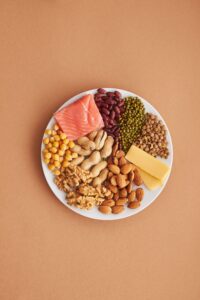
How protein became a health halo, and why the number on the front of the package tells only part of the story
I. The Number on the Front
Walk down any modern supermarket aisle and a single number demands your attention. It is printed in bold sans-serif type across cardboard cereal boxes, stamped on plastic yogurt tubs, embossed on candy bar wrappers, and shouted from bottles of fortified cold brew: 15g, 20g, 30g.
Protein is no longer marketed primarily as sports nutrition. Food manufacturers now market protein-fortified versions of products ranging from pasta and cereal to cookies, frozen desserts, and snack bars. In a grocery sector historically defined by what it removes, low fat, zero sugar, low carb, gluten-free, protein represents a different commercial proposition: a positive nutritional cue that can make a product appear more virtuous.
Protein is an essential nutrient with well-documented roles in muscle maintenance, tissue repair, and satiety. Aging adults, competitive athletes, and some patients using appetite-suppressing medications can have legitimate reasons to prioritize protein. A high-protein product can therefore be nutritionally useful. The distortion begins when a single nutrient quantity becomes the primary evidence offered for the quality of an entire product. Protein has increasingly been used as a commercial shortcut for judging food, allowing a single number on the front of the package to stand in for the broader nutritional profile.
The number on the front of the box can be entirely true while the health impression it creates remains incomplete.
II. Why Protein Won the Grocery Store
Throughout decades of shifting dietary trends, protein maintained an unusually clean reputation. While public health messaging and consumer sentiment oscillated between scrutinizing dietary fat, refined carbohydrates, and added sugars, protein largely avoided culinary stigma. Instead, it accumulated positive cultural associations: physical strength, discipline, lean muscle, metabolic efficiency, and youthful vitality.
For consumer packaged goods manufacturers, protein also offered a practical advantage: cognitive clarity. Modern food labels require consumers to process serving sizes, nutrient quantities, ingredient statements, and percentage Daily Values.
A protein claim can cut through that burden, whether or not any individual manufacturer designed it with that purpose in mind. The number transforms a complicated nutritional question into a simple, legible signal. A consumer does not need to understand the full Nutrition Facts panel to recognize that 20 is larger than 5.
The psychological effect has been demonstrated directly. In a controlled experiment by Catherine Fernan, Jonathon P. Schuldt, and Jeff Niederdeppe, published online in 2017 and in Health Communication in 2018, researchers found that putting protein in a snack bar’s product title increased perceived overall healthfulness. The effect was mediated by increased perceptions of other healthy nutrients that had not been claimed. The experiment included 274 participants.
A 2024 study by Gina Pope McKeon and William K. Hallman reached a similar conclusion in breakfast cereal. In an online survey of 1,022 U.S. adults, participants perceived Special K Protein as healthier and more nutritious than Special K Original. Many participants also failed to recognize differences in sugar, sodium, and calorie content between the cereals.
Together, the studies demonstrate something narrower and more useful than the claim that protein is inherently misleading. A protein-centered label can transfer a positive impression from one nutrient to the product as a whole.
III. Testing the Shelf: A 100-Gram Nutrient and Price Density Comparison
To evaluate the economic and nutritional reality of high-protein claims without the confounding effects of variable manufacturer portion sizes, the following model standardizes thirteen selected supermarket products to a uniform 100-gram baseline across several categories, pairing conventional products with higher-protein counterparts alongside two basic food baselines.
This normalization measures nutrient and price density; it does not represent the amount a consumer normally eats in one sitting. Because the products differ in physical form and preparation state, the table should be read as a standardized retail-density comparison rather than a measure of the cost of a nutritionally equivalent meal. The comparison is most useful for examining retail and nutrient density; deciding which product is the cheaper way to assemble a complete meal requires a separate calculation, since portion size and preparation state vary widely across categories.
| Category | Product Name | Price per 100g | Calories (100g) | Protein (g) | Fiber (g) | Total Sugar (g) | Sodium (mg) | Price per Gram of Protein |
|---|---|---|---|---|---|---|---|---|
| Pasta | Barilla Classic Penne | $0.414 | 357 | 12.5 | 3.6 | 1.8 | 0 | $0.033 |
| Pasta | Barilla Protein+ Penne | $0.798 | 364 | 17.2 | 10.1 | 2.0 | 0 | $0.046 |
| Yogurt | Dannon Whole Milk Plain | $0.467 | 82 | 3.5 | 0.0 | 4.1 | 44 | $0.133 |
| Yogurt | Chobani Plain Nonfat Greek | $0.659 | 53 | 9.4 | 0.0 | 2.4 | 38 | $0.070 |
| Yogurt | Oikos Pro Vanilla Cup | $0.947 | 87 | 13.3 | 0.0 | 2.0 | 30 | $0.071 |
| Cereal | General Mills Cheerios | $1.075 | 359 | 12.8 | 10.3 | 5.1 | 487 | $0.084 |
| Cereal | Premier Protein Cereal, Mixed Berry Almond | $2.737 | 429 | 47.6 | 2.38 | 11.9 | 619 | $0.057 |
| Cookies | Chips Ahoy! Original Cookies | $1.082 | 485 | 3.0 | 3.0 | 33.3 | 318 | $0.361 |
| Cookies | Lenny & Larry’s Complete Cookie | $2.018 | 372 | 14.2 | 8.8 | 22.1 | 389 | $0.142 |
| Candy | Snickers Chocolate Bar | $2.808 | 474 | 7.6 | 1.9 | 53.1 | 228 | $0.369 |
| Protein bars | Quest Nutrition Chocolate Chip Cookie Dough | $4.467 | 317 | 35.0 | 20.0 | 1.7 | 367 | $0.128 |
| Basic foods | Large Grade A Brown Eggs | $0.540 | 143 | 12.6 | 0.0 | 0.4 | 142 | $0.043 |
| Basic foods | Canned Brown Lentils (Plain) | $0.531 | 116 | 9.0 | 7.9 | 0.5 | 15 | $0.059 |
Sources and Methodology: Listed prices represent single-unit catalog retail prices recorded from Walmart.com and Target.com in early 2026, excluding temporary promotional discounts. Package baselines were as follows: Barilla Penne, 16 oz / 454g, $1.88; Barilla Protein+, 14.5 oz / 411g, $3.28; Dannon Whole Milk, 32 oz / 907g, $4.24; Chobani Plain Greek, 32 oz / 907g, $5.98; Oikos Pro Vanilla, 5.3 oz / 150g, $1.42; Cheerios, 18 oz / 510g, $5.48; Premier Protein Cereal (Mixed Berry Almond), 9 oz / 255g, $6.98; Chips Ahoy!, 13 oz / 368g, $3.98; Lenny & Larry’s Complete Cookie, 4 oz / 113g, $2.28; Snickers, 1.86 oz / 52.7g, $1.48; Quest Bar, 2.12 oz / 60g, $2.68; Large Brown Eggs, dozen carton / 600g edible mass, $3.24; and Canned Brown Lentils, 15 oz / 425g can, 260g drained mass, $1.38. Nutritional figures were taken from published manufacturer declarations and USDA FoodData Central records, then normalized to 100 grams. Price per gram of protein equals price per 100 grams divided by labeled grams of protein per 100 grams. Two entries require confirmation against the original product-level sourcing file before this table is considered fully locked: the specific canned-lentil product behind the 15mg sodium figure, and the fiber figure for Barilla Classic Penne, which conflicts across secondary databases (3.6g/100g used here versus approximately 5.3g/100g in at least one other USDA-linked listing). Product formulations and retail prices can change, so the figures represent the specified audit period rather than permanent prices.
Observations from the Comparison
- The Box Markup vs. The Protein Yield: In staple grain categories like pasta, consumers pay a noticeable premium for protein-focused formulation. Barilla Protein+ costs 93% more per 100 grams than standard semolina penne ($0.798 versus $0.414). For that additional expenditure, the consumer receives 38% more protein (17.2g versus 12.5g per 100g). Because the package price is nearly doubled, the price per gram of protein is about 40% higher ($0.046 versus $0.033).
- The Strained Dairy Exception: High-protein products are not uniformly a worse economic value. Strained Greek yogurt and ultra-filtered dairy cups such as Oikos Pro cost more per 100 grams at the checkout counter, but because processing concentrates milk solids, their price per gram of protein is roughly half that of standard whole milk yogurt ($0.070 to $0.071 per gram compared with $0.133 per gram).
- Formulated Snacks: Formulated snacks such as protein cookies and bars deliver substantial protein, but they also carry some of the highest 100-gram prices in the comparison, ranging from about $2.02 to $4.47. Their price per gram of protein can look favorable compared with conventional confectionery because the protein denominator is larger. Depending on formulation, however, they can deliver substantial calories alongside sweeteners, added fibers, fats, and stabilizing ingredients.
- The Basic Food Baseline: Basic foods remain among the most cost-efficient protein sources in the comparison while also supplying nutrients that some formulated products lack. Large brown eggs supply complete protein at $0.043 per gram, beating fortified pasta ($0.046), cereal ($0.057), and protein bars ($0.128). Canned brown lentils provide substantial plant protein at $0.059 per gram alongside 7.9 grams of dietary fiber.
IV. The 20-Gram Problem: Same Number, Different Food
A single number cannot describe a biological matrix, which is the core limitation of judging any food by its protein count alone.
Compare two products that deliver roughly the same amount of protein through very different formulations.
A Quest Chocolate Chip Cookie Dough Protein Bar weighing 60 grams provides 21 grams of protein, alongside 190 calories, 9 grams of fat including 3 grams of saturated fat, 220 milligrams of sodium, and 12 grams of dietary fiber. Its formulation includes milk protein isolate, whey protein isolate, polydextrose, almonds, erythritol, and other ingredients used to provide texture and flavor.
A 200-gram calculation based on the FAGE Total 0% Plain Greek Yogurt label provides about 106 calories, 21.2 grams of protein, 0 grams of fat, and 76 milligrams of sodium. Its listed ingredients are skimmed milk and live active yogurt cultures.
The comparison does not establish that one food is universally healthier than the other. What it establishes is narrower: the same protein quantity can arrive with very different amounts of energy, fat, sodium, fiber, and other ingredients, depending entirely on formulation.
There is another reason the number is incomplete. Grams measure quantity; digestibility and amino-acid composition influence protein quality and amino-acid availability, while the surrounding food matrix determines what else arrives alongside those grams.
Federal dietary guidance encourages consumers to consider the broader nutritional profile of foods. FDA labeling rules govern the information manufacturers place on Nutrition Facts panels and packages. The protein number can therefore be accurate without describing the complete food.
V. Permissible Indulgence: When Protein Rebrands a Snack
Controlled consumer research helps explain why the distinction matters: protein-centered labeling can increase perceived healthfulness even when the underlying nutritional profile does not improve proportionately.
Consider Lenny & Larry’s The Complete Cookie. The product foregrounds protein and plant-based positioning, yet consuming the entire 113-gram Chocolate Chip cookie delivers 420 calories, 25 grams of total sugar, and 12 grams of fat.
The protein claim leaves those other nutritional characteristics unchanged. What shifts is which attribute a shopper notices first.
Within consumer packaged goods marketing, protein can function as a repositioning lever: brands can attract health-conscious shoppers without necessarily changing every other characteristic of the product. The commercial value lies partly in the fact that consumers understand protein as a positive attribute before they examine the complete Nutrition Facts panel.
This is the health halo at work: an accurate number generates a broader conclusion than the evidence supports.
VI. When Protein Really Is the Better Choice
Protein products provide clear utility in several situations where concentrated nutrition solves a practical or physiological problem.
- Older Adults and Muscle Preservation: Aging is associated with anabolic resistance, meaning muscle tissue can become less responsive to a given dose of dietary protein. Clinical nutrition guidance commonly recommends higher protein intakes for older adults than the minimum adult RDA. For older adults experiencing diminished appetite, reduced chewing capacity, or limited meal preparation, a high-protein strained yogurt or ready-to-drink shake can provide an accessible way to increase protein intake.
- Athletic Training and Muscle Recovery: Protein intakes in the range of roughly 1.4 to 2.0 grams per kilogram per day are commonly recommended for athletes seeking to support training adaptations and muscle recovery. For some athletes, achieving those targets exclusively through whole foods can require larger meal volumes, making concentrated protein products a practical option.
- Clinical Support During GLP-1 Treatment: Patients taking GLP-1 receptor agonists such as semaglutide or dual GIP/GLP-1 agonists such as tirzepatide can experience substantial appetite reduction during weight loss. Body-composition studies indicate that a meaningful proportion of weight lost during treatment can come from lean mass, although estimates vary across trials and measurement methods. Adequate protein intake and resistance training are among the strategies used to help preserve lean tissue while food intake is reduced.
- Relative Harm Reduction: In some circumstances, a protein-fortified snack can offer a more favorable macronutrient profile than the conventional confection it replaces. A product providing substantially more protein and less sugar, for example, represents a different nutritional trade-off from a conventional confection containing substantially more sugar and much less protein.
These examples demonstrate why the criticism of protein marketing cannot simply be that high-protein products are unnecessary. Concentrated protein can be useful. The problem begins when a specialized nutritional tool becomes a generalized measure of food quality.
VII. The Population Reality Check
Commercial messaging around protein can suggest that modern consumers face a widespread deficiency problem. Dietary surveillance paints a more complicated picture.
According to the USDA’s What We Eat in America dietary survey, conducted as part of NHANES, adults consumed an average of 77.1 grams of protein per day during the August 2021 through August 2023 survey period. Adult men averaged 89.3 grams and adult women 65.6 grams. These are population averages; individual adequacy varies widely beneath the mean.
Understanding the debate requires distinguishing different benchmarks.
The longstanding Recommended Dietary Allowance is 0.8 grams of protein per kilogram of body weight per day for healthy adults. The RDA is designed to meet the needs of nearly all healthy people in the reference population and has long served as the established reference for preventing deficiency.
The 2025 to 2030 Dietary Guidelines for Americans introduced a higher protein target of 1.2 to 1.6 grams per kilogram of body weight per day, drawing primarily on evidence from weight-management trials in adults with overweight or obesity rather than on a new estimate of the minimum physiological protein requirement. The scientific foundation for that recommendation relied heavily on a rapid systematic review of randomized controlled trials examining weight-management outcomes, supplemented by a narrative review concerning nutrient adequacy.
That distinction matters. The higher range should not be interpreted as evidence that the U.S. population has suddenly become protein deficient. It reflects a different policy question involving weight management, energy restriction, body composition, and nutrient adequacy.
Some demographic groups, particularly older adults with low total food intake, remain more vulnerable to inadequate protein intake. Population averages cannot identify those individuals, and a national average well above the RDA is a weak basis for treating protein deficiency as a universal explanation for the nutritional problems of American adults.
VIII. The Quiet Inversion: The Fiber Blind Spot
While food packaging increasingly emphasizes protein, a long-standing and well-documented public health shortfall lies elsewhere: dietary fiber.
The World Health Organization recommends at least 25 grams of naturally occurring dietary fiber per day for adults. U.S. dietary guidance uses Adequate Intake levels ranging from 25 to 38 grams depending on age and sex.
A widely cited analysis by Quagliani and Felt-Gunderson, published in the American Journal of Lifestyle Medicine in 2017 (volume 11, issue 1), estimated that approximately 95% of Americans fail to meet recommended fiber intakes.
CDC surveillance has also found very low proportions of adults meeting fruit and vegetable intake recommendations. In 2019, only 12.3% of surveyed adults met fruit recommendations and 10.0% met vegetable recommendations.
The connection between protein marketing and fiber intake is behavioral, not biochemical. Protein-fortified foods do not use up or interact with the fiber a person eats separately; the risk is opportunity cost, when a protein-fortified convenience food occupies the meal that beans, whole grains, vegetables, or fruit might otherwise have filled.
Protein claims can occupy prominent front-of-package space, while dietary fiber often requires closer examination of the Nutrition Facts panel and ingredient list. If protein-fortified convenience foods displace beans, whole grains, vegetables, fruit, nuts, or seeds in a person’s routine, the opportunity to obtain fiber from those foods falls.
A protein claim can therefore create the impression that an important health criterion has been satisfied even when other aspects of the nutritional profile receive less attention.
IX. Inside the Factory: Isolates, Concentrates, and the Processing Debate
Protein in an agricultural crop exists embedded within cellular matrices: a soybean, a field pea, or milk from a dairy cow. Protein in an ingredient blending facility can exist as a dry, concentrated powder.
Understanding how plant proteins are processed clarifies both their functional utility and their culinary limitations.
Food scientists distinguish plant protein flours, concentrates, and isolates by their degree of enrichment, although exact thresholds vary by ingredient and specification. Flours retain much of the original food matrix. Concentrates remove part of the starch and other non-protein material. Isolates undergo further fractionation and can exceed 80% protein by dry weight, depending on the ingredient and production process.
One common industrial route for pea and soy isolates involves milling the legume, solubilizing protein in an aqueous solution, separating insoluble material, and precipitating the protein at its isoelectric point before washing and spray-drying. The result is an ingredient that can be blended into foods at concentrations that would be difficult to achieve with intact legumes.
Manufacturers use these ingredients because they provide physical functionality. Protein isolates can contribute water binding, emulsification, foaming, and heat stability. Intact legume flours can contribute stronger flavors, color, and texture, while isolates can be formulated for smoother and more predictable products.
The trade-off occurs during formulation. Depending on the ingredient and finished product, concentrated proteins can contribute bitterness, astringency, dryness, or other sensory challenges. Manufacturers may therefore combine them with fats, sweeteners, fibers, and stabilizing ingredients to manage texture, moisture, and flavor.
Whether the finished food is nutritionally good or poor depends less on the isolate’s existence than on what it is formulated into.
A formulated food can be nutritionally useful, and a basic whole food can be a poor choice in a particular dietary context. Protein processing is a means of formulation; the nutritional verdict depends on what that formulation produces.
X. The Economics Behind the Protein Market
Dairy whey illustrates how ingredient economics can turn a byproduct into a commercially valuable asset. It is generated as a co-product of cheesemaking, and as processors developed membrane technologies such as ultrafiltration and diafiltration, they gained increasingly effective ways to separate and concentrate its protein fraction. The resulting whey protein concentrates and isolates could be standardized, dried, transported, stored, and incorporated into consumer products.
That changed the economics of whey. What had once been primarily a processing by-product became an ingredient with a defined commercial market.
The supply relationship also matters. Because whey is tied to cheese production, the availability of whey protein is linked to the volume and composition of the dairy stream from which it is recovered. Demand for protein ingredients could therefore, in principle, outpace the underlying supply of suitable whey; this is a structural possibility inherent in the supply relationship, not a documented current market condition.
The commercial implication is straightforward. Once consumers value protein as a functional attribute, a concentrated protein ingredient becomes more valuable not only because it supplies nutrition but because it can be incorporated into products that prominently communicate that attribute.
Ingredient economics help explain why protein is commercially attractive, though that is a different claim than evidence that manufacturers engineered the trend to protect margins.
XI. The New Protein Consumer: How GLP-1 Opened a New Use Case
Pharmaceutical weight-loss medications such as semaglutide and tirzepatide have given the commercial trajectory of protein a new catalyst.
GLP-1 receptor agonists such as semaglutide, and dual GIP/GLP-1 agonists such as tirzepatide, affect appetite and gastric emptying. During active weight loss, patients may consume less food, making nutrient density more important for some individuals.
That creates a practical commercial opportunity for foods designed to deliver protein and other nutrients in relatively small portions.
Nestlé provides a concrete example. In 2024, the company introduced Vital Pursuit, a line of portion-aligned foods designed to support GLP-1 users and consumers focused on weight management. Nestlé described the range as consisting of 14 frozen meals in formats including sandwiches, pizzas, and bowls, with an emphasis on protein and nutrient-dense ingredients such as vegetables and whole grains.
Vital Pursuit is a single, concrete corporate response to a changing consumer need. Other companies may follow a similar path, or may not; the case shows how a pharmaceutical shift can create a new market for compact, protein-forward foods, without indicating how far that market will extend across the industry.
XII. The Whole-Food Alternative: Simplicity Over Refinement
Amid the expansion of formulated protein products, basic whole foods offer an intuitive benchmark for consumers seeking nutrition without the price premium of many formulated snacks.
The comparative model illustrates the economics: 100 grams of large brown eggs supplies roughly 12.6 grams of complete protein for $0.54, or $0.043 per gram of protein. One hundred grams of canned brown lentils supplies 9.0 grams of plant protein and 7.9 grams of fiber for $0.53, or $0.059 per gram of protein.
Achieving the same amount of protein through formulated snack bars or functional cookies costs substantially more per 100 grams in this comparison. The products also require additional ingredients to create the desired texture, shelf life, sweetness, and protein concentration.
The more revealing comparison is the opportunity cost of focusing narrowly on protein concentration. Foods that already contain protein can also supply fiber, minerals, fats, and carbohydrates without first separating their components into industrial ingredients, and in this analysis they do so at a lower price per gram of protein than most formulated alternatives.
Protein concentration is a useful technological capability, though converting that capability into a nutritional advantage depends on the rest of the formulation.
XIII. When Protein Claims Meet Warning Labels
The retail food environment increasingly places positive nutrient claims alongside regulatory efforts designed to highlight nutrients of concern.
Globally, public health authorities have implemented or expanded front-of-pack warning systems intended to make high levels of certain nutrients more visible to consumers.
In Latin America, statutory warning systems vary. Chile and Mexico use black octagonal warning symbols on packages exceeding specified thresholds for nutrients such as sugar, sodium, and saturated fat. Brazil uses a front-of-pack magnifying-glass design identifying foods high in nutrients of concern.
In India, the Food Safety and Standards Authority of India filed a compliance affidavit with the Supreme Court on August 28, 2026, proposing red hexagonal front-of-pack warnings on packaged foods and beverages that meet specified thresholds for nutrients of concern. According to reporting by Reuters, which had reviewed the filing, the proposed system would use declarations such as HIGH FAT, HIGH SUGAR, HIGH SALT, or HIGHLY SWEETENED BEVERAGE, with the initial phase applying when two or more specified nutrients are high. The filing itself had not been made public at the time of reporting, and the proposal remains part of an ongoing regulatory and legal process rather than an enacted nationwide labeling requirement.
Where such systems coexist with voluntary or commercial nutrient claims, consumers can encounter two different signals on the same package: a positive claim emphasizing protein and a warning drawing attention to another nutrient of concern.
That juxtaposition exposes the limitation of judging a food by any single positive number, protein included: accuracy on one axis says nothing about the rest of the label.
XIV. The Verdict
The high-protein movement was never built on an outright falsehood. Protein is an essential macronutrient. Preserving skeletal muscle is an important component of healthy aging, physical function, and independence. For older adults, dedicated athletes, and patients navigating medical weight loss, concentrated protein products can serve a legitimate, evidence-based purpose.
The molecule behaves exactly as advertised. What breaks down is the leap from one accurate number to a verdict about the whole product.
When 20 grams of protein is treated as a universal stamp of health, the rest of the food disappears from consumer scrutiny. A product can solve one nutritional metric while leaving the rest of the meal, and the rest of the diet, largely unchanged. It can deliver an impressive protein number while also containing substantial amounts of saturated fat, sodium, sugar, or other ingredients, depending on the formulation.
A healthy diet cannot be reduced to the number of grams of one macronutrient printed on a package. A gram count on the front of the package is a real number, but it was never a substitute for reading what else came with it: the calories, the sodium, the sugar, the fiber it may have displaced, and the rest of a day’s eating that a single claim can’t summarize.
