

The Rise of Organoid Intelligence and the Quest to Build Computers from Living Cells
I. The Computer That Is Alive
In late 2022, an electrophysiology laboratory in Melbourne (the biotechnology company Cortical Labs, working in collaboration with academic research partners) placed an array of approximately 800,000 living brain cells onto a high-density microelectrode grid. The biological culture, comprising embryonic rodent neurons alongside human induced pluripotent stem cell-derived cortical neurons, was interfaced directly with an interactive digital simulation of the arcade game Pong. A host computer translated the coordinate trajectory of the virtual ball into targeted electrical pulse trains delivered to dedicated sensory electrodes. When the neural collective discharged action potentials across designated motor sectors, the host software decoded that firing activity into the vertical displacement of a digital paddle.
The decisive variable governing the system was closed-loop electrophysiological feedback. Whenever the paddle contacted the ball, the digital interface returned an orderly, predictable electrical stimulus at a constant frequency and spatial location. Whenever the paddle missed, the system delivered an aperiodic, unpredictable burst of electrical noise across the entire electrode array.
Within five minutes of continuous closed-loop gameplay, the cultures exhibited measurable changes in firing dynamics. As documented by Kagan et al. (2022) in Neuron, the biological networks exhibited measurable behavioral adaptation: average rally lengths increased systematically, paddle-miss frequencies declined, and electrophysiological performance diverged sharply from control preparations exposed to randomized stimulation or silent rest conditions.
The experiment did not provide evidence establishing a conscious synthetic organism, nor did it construct a functional miniature brain. What it established was a more focused, mathematically tractable milestone: living biological neural networks can be coupled to electronic hardware in a closed operational loop, modulate their collective firing profiles in response to informational feedback, and execute real-time adaptive computation.
For more than seven decades, computing has advanced along an electronic continuum. Vacuum tubes yielded to discrete transistors, which were succeeded by photolithographic microprocessors, integrated silicon dies, and massively parallel graphics processing units. Throughout this progression, the underlying physical paradigm remained constant: fabricated hardware topologies are permanently fixed upon manufacture, while computational state is represented through discrete charges and voltage states shuttled between physically separated processing cores and memory arrays within predominantly von Neumann-derived architectures.
Organoid Intelligence (OI) departs from this continuum. Rather than fabricating solid-state microprocessors that execute mathematical simulations of neural networks, biocomputational engineering cultivates living cellular tissue and incorporates it directly into the physical execution stack. In this architecture, living neurons develop and maintain synaptic networks whose activity can adapt through biological plasticity, processing electrical and biochemical inputs through continuous, non-linear analog dynamics.
The field remains in an exploratory, nascent phase. Present-day biological neural processors cannot replace commercial silicon accelerators, execute arbitrary compiled software binaries, or reproduce general human cognition. Yet across academic laboratories and emerging commercial biocomputing platforms, biohybrid systems are already classifying spoken human audio, forecasting the trajectories of non-linear chaotic dynamical systems, and supporting continuous programmatic experimentation through automated, cloud-accessible infrastructure.
Computing has historically focused on engineering inanimate machines that emulate living intelligence. Wetware biocomputing investigates whether functional computing machines can be built from living tissue itself.
II. From Silicon to Synapse: The Architectural Lineage
The emergence of biological computing is motivated by thermodynamic and physical barriers confronting conventional semiconductor architectures.
Many modern artificial intelligence workloads rely heavily on dense arrays of digital CMOS transistors executing billions of synchronized matrix multiplications, tensor contractions, and linear algebra operations. While exceptionally capable at scale, this brute-force numerical paradigm demands massive electrical infrastructure. The International Energy Agency (IEA) estimated that global data-centre electricity consumption reached approximately 460 terawatt-hours in 2022, while electricity consumption associated with data centres, artificial intelligence and cryptocurrency was projected to nearly double by 2026. Furthermore, energy and carbon estimates by Patterson et al. (2021) demonstrate that the electrical energy required to train large neural-network models can reach hundreds of megawatt-hours (for example, estimating approximately 86 MWh for T5, 179 MWh for Switch Transformer, and 1,287 MWh for GPT-3), with corresponding carbon emissions contingent upon facility cooling efficiencies and regional power grid generation mixes.
The fundamental physical bottleneck stems from classical computer architecture: the physical separation between arithmetic logic units and memory storage banks. In standard deep learning workloads, the continuous shuttling of billions of numerical weights across memory buses and interconnect hierarchies incurs substantial interconnect and I/O energy dissipation, which can dominate total processor power consumption as established in foundational computer architecture analyses by Horowitz (2014).
Neuromorphic engineering took shape during the 1980s, with Carver Mead among its most influential pioneers, to address this separation by designing solid-state electronics that emulate neurobiological organization. Modern neuromorphic platforms (including digital architectures such as IBM TrueNorth and Intel Loihi 2, alongside experimental analog memristive crossbar arrays) tightly couple or collocate processing elements with artificial synaptic storage. These chips operate asynchronously, communicating through sparse, event-driven voltage spikes that mimic biological action potentials.
However, solid-state neuromorphic chips remain bound to the physics of fixed-mask photolithography. Once a silicon wafer is etched in a fabrication facility, its physical circuitry is immutable. An electronic circuit cannot extend new physical axonal connections, selectively prune dendritic branches, or homeostatically modulate its baseline firing thresholds through enzymatic signaling cascades. To emulate synaptic plasticity, neuromorphic chips must update numerical weights held in local SRAM registers, alter the non-volatile conductance of metal-oxide memristors, or modulate charge trapped in floating-gate transistors using external electrical pulses.
Building upon classical computing, a 2026 analytical review by Brown & Varghese (2026) in Nature Computational Science conceptualizes the evolution of neuro-inspired computing across three distinct subsequent phases: first, algorithmic machine learning that simulated connectionist principles mathematically on conventional digital hardware; second, neuromorphic hardware that implemented spiking neural architectures in solid-state silicon; and third, biohybrid systems that introduce living biological neural tissue directly into the computational loop. Where solid-state neuromorphic hardware utilizes lithographic circuits to approximate biological neural dynamics, wetware systems utilize living biological cells as the physical computational substrate.
| Paradigm Level | Hardware Substrate | Memory & Logic Topology | State Update Mechanism | Representative Physical Constraints |
|---|---|---|---|---|
| 1. Classical Digital Computing | Lithographic Silicon CMOS | Hierarchical registers, caches, and memory buses separating logic units from external storage (DRAM) | Deterministic Boolean logic gate switching | Memory bus bottlenecks; interconnect RC delay and resistive dissipation |
| 2. Algorithmic Machine Learning | Solid-state digital accelerators (e.g., GPUs with SIMT cores, TPUs with systolic matrix engines) | Planar processing units coupled to high-bandwidth memory (HBM) hierarchies | Gradient-based optimization with backpropagation (reverse-mode automatic differentiation) | Memory bandwidth limits; high thermal dissipation power |
| 3. Neuromorphic Silicon | Silicon CMOS / Memristive crossbars | Colocated or tightly coupled artificial synapses and spiking soma | Architecture-dependent local learning rules, including STDP in some systems, or programmable device-state updates | Rigid lithographic wiring; fixed physical layout |
| 4. Biohybrid Wetware | Living biological neural cultures and 3D organoids | Self-assembling 2D or 3D biological neural networks; continuous physical synaptic connectivity | Activity-dependent biological plasticity (where mechanisms such as LTP/LTD or structural synaptic remodeling may contribute) and homeostatic adaptation | Microfluidic life-support requirements; developmental stochasticity |
III. The Anatomy of Wetware: Stem Cells, Organoids, and Interfaces
Wetware biocomputing encompasses two distinct experimental preparations: two-dimensional engineered neural cultures and three-dimensional cerebral organoids.
Engineered two-dimensional cultures, such as the planar preparations utilized by Cortical Labs, are cultivated directly upon planar microelectrode arrays. While planar monolayers afford direct electrode access and simplified fluidic perfusion compared to thicker tissue constructs, they remain structurally heterogeneous and lack the cortical laminar architecture, specialized extracellular matrix scaffolding, and complex three-dimensional dendritic arborization found in intact cerebral tissue.
Three-dimensional cerebral organoids represent a biologically more sophisticated tissue construct. Derived through cellular reprogramming, human induced pluripotent stem cells (hiPSCs) can be established from adult somatic tissue, such as dermal fibroblasts or peripheral blood cells. By culturing these pluripotent cells within three-dimensional suspension bioreactors and introducing precise developmental morphogens (including dual-SMAD inhibition cascades), researchers guide the aggregates through neuroectodermal differentiation.
Over developmental spans of weeks to months, these self-assembling aggregates establish cellular populations characteristic of developing cortical tissue:
- Radial Glial Progenitors: Specialized progenitor cells that establish elongated structural scaffolding and guide waves of neurogenesis.
- Excitatory Pyramidal Neurons: Glutamatergic projection neurons that form dense synaptic arborizations, generate local field potentials, and mediate network excitation.
- Inhibitory Interneurons: GABAergic interneurons that regulate population firing rates, establish synchronized network oscillations, and maintain excitation-inhibition balance.
- Astrocytes and Glial Lineages: Non-neuronal populations that support metabolic transport, modulate neurotransmitter reuptake, and, in extended differentiation protocols, contribute to oligodendrocyte maturation and myelin sheath deposition, as cataloged in characterization frameworks (Pașca et al., 2025).
Colloquial characterizations often refer to these constructs as “mini-brains,” a phrase that misrepresents their true biological organization. Standard unguided cerebral organoids lack the integrated macro-anatomical organization, sensory organs, and mature developmental architecture of an intact human brain. While specialized assembloid protocols and co-cultures increasingly model inter-regional projections and rudimentary vascular networks, standard cortical organoid models do not reproduce mature thalamocortical loops, cerebellar circuits, functional vascular perfusion, or a mature blood-brain barrier (Lancaster et al., 2013; Pașca et al., 2025). Furthermore, developmental and transcriptomic characterizations indicate that conventional human organoids generally model relatively early stages of human neurodevelopment, exhibiting cellular transcriptomic signatures and differentiation states characteristic of early fetal cortical tissue (Camp et al., 2015; Lancaster et al., 2013; Pașca et al., 2025).
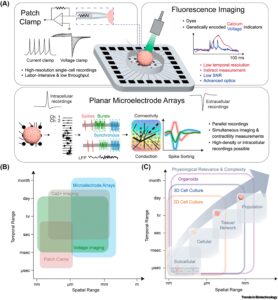
To convert these living biological cultures into functional computational devices, researchers couple them to electronic interface hardware using Microelectrode Arrays (MEAs).
Some high-density CMOS MEA platforms, such as the bi-directional microelectrode system evaluated by Cai et al. (2023), integrate thousands of addressable microelectrodes onto a single sensor chip. In contrast, other biocomputing research platforms use substantially more compact electrode architectures; for example, the Neuroplatform described by Jordan et al. (2024) utilizes 32 electrodes in total across four glass MEAs, allocating eight electrodes to interface each individual organoid.
When an action potential propagates across an adjacent neuronal membrane, the rapid flux of sodium (Na+) and potassium (K+) ions generates localized microvolt-scale fluctuations in the extracellular electrical potential. The microelectrode detects these localized voltage transients, which are band-pass filtered to separate individual action potentials from slow local field oscillations and digitized across multichannel acquisition channels at kilohertz sampling rates (Cai et al., 2023; Jordan et al., 2024).
In the opposite direction, the digital host delivers sensory inputs by driving biphasic current or voltage pulses through designated stimulating electrodes. These electrical transients depolarize adjacent neuronal membranes past action-potential thresholds, initiating spike trains that propagate through the network’s intrinsic synaptic pathways.
| Signal Pipeline Stage | Physical Component | Signal Modality | Operational Function |
|---|---|---|---|
| Input Encoding | Digital Host Workstation | Binary software instructions | Translates environmental states into spatial-temporal pulse matrices |
| Bio-Transduction In | CMOS Microelectrode Array | Extracellular current/voltage pulses | Depolarizes cell membranes to trigger localized action potentials |
| Processing & Plasticity | Living Neural Substrate | Intracellular ionic flux; neurotransmission | Executes analog integration, dendritic summation, and synaptic adaptation |
| Bio-Transduction Out | High-Density Sensing Electrodes | Microvolt-scale extracellular potentials | Captures extracellular action potentials across multichannel acquisition hardware |
| Decoding & Actuation | Digital Feature Classifier | Spike frequency vectors and event timestamps | Converts decoded biological activity into system actuation commands |
IV. Teaching Cells to Compute: DishBrain, Pong, and Active Inference
A central challenge in wetware engineering is establishing how cultured biological networks can be directed to perform specific computational tasks without conventional software programming. In supervised artificial neural networks, training proceeds via loss optimization: loss gradients are systematically evaluated across parameter layers via algorithmic backpropagation (reverse-mode automatic differentiation), and connection weights are incrementally updated via gradient descent:
Wt+1 = Wt − η · (∂L / ∂Wt)
Living biological neural networks do not implement the explicit global error gradients, weight-transport symmetry, and reverse computational passes used by algorithmic backpropagation. An external investigator cannot directly inspect or set individual synaptic conductances distributed across hundreds of thousands of living cells.
To interpret the adaptive dynamics observed in the DishBrain experiment (conducted by researchers affiliated with Cortical Labs and academic institutions), Kagan et al. (2022) applied the theoretical framework of the Free Energy Principle formulated by Karl Friston. This model posits that adaptive non-equilibrium biological systems self-organize to minimize variational free energy, an information-theoretic bound on surprise or sensory divergence:
F ≈ DKL(q(θ) ∥ p(θ | y)) − ln p(y | m)
In the active-inference framework, adaptive systems are modeled as reducing variational free energy by updating internal states and/or acting on their environment to reduce discrepancies between predicted and received sensory states.
To apply this principle to computation, the researchers organized the microelectrode interface into coordinated functional domains:
- Sensory Stimulation Sectors: Dedicated electrodes delivered continuous electrical pulse trains whose frequency and spatial location encoded the coordinates of the virtual *Pong* ball and its distance from the paddle.
- Motor Recording Sectors: Recording electrodes monitored spike discharge rates from two discrete neuronal clusters. Elevated firing in the upper sector directed the paddle upward; elevated firing in the lower sector directed it downward.
- Structured vs. Chaotic Feedback: When the neural activity correctly positioned the paddle to return the ball, the system delivered a structured, predictable electrical pulse at a fixed frequency and single location. When the paddle missed the ball, the interface delivered an aperiodic, unpredictable burst of electrical noise across all channels.
Under this experimental design, the authors observed that cultures exposed to continuous closed-loop feedback adapted their collective activity to produce longer rallies and fewer missed balls. The authors interpreted this behavioral shift through active inference, proposing that structured feedback supplied more predictable sensory consequences than chaotic stimulation.
The empirical findings from DishBrain demonstrated that living neural networks, when placed inside an interactive feedback loop, can alter their physical dynamics to perform real-time adaptive control tasks without relying on algorithmic gradient descent.
V. Brainoware: Physical Reservoir Computing with 3D Organoids
While the DishBrain experiment established closed-loop sensorimotor control in planar neural cultures, researchers at Indiana University Bloomington extended biocomputation into three dimensions. In a study published in Nature Electronics, a research group led by bioengineer Feng Guo (Cai et al., 2023) demonstrated “Brainoware,” a biohybrid architecture utilizing an intact human cortical organoid as a physical computational reservoir.
Reservoir computing is an established paradigm designed for processing dynamic, non-linear spatiotemporal data. In conventional recurrent neural networks (RNNs), optimizing internal recurrent feedback loops requires substantial computational overhead and often encounters vanishing or exploding gradient artifacts.
Physical reservoir computing circumvents this training bottleneck: temporal input signals are mapped into a high-dimensional, non-linear physical system (the reservoir), which projects the inputs across a rich dynamical state space. Because the physical substrate natively performs the non-linear temporal projection, internal recurrent connections are left unmodified. Only a simple, linear readout layer coupled to the reservoir outputs is trained using standard regression techniques.
| Computational Phase | Technical Implementation | Biological Substrate Role | Quantitative Benchmark |
|---|---|---|---|
| Input Encoding | Spatiotemporal electrical pulse stimulation | Acoustic spectrogram spatial mapping | 240 audio clips across 8 Japanese speakers |
| Reservoir Transformation | 3D cortical organoid on HD-MEA | High-dimensional non-linear synaptic routing | Intrinsic fading memory over hundreds of milliseconds |
| Output Readout | Linear classification (logistic regression) readout | Multi-channel spike feature decoding | \~78 percent accuracy in the reported eight-speaker Japanese-vowel speaker-identification benchmark |
| Nonlinear Forecasting | Chaotic Hénon map trajectory prediction | Recurrent dynamic mapping of phase space | Regression score improvement from \~0.356 to 0.812, outperforming the reported linear-regression baselines (Cai et al., 2023) |
Guo’s team placed an intact human cortical organoid on a high-density multielectrode array and evaluated its computational performance across two distinct tasks: acoustic speaker identification and non-linear chaotic dynamical system forecasting (Cai et al., 2023).
For the speech recognition benchmark, the team evaluated 240 audio recordings of eight individual speakers pronouncing Japanese vowel sounds, converting acoustic frequency spectrograms into spatiotemporal electrical pulse sequences delivered to the organoid.
The biological reservoir exhibited two signature computational capabilities:
- Non-linear Spatiotemporal Transformation: The organoid transformed complex spatiotemporal stimulation patterns into separated, high-dimensional electrophysiological firing patterns across the recording array. It is important to emphasize that these transformations were measured functionally as electrophysiological population dynamics; while cellular mechanisms such as dendritic integration, recurrent synaptic excitability, and short-term facilitation are plausible contributors, the experiment measured input-output functional mappings rather than direct structural rewiring of individual synapses (Cai et al., 2023).
- Fading Memory Capacity: Due to intrinsic cellular biophysical time constants and short-term synaptic dynamics, stimulation-evoked responses persisted across hundreds of milliseconds, providing native temporal memory that integrated sequential inputs over time.
A linear classifier (logistic regression) trained on the organoid’s extracellular spike feature vectors achieved approximately 78 percent classification accuracy in the reported eight-speaker Japanese-vowel speaker-identification benchmark (Cai et al., 2023).
In the non-linear forecasting evaluation, Brainoware was tasked with predicting the chaotic trajectory of a discrete-time Hénon map. As reported by Cai et al. (2023), coupling the linear readout layer to the organoid reservoir improved the forecasting regression score from approximately 0.356 to 0.812, outperforming the reported linear-regression baselines lacking recurrent reservoir dynamics.
The Brainoware experiment demonstrated that a three-dimensional human brain organoid, when interfaced with high-density electronics, can operate as a physical reservoir computer, executing non-linear temporal transformations through its intrinsic electrophysiological dynamics.
VI. The Biological Infrastructure Stack: FinalSpark and Cortical Labs
As academic experiments validated the technical feasibility of biohybrid computation, private engineering ventures began constructing infrastructure to make living neural systems standardized, programmatic, and remotely accessible.
In Switzerland, biocomputing enterprise FinalSpark launched the Neuroplatform, an infrastructure installation designed to provide remote, cloud-based access to living human brain organoids. Because maintaining neural tissue requires specialized cell-culture, microfluidic, incubation and electrophysiological infrastructure, access has traditionally required laboratory facilities and biological expertise. FinalSpark addressed these operational hurdles by centralizing biological maintenance within an automated facility.
As documented by Jordan et al. (2024) in Frontiers in Artificial Intelligence, the Neuroplatform installation houses 16 human cerebral organoids distributed across four dedicated glass multi-electrode arrays.
The supporting instrumentation stack incorporates:
- Automated microfluidic peristaltic pumps that maintain continuous circulation of oxygenated nutrient media while clearing metabolic waste products.
- Hermetically sealed incubation chambers that regulate environmental conditions at 37.0°C and 5.0% carbon dioxide.
- Digital electrophysiology boards capable of uninterrupted 24/7 stimulation and multichannel extracellular recording.
- A programmatic Python API that enables remote researchers to write code, configure stimulation sequences, and stream electrophysiological telemetry over standard internet protocols.
Research published by Jordan et al. (2024) reported that the Neuroplatform accumulated more than 18 terabytes of electrophysiological recordings across more than 1,000 organoids during initial operational benchmarking. According to updated platform documentation released by FinalSpark (FinalSpark, 2026), the company reports that this internal electrophysiological data repository has expanded past 30 terabytes. By automating fluidic replacement and environmental maintenance, Jordan et al. reported individual organoid operational lifespans exceeding 100 days within the Neuroplatform.
| Infrastructure Layer | Functional Components | Primary Engineering Requirement |
|---|---|---|
| Application Layer | Drug screening assays, physical reservoir computing, edge robotics | Task-specific encoding protocols and classification models |
| Platform & API Layer | Cloud access orchestration, Python client libraries, automated scheduling | 24/7 programmatic access and streaming data telemetry |
| Signal Translation Layer | Real-time spike sorting engines, digital filtering, regression readouts | Low-latency feature extraction and event classification |
| Physical Interface Layer | High-density microelectrode arrays (hundreds to thousands of microelectrodes) | Biocompatible surface coatings and microvolt-scale amplification |
| Life-Support Layer | Peristaltic microfluidics, sterile media perfusion, thermal/gas regulation | Homeostatic maintenance (37°C, 5% CO2) and nutrient delivery |
| Biological Substrate Layer | hiPSC-derived cortical neurons, 3D organoids, neural assembloids | Controlled differentiation, structural integrity, and synaptic viability |
Cortical Labs has pursued an alternative, decentralized hardware model. Rather than providing cloud-hosted time-share access to a centralized biological compute cluster, the company developed the CL1, an autonomous desktop and rack-mountable biological processing unit described in Cortical Labs Hardware Specifications.
While Cortical Labs’ early academic studies in Neuron utilized both embryonic mouse and human induced pluripotent stem cell-derived cortical neurons, commercial deployments of the CL1 center on human-derived neural preparations. The CL1 encloses these living neural networks within an autonomous, field-swappable biological cartridge containing integrated nutrient reservoirs, fluidic circulation loops, gas-permeable incubation membranes, and high-density microelectrodes. Cortical Labs states that these closed-loop cartridges can maintain viable neural networks for operational horizons of up to six months.
The deployment of these commercial platforms marks an exploratory transition from bespoke laboratory preparations toward standardized, programmatic infrastructure for biological computing.
VII. The Physical Limits of Growing a Computer
Despite these empirical achievements, biological computing faces severe material and biophysical constraints. Public discussions frequently cite the adult human brain’s low metabolic power consumption, often estimated at approximately twenty watts (Clarke & Sokoloff, 1999), as presumed proof that biological processors will rapidly displace silicon accelerators. This comparison is scientifically incomplete because it isolates the metabolic consumption of cellular tissue from the external energy required to keep that tissue alive in a laboratory.
The human brain operates within an intact organism that provides continuous cardiovascular circulation, autonomous pulmonary oxygenation, liver-regulated glucose homeostasis, and systemic immune defense. A millimeter-wide organoid mounted on an electrode grid is an incomplete, fragile biological system that requires substantial external life-support machinery.
When evaluating real-world operational efficiency, one must distinguish between the metabolic energy of the tissue and the total electrical power required by external life support, fluidic perfusion, environmental thermal regulation, and signal translation electronics. Biological tissue’s low intrinsic metabolic power does not represent the total energy required to maintain, stimulate, record from, and control a living computational substrate in vitro. While cultured neural networks metabolize minimal chemical energy, operating those networks in a laboratory requires active life-support instrumentation, microfluidics, signal amplification, and digital host computing systems.
Beyond system thermodynamics, biological scaling is bounded by three major engineering constraints:
1. The Diffusion Limit and Vascularization Deficits
In the mammalian cortex, an extensive capillary network ensures that neurons reside in close physical proximity to perfused microvessels, facilitating rapid metabolic exchange. By contrast, conventional in-vitro cerebral organoids lack endogenous blood vessels and functional endothelial perfusion. Dissolved oxygen and glucose must diffuse passively from the surrounding liquid media through the outer layers of cells. Under Fick’s first law of diffusion, the flux of dissolved oxygen drops rapidly with depth:
J = −D · (∂C / ∂x)
In avascular tissue, oxygen availability declines substantially with increasing distance from the surface, with roughly 100 to 200 micrometers often used as an approximate physiological diffusion scale (McMurtrey, 2016). In cerebral organoids, this limitation can contribute to hypoxic and necrotic cores as tissue dimensions increase (Lancaster et al., 2013; Pașca et al., 2025), although the precise viability threshold depends on cellular density, metabolic demand, architecture, and culture conditions. Necrotic cores can compromise the viability and physiological integrity of surrounding tissue (Lancaster et al., 2013; Pașca et al., 2025).
Without effective vascularization or engineered nutrient-delivery strategies, increasing organoid size can intensify hypoxia, necrosis and metabolic constraints.
2. Stochastic Morphogenesis and the Reproducibility Barrier
Industrial semiconductor manufacturing is engineered for high physical determinism, with tightly controlled lithographic processes and rigorous quality assurance ensuring that fabricated units execute software instructions with reproducible digital behavior.
Biological tissue self-assembles through stochastic molecular cascades. When human stem cells differentiate into an organoid, their developmental trajectories are influenced by local microenvironmental fluctuations, chemical gradients, and cell-to-cell signaling variations. Consequently, two organoids grown from the same genetic cell line under identical laboratory protocols vary in their final cell-type proportions, baseline firing rates, synaptic density, and spatial connectivity.
A 2025 consensus framework published in Nature highlighted reproducibility and batch variability as major technical hurdles facing organoid translation. If every biological processing unit possesses a unique, variable internal architecture, establishing standardized software compilers, consistent operating parameters, and reliable performance benchmarks becomes exceptionally difficult.
Separately, the U.S. National Institutes of Health established the Standardized Organoid Modeling Center with $87 million in contracts over its first three years. The program’s core objective is the standardization and quality control of organoid systems: establishing rigorous validation benchmarks, automated culture protocols, and multi-batch characterization pipelines to improve biological reproducibility and reduce reliance on animal models.
3. Substrate Mortality and Non-Replicable Physical Memory
Digital computational state can be serialized to non-volatile storage and reproduced on compatible hardware. Model parameters and explicitly serialized computational state can be stored and reproduced with bit-level fidelity:
Serialized Weight Parameters ──\[Bitwise Replication\]──► Arbitrary Compatible Processors
In a biological neural network, computational memory is physically embodied in the living substrate itself: the geometric arborization of dendritic trees, the spatial distribution of axonal projections, receptor densities across postsynaptic densities, and dynamic distributions of intracellular ion pools. There is currently no established method for nondestructively reading out the complete computationally relevant biological state, serializing it into a bitstream, and reproducing an equivalent living network elsewhere.
Furthermore, biological tissue remains mortal. Planar cultures and organoids are vulnerable to bacterial or fungal contamination, fluidic shear stress, pH shifts, osmotic shock, and cumulative electrophysiological fatigue from repeated stimulation. When an organoid dies, the specific physical network topology formed through prior stimulation is permanently lost.
VIII. The Engineering Realities: A Comparative Assessment
To assess biological computing in engineering terms, it is useful to compare it with silicon accelerators and solid-state neuromorphic chips across consistent physical and operational dimensions.
A critical requirement is establishing consistent system boundaries when discussing power consumption. Table 5 defines these operational boundaries explicitly, separating isolated processor power from total facility overhead.
| System Boundary | Physical Sub-Systems Included | Primary Physical Energy / Signal Mechanism | Thermodynamic & Infrastructure Characteristics |
|---|---|---|---|
| CMOS Processor Core (Silicon Alone) | Arithmetic logic units, register files, SRAM caches | Deterministic electronic switching of CMOS gate capacitances | High active power dissipation dominated by clock distribution, logic switching, and memory bus transfers. |
| Neuromorphic Chip (Silicon Alone) | Spiking digital soma, on-chip SRAM / routing mesh, or analog memristor array | Sparse, event-driven state transitions; low static leakage | Event-driven energy dissipation scales directly with spike activity; orders of magnitude lower idle power than conventional clocked processors. |
| Biological Substrate Alone (Cellular Tissue) | Living cortical tissue (approx. 10^5 to 10^6 cells on MEA) | Enzymatic ATP hydrolysis; continuous passive and active ionic flux | Extremely low intrinsic metabolic dissipation sustained by biochemical nutrient consumption rather than electrical wall power. |
| Complete Wetware Installation (Facility Level) | Peristaltic pumps, incubator thermal heaters, CO2 gas regulators, fluidics, signal conditioning, host PC | Total infrastructure electrical power supporting continuous bioreactor homeostasis | Overall facility electrical power draw dominated by external electro-mechanical life support, fluidic circulation, environmental heating, and host computing systems. |
Note on System Boundaries: The isolated biological tissue exhibits extremely low metabolic power consumption, but operating the biological processor requires active life-support instrumentation, microfluidics, signal amplification, and digital host computing systems.
Table 6 provides a comparative assessment across physical, operational, and computational dimensions.
| Performance Attribute | Advanced Silicon Accelerator (e.g., Modern GPU / TPU) | Neuromorphic Silicon (e.g., Intel Loihi 2, Memristive Crossbars) | Biohybrid Wetware Processor (e.g., FinalSpark Neuroplatform, Cortical Labs CL1) |
|---|---|---|---|
| Physical Substrate | Etched crystalline silicon with high-k metal-gate CMOS transistors | Silicon CMOS spiking circuits; experimental analog memristor crossbars | Living human and rodent neurons, glia, and 3D cerebral organoids |
| Signal Modality | Clocked digital logic with binary state representation and high-frequency synchronous operation | Asynchronous event-driven electrical voltage spikes (sparse event timing) | Analog electro-chemical ion flux (Na+, K+, Ca2+), neurotransmitter release, field potentials |
| Computational Primitive | Synchronous matrix multiplication, floating-point tensor arithmetic | Integrate-and-fire spike dynamics, state-dependent synaptic updates | Non-linear spatial-temporal integration, dynamic dendritic summation, intrinsic resonance |
| Energy Dissipation (Substrate Only) | High electrical dissipation associated with computation and memory movement | Low power relative to conventional clocked architectures under suitable event-driven workloads | Low intrinsic cellular metabolic energy dissipation |
| Energy Dissipation (Total System) | Substantial facility-level power consumption including active cooling, power delivery, and host server infrastructure | Low-overhead peripheral footprint including host interface boards and peripheral I/O | Facility-scale life-support power footprint including microfluidic pumps, thermal heaters, gas regulation, and host workstation |
| Plasticity & Learning Mechanism | Offline gradient descent with backpropagation via global weight optimization | Architecture-dependent local learning rules (including STDP in some systems) or programmable device updates | Biological plasticity mechanisms (e.g., activity-dependent remodeling, LTP/LTD) and homeostatic tuning |
| Hardware Architecture Adaptability | Permanently fixed upon lithographic fabrication | Fixed circuit layout; reconfigurable digital routing or variable resistance weights | Dynamic living physical substrate capable of continuous structural self-assembly |
| Operational Lifespan & Retention | Multi-year continuous operation with non-volatile memory retention | Multi-year operation; volatile SRAM or non-volatile analog memristive state | Bounded biological lifespan (reported from weeks up to slightly >100 days); non-transferable physical memory |
| Scalability & Manufacturability | Highly mature global foundry infrastructure with automated fabrication | Growing semiconductor ecosystem with standard CMOS process compatibility | Custom biological cleanrooms, manual or semi-automated cell culture, stochastic organoid differentiation |
IX. Near-Term Horizons: Where Wetware May Address Specialized Problems
Current evidence does not establish biological computing as a replacement for silicon accelerators in general computation, high-throughput cloud services, or large-model training. However, there are specialized domains where the distinctive dynamics of living neural tissue may offer capabilities that are difficult to reproduce efficiently in conventional solid-state architectures.
Among the proposed applications of organoid intelligence, biomedical research, pharmacology, and toxicology are prominent areas of investigation, developing at the interface of computational neurobiology and preclinical safety testing.
1. High-Content Neurotoxicology and Safety Screening
Historically, CNS drug development has exhibited exceptionally high failure rates; one cited analysis found final FDA marketing-approval rates of only 6.2 percent for CNS drugs during its sampled period (Gribkoff & Kaczmarek, 2017). One important contributor is the limited predictive validity of some preclinical models, including differences between animal neurobiology and human physiology.
Biohybrid wetware platforms offer a potential complementary approach: measuring functional electrophysiological responses to chemical compounds in living human neural networks. Rather than waiting for animal behavioral readouts or static cell-death assays, researchers can expose an instrumented human cortical organoid to candidate compounds and continuously monitor changes in network-level electrophysiological activity.
Disruptions in synchronized firing bursts, population oscillatory activity, or baseline synaptic transmission can provide functional electrophysiological readouts of neurotoxicity (Johnstone et al., 2010).
In July 2025, the U.S. National Institutes of Health announced changes to its funding-announcement practices intended to prioritize human-based research methodologies, encouraging the use of human-based in-vitro systems, microphysiological models, and organoid platforms alongside traditional methodologies (NIH Grants & Funding, 2025). By providing automated platforms capable of continuous electrophysiological recording from human neural tissue, such systems could support research approaches consistent with this broader policy emphasis.
2. Patient-Specific Disease Modeling and Personalized Pharmacotherapy
Because human cerebral organoids can be generated from patient-derived induced pluripotent stem cells, they can capture the specific genetic background of individual patients.
For neurological conditions characterized by polygenic risk architectures, such as autism spectrum disorders, schizophrenia, and sporadic forms of Alzheimer’s and Parkinson’s diseases, animal models can have limited ability to reproduce aspects of human disease biology. An organoid derived from a patient’s own somatic cells retains the individual’s genetic background, enabling researchers to study disease-associated biology in human neural tissue.
When coupled to microelectrode interfaces, these patient-derived organoids serve as functional disease testbeds. Researchers can evaluate whether experimental compounds restore normal firing synchrony or baseline plasticity in patient-specific networks, potentially enabling functional preclinical drug screening before compounds advance to clinical testing.
As highlighted in translational roadmaps (Smirnova et al., 2023; Hartung et al., 2024), these pharmacological and toxicological applications represent among the nearer-term potential translational applications of organoid intelligence.
| Application Domain | Conventional Testing Approach | Wetware Electrophysiological Approach | Translational Advantage |
|---|---|---|---|
| Neurotoxicity Screening | Animal behavioral models and static cell viability assays | Continuous multichannel electrophysiological recording | Direct detection of functional, sub-lethal electrophysiological disruption in human tissue |
| Personalized Medicine | Generalized clinical trial statistics and demographic profiling | Patient-derived hiPSC organoids instrumented on MEAs | Functional screening of patient-specific genetic backgrounds and therapeutic responses |
| CNS Drug Discovery | Rodent models with divergent receptor architectures | Human 3D cortical organoids and neural assembloids | Human-relevant synaptic responses and therapeutic effects; potential to improve human relevance and translational screening |
| Neurodevelopmental Research | Post-mortem histology and genetic knockout animals | Longitudinal recording of spontaneous neural network maturation | Longitudinal tracking of neural network maturation and functional development in living tissue |
X. The Ethical and Governance Frontier
Interfacing living human brain tissue with electronic hardware and training it to execute functional computational tasks raises profound ethical and legal questions. As biological computing advances from basic cell cultures to increasingly complex 3D organoids, the scientific community faces novel governance challenges.
A primary ethical threshold centers on the concepts of consciousness, sentience, and the capacity to experience pain or distress.
The International Society for Stem Cell Research (ISSCR, 2021/2025) guidelines state that there is currently no biological evidence suggesting consciousness or pain perception in CNS organoids that would warrant specialized oversight, while noting that future maturation or increased complexity could alter the ethical assessment. Standard cerebral organoids lack the integrated macro-anatomical organization, sensory organs, and mature developmental architecture of an intact human brain. While specialized assembloid protocols and co-cultures increasingly model inter-regional projections and rudimentary vascular networks, standard cortical organoid models do not reproduce mature thalamocortical loops, cerebellar circuits, functional vascular perfusion, or a mature blood-brain barrier (Lancaster et al., 2013; Pașca et al., 2025).
A central concern highlighted by bioethicists is the risk of policy distortion and misdirected regulatory frameworks caused by sensationalized media coverage. While Cortical Labs adopted the term “synthetic biological intelligence” and used the colloquial phrase “sentience” in the title of its 2022 Neuron paper (Kagan et al., 2022), the terminology subsequently drew scientific criticism (Balci et al., 2023), with researchers arguing that terms such as ‘sentience’ and ‘intelligence’ required greater evidentiary and conceptual caution. The episode illustrates a broader governance challenge: scientific communication can shape public perceptions of biological capabilities before the underlying evidence is mature.
Nevertheless, bioethicists point out that governance frameworks must be established before laboratory systems achieve greater biological complexity. Reviews by Shlobin et al. (2024) in Nature Reviews Bioengineering and Smirnova et al. (2023) in Frontiers in Science identify several practical governance questions:
- Donor Consent and Intellectual Property: Standard informed consent forms for somatic tissue donation (e.g., skin biopsies or blood draws) traditionally cover biomedical research, disease modeling, and genetic sequencing. They do not explicitly contemplate that the donor’s cells might be reprogrammed into immortalized stem cell lines, differentiated into neural organoids, coupled to electronic hardware, and utilized as computational processing units. Who owns the intellectual property or computational models derived from an individual donor’s living cells?
- Commercial Ownership of Living Compute Substrates: If a private company provides remote cloud access to living human brain tissue, what legal classifications govern that tissue? Is an organoid deployed on a biocomputing cluster classified as a biological specimen, a medical device, or an industrial asset?
- Dual-Use Considerations: As biohybrid systems become more capable, frameworks must be established to monitor potential dual-use applications, ensuring that autonomous biological computing systems operate under strict human oversight and biosafety protocols.
To address these questions, researchers in organoid intelligence have advocated for an embedded ethics approach, integrating bioethicists, legal scholars, and regulatory specialists directly into biocomputing research teams from the inception of experimental programs (Smirnova et al., 2023; Hartung et al., 2024).
| Biological & Functional Stage | Electrophysiological & Physical Markers | Current Scientific Assessment & Oversight Framework |
|---|---|---|
| Stage 1: Planar 2D Monolayers | Unsynchronized spikes; localized field potentials; simple closed-loop sensorimotor adaptation | Current evidence does not establish consciousness or pain perception; standard institutional biosafety and stem-cell oversight frameworks apply |
| Stage 2: Standard 3D Organoids | Spontaneous oscillatory burst patterns; localized network synchronization; intrinsic short-term plasticity | Current biological evidence does not establish consciousness; current organoid models lack mature whole-brain organization and integrated sensory architecture; subject to applicable institutional stem-cell research oversight frameworks (ISSCR Version 1.2, August 2025 update; provisions retained from 2021) |
| Stage 3: Advanced Assembloids | Reciprocal inter-regional signaling; complex network oscillations; activity-dependent plasticity across repeated stimulation or task conditions | Active neuroethical investigation: may warrant enhanced prospective ethical review, electrophysiological monitoring, and clearly defined developmental endpoints |
| Stage 4: Vascularized / In Vivo Chimeras | Sustained long-term viability; integration with host vasculature; behavioral modulation in animal hosts | High ethical sensitivity: stringent regulatory governance, rigorous animal-welfare oversight, and heightened scrutiny of human-cell contributions to animal nervous systems, with particular ethical sensitivity in non-human-primate research. |
XI. Synthesis and the Bio-Silicon Convergence
The trajectory of biological computing is not a zero-sum contest between living cells and silicon chips. Rather than replacing solid-state semiconductors, biological neural systems offer complementary capabilities that can operate alongside conventional processors.
Biological neural signaling operates on substantially slower timescales than signal propagation in conventional electronic and optical interconnects, although biological networks compensate in part through high interconnectivity, massive parallelism, and distributed dynamical processing. A biological action potential propagates along an unmyelinated axon at speeds between one and ten meters per second, which is orders of magnitude slower than an electrical signal traveling through a copper trace on a silicon motherboard.
Biological neural networks compensate for their slower transmission speeds through high interconnectivity, massive parallelism, and distributed dynamical processing. Each cortical neuron maintains thousands of dynamic, non-linear synaptic connections, processing continuous analog inputs concurrently across complex dendritic trees.
Silicon systems provide deterministic numerical calculation, high-precision floating-point arithmetic, rapid programmatic execution, and reliable non-volatile data storage. Biological systems provide continuous spatiotemporal dynamics, adaptive responses to inputs, and self-organizing physical substrates.
One proposed architectural direction is the hybrid bio-digital co-processor. In this paradigm:
- Conventional digital hardware manages high-speed input/output communication, software execution, and system-level control.
- Neuromorphic interface circuits perform real-time analog-to-digital and digital-to-analog signal transduction between electronics and biological tissue.
- Living neural organoids operate as specialized analog acceleration units, performing physical reservoir transformations and adaptive filtering.
- Digital machine learning readouts decode multi-channel electrophysiological activity into discrete actuation commands.
| Architectural Sub-System | Primary Physical Medium | Native Operational Strengths | Primary Engineering Role in Biohybrid Stack |
|---|---|---|---|
| Digital Host Processor | CMOS Silicon Transistors | Deterministic logic, gigahertz clock speeds, exact memory serialization | Platform orchestration, API handling, environment simulation |
| Neuromorphic Transceiver | Mixed-Signal CMOS / MEAs | Microvolt signal amplification, low-latency spike detection | Bi-directional signal translation between electrons and ions |
| Biological Neural Reservoir | Living Human 3D Organoid | Continuous non-linear dynamics, native temporal memory | High-dimensional physical reservoir projection and non-linear mapping |
| Digital Readout Classifier | Linear Digital Readout | Low-complexity parameter optimization, rapid inference | Decodes high-dimensional biological firing states into system outputs |
Whether biological computing develops into a mainstream computing technology or remains a specialized research tool will depend on resolving fundamental physical challenges: overcoming diffusion limits through artificial vascularization, standardizing morphogenesis to achieve manufacturing reproducibility, and constructing long-lasting, high-density bio-electronic interfaces.
The significance of Organoid Intelligence may extend beyond computational utility. By building machines that compute using living human neurons, researchers are constructing experimental platforms that bridge the boundary between information theory and neurobiology. In seeking to program the cell, science is developing an experimental apparatus to comprehend the physical foundations of intelligence itself.
References
1.
Kagan, B. J., Kitchen, A. C., Tran, N. T., Habibollahi, F., Khajehnejad, M., Parker, B. J., Bhat, A., Rollo, B., Razi, A., & Chong, H. W. (2022). In vitro neurons learn and exhibit sentience when embodied in a simulated game-world. Neuron, 110(23), 3952–3969.
- Cai, H., Ao, Z., Tian, C., Wu, Z., Liu, H., Tchieu, J., Gu, M., Mackie, K., & Guo, F. (2023). Brain organoid reservoir computing for artificial intelligence. *Nature Electronics*, 6, 1032–1039.
- Smirnova, L., Morales Pantoja, I. E., Bako, P. O., Chew, D. J., Curley, M. G., Dikeakos, J. D., Emani, P. S., Gomez, J. M., Gordon, J. M., Huang, F., Jordan, F. D., Kagan, B. J., Kothamasu, V., Kutter, M., Lewis, G., Liu, Q., Namboodiri, V. M., Pasca, S. P., Politzer, L. E., … & Hartung, T. (2023). Organoid intelligence (OI): the new frontier in biocomputing and intelligence-in-a-dish. *Frontiers in Science*, 1:1017235.
- Jordan, F. D., Kutter, M., Comby, J.-M., Brozzi, F., & Kurtys, E. (2024). Open and remotely accessible Neuroplatform for research in wetware computing. *Frontiers in Artificial Intelligence*, 7:1376042.
- FinalSpark (2026). Neuroplatform: The World’s First Biocomputing Platform. *FinalSpark R\&D Platform Documentation*.
- Cortical Labs (2025/2026). CL1: Biological Computer Hardware Specification. *Cortical Labs Corporate Documentation*.
- Hartung, T., Morales Pantoja, I. E., & Smirnova, L. (2024). Brain organoids and organoid intelligence from ethical, legal, and social points of view. *Frontiers in Artificial Intelligence*, 6:1307613.
- Kinderlerer, J. (2023). Organoid intelligence: society must engage in the ethics. *Frontiers Policy Labs*.
- International Society for Stem Cell Research (ISSCR). (2021/2025). Guidelines for Stem Cell Research and Clinical Translation (Version 1.2, August 2025 update; organoid-relevant provisions retained from 2021 framework).
- National Institutes of Health (NIH) (2025). NIH establishes nation’s first dedicated organoid development center to reduce reliance on animal modeling. *NIH Press Releases*.
- National Institutes of Health (NIH) Grants & Funding (2025). NIH Initiative to Prioritize Human-Based Research in Funding Announcements. *NIH Extramural Nexus*.
- Pașca, S. P., Arlotta, P., Bateup, H. S., Camp, J. G., Cappello, S., Gage, F. H., Knoblich, J. A., Kriegstein, A. R., Lancaster, M. A., Ming, G. L., Novarino, G., Okano, H., Park, I. H., Parmar, M., Reiner, O., Song, H., Studer, L., Takahashi, J., Temple, S., Testa, G., Treutlein, B., Vaccarino, F. M., Vanderhaeghen, P., & Young-Pearse, T. L. (2025). A framework for neural organoids, assembloids and transplantation studies. *Nature*, 639(8054), 315–320.
- Shlobin, N. A., Savulescu, J., & Baum, M. L. (2024). The ethical landscape of human brain organoids and a mindful innovation framework. *Nature Reviews Bioengineering*, 2(9), 785–796.
- Brown, P., & Varghese, S. (2026). Computing inspired by the brain: a journey from algorithms to organoids. *Nature Computational Science*, 6, 686–696.
- Johns Hopkins University Applied Physics Laboratory (2024). Neuroscience-Inspired Artificial Intelligence. *JHU APL Research Initiatives*.
- International Energy Agency (IEA) (2024). Data Centres and Data Transmission Networks. *IEA Tracking Report*.
- Patterson, D., Gonzalez, J., Le, Q., Liang, C., Munguia, L.-M., Rothchild, D., So, D., Texier, M., & Dean, J. (2021). Carbon Emissions and Large Neural Network Training. *arXiv preprint arXiv:2104.10350*.
- McMurtrey, R. J. (2016). Analytic Models of Oxygen and Nutrient Diffusion, Metabolism Dynamics, and Architecture Optimization in Three-Dimensional Tissue Constructs with Applications and Insights in Cerebral Organoids. *Tissue Engineering Part C: Methods*, 22(3), 221–249.
- Gribkoff, V. K., & Kaczmarek, L. K. (2017). The Need for New Approaches in CNS Drug Discovery: Why Drugs Have Failed, and What Can Be Done to Improve Outcomes. *Neuropharmacology*, 120, 11–19.
- Lancaster, M. A., Renner, M., Martin, C. A., Wenzel, D., Bicknell, L. S., Hurles, M. E., Homfray, T., Penninger, J. M., Jackson, A. P., & Knoblich, J. A. (2013). Cerebral organoids model human brain development and microcephaly. *Nature*, 501(7467), 373–379.
- Horowitz, M. (2014). 1.1 Computing’s energy problem (and what we can do about it). *2014 IEEE International Solid-State Circuits Conference Digest of Technical Papers (ISSCC)*, 10–14.
- Vaswani, A., Shazeer, N., Parmar, N., Uszkoreit, J., Jones, L., Gomez, A. N., Kaiser, Ł., & Polosukhin, I. (2017). Attention Is All You Need. *Advances in Neural Information Processing Systems*, 30, 5998–6008.
- Clarke, D. D., & Sokoloff, L. (1999). Circulation and Energy Metabolism of the Brain. In *Basic Neurochemistry: Molecular, Cellular and Medical Aspects*, 6th ed., Siegel, G. J., et al. (eds). Philadelphia: Lippincott-Raven.
- Camp, J. G., Badsha, F., Florio, M., Kanton, S., Gerber, T., Wilsch-Bräuninger, M., Lewitus, E., Sykes, A., Hevers, W., Lancaster, M. A., Knoblich, J. A., Lachmann, R., Pääbo, S., Huttner, W. B., & Treutlein, B. (2015). Human cerebral organoids recapitulate gene expression programs of fetal neocortex development. *Proceedings of the National Academy of Sciences*, 112(51), 15672–15677.
- Balci, F., Hamed, S. B., & van den Heuvel, M. P. (2023). A response to claims of emergent intelligence and sentience in a dish. *Neuron*, 111(5), 604–605.
- Johnstone, A. F. M., Gross, G. W., Weiss, D. G., Schroeder, O. H. U., Gramowski, A., & Shafer, T. J. (2010). Microelectrode arrays: a physiologically based neurotoxicity testing platform for the 21st century. *Neurotoxicology*, 31(4), 331–350.
