
The hidden economy behind the plasma donors who supply some of medicine’s most essential drugs
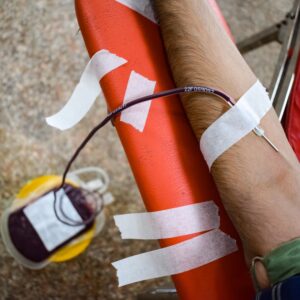
Inside a commercial plasma center, the exchange is stripped of clinical romance. A donor sits in a vinyl recliner, tethered by tubing to an automated plasmapheresis machine. Blood leaves the arm, passes through an automated separator that strips away its amber liquid, and returns the red cells to the vein. The donor walks out with a bruised crook of the elbow and fifty dollars loaded onto a prepaid card. At least 48 hours later, they can do it again.
Most people assume this is a marginal quirk of the gig economy, a rougher cousin of the payday loan. The market numbers say otherwise. Commercial market-research firms put the global plasma-derivative market at roughly $34 to $38 billion, on track to roughly double by the mid-2030s. Those are industry estimates, not audited totals, but even the low end of that range describes a market with tens of billions of dollars moving through it every year.
An entire tier of medicine depends on a raw material that industrial biotechnology still cannot make in a vat. These are the therapies used to treat immune deficiencies, bleeding disorders, and severe burns. It has to come from a living person, one bag at a time. Who bears the physical cost of supplying that material, and who captures the money it generates? The second question turns out to be harder to answer cleanly than the first.
I. A Raw Material That Resists Substitution
Whole blood is bound by a stubborn biological limit. Red cells take about eight weeks to regenerate, so blood donation is capped globally at a handful of visits a year. Plasmapheresis gets around that ceiling. The machine returns the donor’s red cells and platelets and keeps only the protein-rich plasma, so blood volume is largely preserved and circulating plasma volume is generally restored within a day or two. Rebuilding the specific proteins that plasma carries takes longer, a distinction that matters more once donation frequency climbs.
Under FDA rules, a qualifying donor can give twice within any seven-day period, with at least 48 hours between visits. That creates a theoretical ceiling of 104 donations a year. The FDA’s nomogram sets collection volume in three tiers based on donor weight, ranging from about 625 milliliters for the lowest-weight donors up to 800 milliliters for the highest. Multiplying the regulatory maximum by that tiered range works out to somewhere between 65 and 83 liters annually from a single person, a figure derived from the regulation’s own volume limits rather than one that appears in it directly. Actual donor behavior varies well below it. The rule made high-frequency donation possible, and plasma built an industrial supply chain around that possibility in a way whole blood never did.
Recombinant clotting factors are grown in bioreactors rather than pooled from donors, and they have transformed hemophilia care over the past three decades. That substitution shows the raw-material constraint has real limits, and any honest account of this industry has to take it seriously.
It hasn’t extended to the industry’s largest product line. Immunoglobulin therapies work because they contain a polyclonal mix of antibodies, the accumulated immune memory of thousands of different people’s exposures to thousands of different pathogens. A bioreactor can be engineered to produce one antibody with great precision. It cannot replicate the breadth of a pooled human immune history. Until that changes, the industry’s largest product category stays tied to human donors.
II. Putting a Number on “Billion-Dollar”
Commercial market-research firms estimated the global market for plasma-derived medicines at roughly $34 to $38 billion around 2024 and 2025, growing at a compound rate of around 7 to 9% a year. GMI and Towards Healthcare are among the firms behind that range. Those are separate commercial estimates rather than a single converging figure, and they’re informed industry estimates rather than official statistics. There is no widely cited regulator-produced audited total for the global market.
Within that estimated range, immunoglobulins are the dominant category. CSL Limited reported $6.06 billion in immunoglobulin revenue in its 2025 annual report, its largest single product category. That compares with $1.3 billion in albumin and $1.5 billion in hemophilia treatments. Those three categories make up most of CSL Behring’s $11.16 billion in total 2025 segment revenue, with the remainder coming from smaller product lines.
That revenue sits downstream of an unusually consolidated manufacturing layer. Plasma fractionation is dominated by a small number of companies. It’s the industrial chemistry that separates raw plasma into its component proteins. GMI Research names CSL, Takeda, Grifols, Octapharma, and Kedrion as the top five fractionators, and puts their combined share at around 80% of the global fractionation market as of 2024. That figure is about market share rather than physical manufacturing capacity. Other market-research firms cite similar ranges, though the precise number moves by analyst and year. This is a genuine oligopoly at the fractionation and manufacturing layer, requiring hundreds of millions of dollars in capital and years of regulatory approval to build. The collection side looks nothing like it. It’s a sprawling network of thousands of storefront centers, many run by those same companies but geographically dispersed in a way manufacturing isn’t.
A fragmented, dispersed collection layer feeds a concentrated, capital-intensive manufacturing layer, and that gap shapes the whole industry.
III. The Machinery Between a Vein and a Vial
Once collected, source plasma from paid donors must go through a mandatory quarantine hold before it can be released for manufacturing. The underlying regulation sets that hold at a minimum of 60 calendar days, a window meant to cover the interval in which a recent infection might not yet register on screening tests. The rule is codified at 21 CFR 640.69(f). That 60-day figure is still the codified rule. What has changed is enforcement. A 2023 FDA compliance guidance states the agency does not intend to take regulatory action against establishments that release plasma after 45 days instead, provided other donor-eligibility and testing requirements are met. Guidance documents like this one are explicitly non-binding. They state the agency’s current enforcement posture rather than change the regulation itself. In practice, the guidance makes the shorter timeline available rather than guaranteeing establishments use it.
From there, thousands of liters from different donors are pooled and run through Cohn cold-ethanol fractionation, a decades-old process using temperature, alcohol concentration, and pH to separate specific protein bands, followed by nanofiltration and viral-inactivation steps. CSL’s own reporting puts the full cycle from donation to finished vial at up to 12 months.
None of it is cheap to build. A commercial fractionation plant requires cleanroom-grade engineering and years of regulatory sign-off, a large part of why manufacturing capacity stayed consolidated even as collection centers multiplied. CSL Behring says the cost of producing plasma-derived therapies typically runs around 70% of the selling price, compared with about 19% for conventional chemical pharmaceuticals. That gap between cost and price is far narrower than for a typical drug, and it’s a real counterweight to any simple story about corporations extracting value from donors. A meaningful share of the difference between a $50 donation payment and a several-thousand-dollar vial of immunoglobulin is processing cost, not pure margin. Whether the scarcity of the raw material itself is also priced into that gap is a separate question. Later sections take it up once manufacturing, geography, and physiology have all been laid out.
IV. Where the Centers Are, and Why That Matters
Collection centers don’t wait passively for altruistic donors. A landmark study of commercial plasma clinics between 1980 and 1995 found they were five to eight times more likely to be sited in economically disadvantaged neighborhoods than chance would predict. More recent spatial research finds a similar pattern today, with centers clustering disproportionately in census tracts marked by high poverty rates, high rent burden, and low median income.
That’s a strong statistical association, though it doesn’t prove a specific corporate siting strategy. Plenty of donors give plasma for ordinary reasons rather than acute distress. It’s a flexible source of extra income, close to home, or just a habit. The association holds across two different eras and two different sets of researchers using different methods, which is harder to explain away than a single study would be. The industry’s supply is disproportionately drawn from places where a cash-for-time trade is more attractive, a narrower claim than saying the system runs on desperation.
Operators also actively manage donor retention on top of geography. Compensation is typically tiered, with payouts rising for a donor’s third, fourth, or fifth visit in a given period. Reuters reported in 2024 that CSL had begun testing dynamic pricing software, using a CRM tool to target donor incentives more precisely, including higher payments during low-traffic periods and lower payments at peak times, with the stated aim of managing donor costs and plasma supply together. The donor supplies biological material, but the company is also tracking and adjusting for donor behavior in a way that resembles inventory management, at least in the terms Reuters described.
V. What High-Frequency Donation Does to a Body
U.S. rules permit donation roughly twice as often as many European countries allow, where interdonation intervals commonly run up to two weeks rather than 48 hours, though European practice isn’t uniform and varies by country and blood service. That gap in frequency is also a gap in what the body is asked to rebuild between visits, since plasma volume and plasma protein don’t recover at the same rate.
A 2024 systematic review found that while donation is broadly safe at low-to-moderate frequency, high-frequency donors show measurable drops in total serum protein, IgG, and ferritin, though the review’s authors cautioned that the underlying evidence base remains limited and methodologically uneven. A more recent randomized trial found a similar pattern, with recovery of baseline IgG levels taking more than four weeks after donors stopped. The tiered payout structure described above rewards frequent visits, and it’s asking donors’ bodies to do something that pricing schedule doesn’t account for.
FDA rules require centers to maintain donor records and procedures meant to prevent cross-donation, though no evidence surfaced of a single nationwide registry linking donor records across competing commercial plasma companies. A donor who wanted to circumvent the 48-hour rule could, in principle, do so by visiting a different company’s center. How often that happens isn’t something the available evidence pins down.
VI. Why the Rest of the World Still Needs This System
Framing this as American commercial plasma against European altruism doesn’t survive contact with the data. Across Europe, domestically collected plasma covers only about 63% of demand for plasma-derived medicines, with most of the remainder predominantly imported from the United States.
The more telling detail is which European countries close that gap on their own, and how. Austria, Czechia, and Germany are close to 100% self-sufficient in immunoglobulins, and so is the United States outside Europe. All three European countries share a specific structural feature. Alongside public, non-profit blood services, they license private commercial operators to collect plasma and pay donors directly for their time. That’s the same basic model used in the U.S., though payment levels and program design differ by country.
Countries relying solely on unpaid public donation tend to run larger deficits and import to cover the difference. That correlation doesn’t prove compensation is the only route to self-sufficiency, and program design varies enough between countries that the comparison shouldn’t be flattened into a simple paid-versus-unpaid split. It does undercut the simpler story where a ban on compensation is a purely ethical choice with no supply consequence attached. The European Medicines Agency has warned directly that eliminating remunerated donation could trigger real shortages.
Australia adds a similar lesson from a different angle. Despite a well-regarded public, voluntary blood service, domestic plasma collection covered 38% of national demand as of 2024 reporting from Australia’s Productivity and Equality Commission, with the rest imported, again mostly from the U.S.
Most wealthy countries remain dependent on imported plasma rather than operating a domestic paid-collection system at the scale the U.S. and a handful of European countries run. Austria, Czechia, Germany, and the U.S. are the ones with demonstrated self-sufficiency. The rest continue to rely, to varying degrees, on imports to close the gap.
VII. Who Captures the Value
A finished dose of immunoglobulin therapy typically costs a health system several thousand dollars. The underlying business of collection, fractionation, and distribution is genuinely expensive to run, for the reasons Section III laid out. CSL Behring’s $11.16 billion in 2025 segment revenue came with a reported segment gross margin of 50.6%. That’s high for a business with this much physical infrastructure, but comparable margins are common across specialty pharmaceuticals with long development and approval cycles, so the figure alone doesn’t prove anything unusual is happening.
A clean per-liter accounting of a finished therapy’s price isn’t publicly available. Nobody breaks down how much comes from donor payment, collection overhead, manufacturing, distribution, and profit. Companies don’t publish that breakdown, and I could not find a credible public third-party dataset that does either. Who bears the physical cost of supplying plasma is straightforward. It’s the donor, measured in donation frequency and documented protein loss. Who captures the money is murkier. Captured revenue at the company level is measurable. The finished product’s economic surplus can’t be cleanly separated between the raw plasma and everything done to it afterward, not with the data that’s publicly available.
The donor’s fifty dollars represents a small share of a finished product’s selling price. But a finished vial’s price also embeds years of R&D, regulatory compliance, cold-chain logistics, and financing costs that have nothing to do with the donor, and a small share of final price is not the same claim as a small share of economic surplus. What can be said is narrower, and it holds regardless. Collectors, fractionators, and distributors all operate with a margin the donor has no visibility into and no real ability to bargain over. That’s a structural asymmetry between the party supplying a non-substitutable, physically limited resource and every party adding processing to it, even without a specific multiplier attached to it.
Conclusion
Two things are true at once. A commercially powerful system has grown up around plasma donation. It places recurring physical demands on the people supplying its raw material and gives them almost no visibility into what happens to the value downstream. The evidence from Austria, Czechia, Germany, and the U.S. suggests that same paid system may be close to necessary for keeping the world’s supply of plasma-derived medicine intact. Neither fact cancels the other out.
Picture the donor again, back in the recliner with the tubing in the arm and the machine running. Fifty dollars on a card, and legally back in that chair within 48 hours. What happens next is genuinely sophisticated, up to twelve months of quarantine, cold-ethanol fractionation, viral testing, and global distribution, ending in a vial that costs a hospital thousands of dollars. Strip away everything the industry has built on top of that donation, and a person is still where the chain starts, supplying something medicine still doesn’t know how to make without one.
Sources & References
- WHO: Blood Safety and Availability
- FDA: Inspection Guide, Source Plasma
- 21 CFR 640.65(b)(8), plasmapheresis donation frequency requirement
- 21 CFR 640.69(f), Source Plasma quarantine hold requirement
- FDA: Compliance Policy Regarding Blood and Blood Component Donation Suitability, Donor Eligibility and Source Plasma Quarantine Hold Requirements (2023, allowing 45-day release)
- CSL Limited 2025 Annual Report
- CSL Behring: Our Company (cost of production vs. selling price)
- CSL: The Journey of a Plasma Donation (manufacturing cycle time)
- GMI Research: Plasma Fractionation Market Size & Share, 2024 to 2034
- Towards Healthcare: Plasma Fractionation Market Sizing
- PMC: Understanding Supply Sustainability of Plasma-Derived Medicinal Products
- European Blood Alliance: EU Self-Sufficiency Fact Sheet
- NCBI Bookshelf: International Plasma Collection Practices
- EMA: Position Statement on Remunerated and Non-Remunerated Plasma Donors
- NSW Government: Growing Import Reliance for Plasma (Australia, 38% domestic coverage)
- PubMed Central: Geographic Concentration of Commercial Plasma Clinics
- ScholarWorks: Blood Plasma and Poverty in the United States
- ScienceDirect: Systematic Review, Plasmapheresis Frequency and Donor Health
- PubMed Central: Randomized Trial on Plasma Donation Frequency
- Reuters: CSL Tests Dynamic Pricing for Donor Compensation
