

How Human Trafficking and Organized Crime Built an Industrial Internet Business in Southeast Asia
The initial message arrives with calculated informality. The sequence below is a composite reconstruction of tactics documented across survivor accounts and investigations. The opening contact often appears as a mundane error: an inquiry asking if you are the tour guide from last Tuesday, a greeting sent to a slightly transposed telephone number, or a polite professional outreach on LinkedIn. The accompanying profile image displays a poised individual photographed in soft lighting: a luxury watch resting on a cafe table, an airport lounge in the background, a portrait of effortless stability.
If the recipient responds to clarify the mistake, the conversationalist does not disengage. They apologize with self-effacing courtesy. They remark upon the pleasant coincidence, offer a polite compliment, and steer the dialogue toward daily routines, business ventures, or personal reflections. Over days and weeks, they cultivate an atmosphere of unhurried, attentive intimacy.
Documented survivor testimonies collected by international human rights monitors reveal a starkly contrasting reality on the other side of that exchange.
The person sending those messages is not relaxing in an airport lounge. Across documented facilities in Southeast Asia, they are seated on an open production floor under fluorescent lighting, surrounded by rows of identical computer terminals. Supervisors patrol the aisles, enforcing discipline through threats and physical violence. The worker’s passport, identification cards, and personal telephone have been locked in an administrative safe. Taped to their workstation are instructional playbooks detailing conversational hooks, psychological scripts for manufacturing romantic attachment, and target profiles categorizing victims by age, liquid assets, and personal vulnerabilities.
This is one of the documented realities of cyber-fraud across parts of Southeast Asia. The digital interaction appears personal, spontaneous, and modern. At the most coercive facilities, the operational environment exhibits characteristics of a forced-labor camp. The person being defrauded thousands of miles away may be losing substantial savings to an organization that holds the worker typing the messages in coercive confinement.
I. The Scale of the Apparatus
To understand the phenomenon, one must first discard the image of the solitary hacker working behind terminal code in a darkened bedroom. The modern cyber-fraud compound is organized on the principles of factory production.
There is no single, unified global census of scam-compound workers, a limitation that international bodies acknowledge. However, international assessments outline an enterprise of staggering proportion:
- In a July 2026 press briefing at the United Nations in Geneva, the International Organization for Migration reported that online scam centres operating across Myanmar, Cambodia, and Laos could encompass as many as 300,000 workers, drawing personnel and trafficking victims from more than 80 countries (IOM Press Briefing / UN Geneva).
- In a separate, Myanmar-specific operational assessment, the International Organization for Migration reported that over 300,000 Myanmar and foreign nationals from more than 40 countries had been trafficked into forced cyber-fraud operations within Myanmar alone between late 2023 and 2026 (IOM Crisis Response).
- An assessment released through the INTERPOL Global Financial Fraud Threat Report noted that, as of March 2025, victims from 66 countries had been trafficked into online scam centres, with 74% of identified trafficking victims in relevant operational notices concentrated in Southeast Asian hubs.
These figures do not constitute a single, verified regional census. They represent distinct agency reporting periods, varying methodologies, and overlapping geographic estimates that must not be conflated into a single cumulative total. Yet taken together, these distinct reporting efforts suggest the substantial scale of the underlying labor systems: maintaining continuous messaging operations across multiple global time zones is consistent with large labor forces organized for sustained, multi-shift production.
II. The Architecture of the Compound
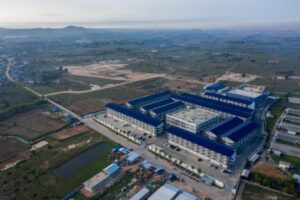
Scam facilities can be embedded in ordinary commercial developments. Depending on the jurisdiction, operations have been documented in integrated resort complexes, unfinished hotels, commercial office parks, and gated residential clusters.
In field research published by Amnesty International in November 2025, investigators documented at least 53 discrete compound locations across Cambodia where trafficking, forced labor, physical confinement, and torture occurred; in follow-up 2026 research tracking compound sites across the country, monitors expanded that registry to 86 total identified facilities. The physical layout reflects an operational pattern that integrates outward commercial camouflage with inward labor control:
┌────────────────────────────────────────────────────────────────────────┐
│ SCHEMATIC SYNTHESIS OF DOCUMENTED COMPOUND FEATURES │
│ Reinforced Walls · Barbed Wire · Guarded Gates · Security Checkpoints │
└───────────────────────────────────┬────────────────────────────────────┘
│
┌───────────────────────────────┴──────────────────────────────┐
▼ ▼
[SECURE LIVING QUARTERS] [THE PRODUCTION FLOOR]
• Controlled Dormitories • Rows of Computer Terminals
• Internal Canteens and Stalls • Barred Windows and Secure Doors
• Confinement and Punishment Areas • Operational Supervisors
• Confiscated Document Storage • Active Message Monitoring
The facility functions as a closed operational ecosystem. In reports published by the UN Office of the High Commissioner for Human Rights, investigators documented that compounds frequently combine multi-story buildings, reinforced gates, window grilles, and armed internal security. Workers live in dormitories on-site, purchase essentials from compound-operated stores, and work in tightly monitored operational rooms.
This architectural design serves operational functions. By physically enclosing workers behind perimeter checkpoints and barred windows, compound managers maintain strict physical containment, restrict workers’ ability to leave or communicate externally, and secure the uninterrupted operation of the message production rooms.
III. The Recruitment Machine and Debt Bondage
Physical architecture provides the container. The system also requires a continuous supply of human labor.
Recruitment pathways documented by the UN Office of the High Commissioner for Human Rights and partner monitoring bodies center on deceptive job advertisements deployed across social media platforms and messaging channels. While targeting varies, postings typically promise legitimate, well-remunerated positions in customer service, administrative support, data entry, and digital marketing, appealing to educated, multilingual, or digitally capable jobseekers facing limited employment opportunities in their home countries.
In its February 2026 report, A Wicked Problem, the UN Office of the High Commissioner for Human Rights emphasized that vulnerability to these recruitment schemes is shaped by systemic socioeconomic pressures. Economic inequality, social expectations, and persistent governance gaps constrain the choices available to jobseekers, making overseas offers compelling despite inherent risks.
Field investigations document a multi-stage recruitment and transit pattern:
- The Initial Offer: Recruits respond to deceptive job postings for technical or administrative positions that promise legitimate employment and travel support.
- Transit Corridors: In specific cases documented by human rights monitors and law enforcement, recruits travel through regional air hubs, with travel arrangements coordinated by recruitment facilitators.
- The Clandestine Transfer: In documented survivor accounts, facilitators move recruits across unofficial land or river crossings into guarded compounds or contested border areas.
- The Contract Inversion: Upon entry into the facility, managers seize recruits’ passports and personal communication devices.
At this point, the nature of the relationship changes. In documented cases, recruits are informed upon arrival that the promised employment does not exist and are told that they have incurred debts for transport, lodging, recruitment, or other associated costs. Under this debt-bondage mechanism, workers are told they must arrange outside payments or work inside the facility to clear the accumulated balance.
The mechanics of this labor trade are illustrated in specific legal proceedings. In May 2026, the National Investigation Agency of India filed a chargesheet against five individuals involved in a human-trafficking syndicate that lured Indian youths to Cambodia under false promises of data-entry employment. The NIA documented that the victims had their passports seized, were subjected to physical and mental coercion, and were forced to execute cyber-fraud schemes. In that specific investigation, the NIA established that the recruitment brokers charged between $2,000 and $3,000 for each individual delivered to the fraudulent enterprise.
The legal composition of the workforce requires careful delineation. As noted in the UNODC Inflection Point Report, the population inside these centers is not uniform. While many are trafficking victims subjected to forced criminality and debt bondage, others participate voluntarily as technical administrators, financial managers, or operational supervisors. Recognizing this distinction is essential for judicial systems, ensuring that genuine trafficking victims are protected under international non-punishment principles rather than treated as willing perpetrators.
IV. The Factory Floor: Specialization on the Assembly Line
Once recruitment delivers a controlled workforce, the next operational requirement is organizing that labor into specialized operational roles.
One major scam model documented in investigations of these operations is Sha Zhu Pan (pig butchering), a term describing long-cycle social engineering where a target is carefully cultivated before financial extraction takes place. The operational progression documented in investigative reports can be represented as a schematic workflow of common stages:
┌───────────────────┐ ┌───────────────────┐ ┌───────────────────┐ ┌───────────────────┐
│ STAGE 1 │ │ STAGE 2 │ │ STAGE 3 │ │ STAGE 4 │
│ INITIAL CONTACT │ → │ CULTIVATED TRUST │ → │ SIMULATED PROFIT │ → │ THE EXTRACTION │
│ Unsolicited Text │ │ Weeks of Personal │ │ Fraudulent Trading│ │ Account Frozen; │
│ or Dating Profile │ │ Interaction/Script│ │ App Displays Gains│ │ Demands for Fees │
└───────────────────┘ └───────────────────┘ └───────────────────┘ └───────────────────┘
Survivor testimonies and investigative reports compiled by human rights organizations describe specialized roles across the production floor, dividing the con into functional stages:
- Persona Construction: Dedicated operators create and maintain fraudulent identities, using curated image libraries, lifestyle narratives, and social media backstories.
- Scripted Relationship Management: Workers operate in assigned shifts, adhering strictly to pre-written conversational playbooks. If a target expresses specific emotional vulnerabilities, financial concerns, or personal interests, the playbook outlines corresponding responses designed to deepen trust.
- Technological Assistance: Research by the investigative intelligence group C4ADS documented that scam operators utilize commercial software platforms such as 007TG SCRM Champion. According to platform analysis by C4ADS, these specialized suites integrate four large language model translation engines covering more than 100 languages across 15 messaging platforms, alongside customer relationship management tools that log detailed interaction histories, automate responses, and facilitate conversation handoffs between shifts.
- The Financial Pivot: After establishing trust, the operator introduces an ostensibly lucrative investment opportunity, directing the target to a fraudulent digital asset liquidity pool or cloned foreign-exchange portal.
- Simulated Returns: The victim is guided to a custom website or modified trading interface that displays fabricated financial gains. In some documented schemes, victims are allowed to withdraw small amounts initially to build confidence and disarm suspicion.
- The Final Extraction: When the victim deposits substantial capital, the platform halts further withdrawals. The victim is informed that their funds are held pending regulatory clearance, tax compliance, or verification fees. The demands for additional payments continue until the victim’s financial capacity is exhausted, at which point communication ceases.
This division of labor transforms fraud from an individual confidence trick into a workflow with industrial characteristics. By dividing persona construction, multi-shift messaging, translation, and technical hosting into distinct tasks, this organization gives the compound characteristics of a coordinated production facility capable of sustaining high-volume target communications.
Discipline within documented coercive compounds is enforced through repeated forms of abuse. In survivor testimonies compiled by Amnesty International and corroborated in sanctions documentation from the U.S. Department of the Treasury, workers recount intense pressure to meet revenue quotas. Documented disciplinary measures include physical beatings, electric shocks, solitary confinement, and threats to family members. In field investigations by Amnesty International, survivors reported working shifts extending from 12 to 16 hours under close supervision, using assigned pseudonyms, and facing physical violence if financial targets were not met. In addition, investigative accounts and human rights monitors have documented workers being transferred between facilities, with newly calculated fees added to their debt.
V. The Financial Engine: Clearinghouses and Laundering Rails
Managing capital from transnational cyber-fraud requires financial mechanisms to move and conceal illicit funds across jurisdictions. The broader financial volume associated with suspected digital-asset scams was highlighted in a September 2026 threat analysis by the Financial Crimes Enforcement Network. FinCEN examined 33,904 Bank Secrecy Act reports filed between September 8, 2023, and December 31, 2025, concerning suspected digital-asset investment scams, identifying approximately $12.7 billion in suspicious transaction activity across those filings.
The laundering architecture documented across regulatory filings and law enforcement actions can be represented as one schematic pathway through which illicit proceeds may move:
[Victim’s Bank Account] → [Intermediary Accounts] → [Money Mule Layers] → [Tether (USDT) on Tron] → [Guarantee Marketplaces] → [Physical Assets and Real Estate]
- Digital Asset Settlement: In regional assessments by the UNODC Inflection Point Report, Tether (USDT) issued on the Tron blockchain is documented as a primary settlement mechanism among Southeast Asian cybercrime syndicates involved in cyber-enabled fraud and money laundering.
- Underground Marketplaces: Compound operators rely on commercialized service providers within the broader criminal ecosystem. In September 2026, the U.S. Department of the Treasury and federal prosecutors sanctioned and disrupted backend infrastructure tied to Xinbi Guarantee. Authorities identified Xinbi as an illicit marketplace that had processed the equivalent of more than $24 billion in digital assets and fiat transactions since around 2022, providing scam operators with escrow and transaction services.
- Allegations of Corporate and Commercial Integration: A prominent example of alleged corporate involvement appears in legal proceedings initiated by the U.S. Department of Justice. In October 2025, federal prosecutors indicted Chen Zhi, chairman of Prince Holding Group, alleging his involvement in directed forced-labor scam compounds and associated money-laundering networks in Cambodia. The indictment was accompanied by a civil forfeiture action targeting approximately 127,271 Bitcoin, valued at roughly $15 billion at the time of filing. These claims represent formal government allegations within legal proceedings.
By utilizing specialized third-party services for payments, escrow, and financial transfers, scam operators can externalize parts of the financial infrastructure supporting their operations.
VI. The Geopolitical Moat: Why Law Enforcement Struggles
The persistence of the scam compound system does not stem from a single structural factor. It persists where several conditions intersect: armed territorial control in some border regions, documented enforcement weaknesses and allegations of corruption or collusion in some settings, cross-border criminal networks, and high operational mobility.
Myanmar: Conflict and Territorial Fragmentation
In Myanmar, the post-2021 armed conflict severely undermined centralized governance. In peripheral border territories such as Karen State, armed groups and border guard forces exercise substantial territorial control. In May 2025, the U.S. Department of the Treasury designated Saw Chit Thu and the Karen National Army under sanctions authorities, alleging that their leadership profited from cyber-scam operations and human trafficking within complexes such as KK Park. In these contested borderlands, state law enforcement faces severe access and operational constraints, creating environments where armed groups can provide physical security and other forms of protection for commercial complexes.
Cambodia: Commercial Integration and Relocation
In Cambodia, many compounds operated from casinos, hotels, and other commercial properties. In August 2026, the Cambodian government announced that it had dismantled 624 scam sites and detained nearly 30,000 suspects since July 2025, asserting that large-scale scam compounds had been eliminated.
However, reporting by international news organizations, including Reuters, alongside research from Amnesty International, noted that independent observers and human rights researchers questioned claims that the crackdown had eliminated the industry. In its 2026 follow-up investigation, Amnesty International identified 86 compounds in Cambodia, finding evidence of state intervention at only 24 of them. During the same period that authorities reported compound closures, monitors documented operations functioning across residential condominiums, rented villas, guesthouses, and smaller commercial properties.
Laos: Concession Governance and Enforcement Pressures
In Laos, operations have clustered within Special Economic Zones, notably the Golden Triangle Special Economic Zone. As documented in research by the UNODC Inflection Point Report, the Golden Triangle SEZ operates under a long-term 99-year commercial concession framework established in 2007 with the Kings Romans Group, creating distinct jurisdictional complexities and oversight limitations for routine domestic policing. Although Lao law enforcement authorities reported arresting more than 6,200 cybercrime suspects during the first eight months of 2026, administrative boundaries and cross-border mobility can complicate enforcement and facilitate movement across jurisdictions.
The durability of the scam economy is therefore rooted in structural convergence: where armed territorial autonomy, administrative concession barriers, weak enforcement capacity, and cross-border mobility intersect, criminal networks can exploit these conditions to sustain operations and, where necessary, move across jurisdictions.
VII. The Next Evolution: The Shift to the Micro-Factory
Evidence from recent investigations points to an operational shift in parts of the scam industry. Large centralized compounds remain under increasing legal, diplomatic, and physical pressure, while smaller operating configurations are also being documented.
As reported by the Financial Times in September 2026, monitors at the Financial Action Task Force noted a reported shift toward smaller, AI-equipped teams operating across Southeast Asia. This structural evolution represents an emerging organizational configuration that can be understood as a micro-factory:
- Algorithmic Augmentation: Automated translation software, generative language models, and lead-tracking tools can allow smaller teams to manage larger volumes of communications and targets. As documented by C4ADS, software platforms that handle multi-platform messaging and automated replies allow teams to maintain persistent contact with targets across multiple platforms while automating parts of the workflow.
- Physical Decentralization: Rather than relying exclusively on massive campuses with high satellite visibility, operations have also been documented in rented urban apartments, residential homes, and commercial office suites across the region.
- Dispersed Infrastructure: In its report A Wicked Problem, the UN Office of the High Commissioner for Human Rights observed that while large fortified compounds remain prominent, operations are also actively documented in smaller apartments, gated houses, and hotels. Investigations have documented both enforcement pressure and operations in smaller, less conspicuous locations.
The Structural Verdict
The important organizational innovation exposed by these operations was not primarily the sophistication of the financial trick. Fraudulent investment platforms, manufactured romantic identities, and manipulated software balances can be understood as digital adaptations of traditional confidence schemes.
Taken together, these documented features, including perimeter containment, standardized scripts, algorithmic translation, and commercialized financial rails, show how cyber-fraud operations can be organized along industrial lines. By structuring labor into specialized roles, tracking interactions through software, and clearing proceeds through third-party networks, these criminal operations organized the exploitation of personal and financial vulnerability into a repeatable system operating at scale.
As regional law enforcement operations and international sanctions target prominent Mekong compounds, researchers and multilateral monitors observe both closures of large facilities and the emergence of smaller, more mobile configurations. The challenge confronting international authorities is not merely addressing fortified physical compounds, but dismantling a decentralized, adaptable criminal apparatus operating across national jurisdictions and digital networks.
