

How Cheap Weapons Are Challenging Billion-Dollar Warfare
I. Firing a Ferrari at a Moped
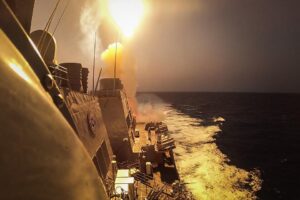
On October 19, 2023, USS Carney, an Arleigh Burke-class guided-missile destroyer patrolling the Red Sea, intercepted missiles and drones launched from Yemen. Initial Pentagon reporting described three land-attack cruise missiles and several drones intercepted. A December 2024 U.S. Navy retrospective detailed a ten-hour engagement in which Carney’s crew used SM-2 interceptors and its 5-inch deck gun against 15 drones and four cruise missiles. Because both weapons were employed, the available reporting does not establish that all 19 threats were defeated by missile interceptors.
Defense-budget reports and financial press estimates generally place the procurement cost of an SM-2 interceptor at slightly over $2 million per round, depending on the specific block configuration and contractual support package. Expending expensive interceptors to defend a guided-missile destroyer, its crew and potentially threatened shipping can be tactically justified. The harder question is how long such weapons can be replenished when inexpensive aerial threats arrive in large numbers.
Military economists evaluate this dynamic through three interconnected measures: the cost to build and launch an attack, the cost to intercept that incoming weapon, and the cumulative expenditure required to achieve a verified operational effect, such as disabling a radar array or severing an electrical transformer.
The asymmetry becomes acute when strike volume collides with finite defensive magazines. In an illustrative operational model, an offensive drone carrying an improvised warhead that costs $500 to assemble, but achieves its objective only once in five attempts due to electronic jamming, poor weather, or ground fire, requires roughly $2,500 per successful strike for the attacker, excluding launch personnel and transport logistics. For the defender, whether expending a multimillion-dollar interceptor against each incoming wave remains sustainable depends on the strategic value of the asset being shielded and the rate at which depleted magazines can be reloaded. This structural tension between precision military manufacturing and high-volume commercial production is visible in Ukraine, where commercial electronics have become central to the conduct of attritional warfare.
II. The Battlefield That Became a Factory
Ukraine’s wartime defense industry illustrates how decentralized commercial manufacturing can scale to meet frontline demand. Ukraine’s National Security and Defense Council reported in January 2026 that domestic industry had reached an annual production capacity exceeding eight million First-Person-View (FPV) drones, supported by more than 160 domestic manufacturing enterprises. These figures reflect declared industrial capacity rather than verified frontline delivery totals, but they highlight an unprecedented mobilization of light industry and commercial engineering during active conflict.
Ukraine’s Ministry of Defence announced on July 17, 2026 that the Defence Procurement Agency had executed drone contracts valued at UAH 333.6 billion during the first half of 2026, doubling the contract value signed during the equivalent period in 2025. The ministry attributed an average nine-day delivery turnaround for in-stock equipment to its DOT-Chain digital procurement marketplace, allowing military units to draw down allocated state funds directly.
This domestic manufacturing base operates alongside international procurement partnerships. On July 13, 2026, Auterion announced a partnership with Ukrainian manufacturer Skyfall to deliver 50,000 Shrike FPV attack drones equipped with Auterion’s Skynode S autonomy processors. Defense reporting by Janes described the deployment schedule, attributing its account to an Auterion representative and an interviewed defence source. Reporting by Reuters, carried by Ukrainska Pravda and Resilience Media, identified Germany as the financier of the 50,000-drone contract and put its estimated value at €90 million. Skyfall confirmed German involvement, although the full contract terms were not publicly disclosed. Across the announced order of 50,000 units, an illustrative division of reported contract value by announced quantity represents an average programmatic commitment of approximately €1,800 per drone, reflecting overall contract value rather than a verified hardware unit price.
The speed of commercial iteration contrasts sharply with traditional military acquisition. While clean-sheet development for conventional Western armored vehicles or manned aircraft often spans a decade or more, commercial drone builders can revise airframes, radio protocols, and flight software far more rapidly than conventional major weapons programs. Ukraine’s experience shows how commercial supply chains and decentralized production can expand the volume of precision-strike weapons, even as actual deliveries remain constrained by contracts, components and frontline demand.
III. The Adaptation of Heavy Armor and Naval Fleets
The vulnerability of armored vehicles to FPV drones carrying shaped-charge warheads has prompted debate over the future of heavy armor. Modern main battle tanks concentrate substantial protection around their frontal arcs, while roof armour, engine compartments and other exposed components present different vulnerabilities. FPV drones have made these less-protected areas increasingly accessible to attackers. Documented drone strikes have damaged tracks, running gear and exposed engine components, sometimes immobilizing vehicles without destroying their protected crew compartments. The available evidence does not establish how frequently such vehicles can be recovered.
Armored formations have responded with several visible layers of field adaptation. Field workshops widely fit tanks and infantry fighting vehicles with overhead steel frames (“cope cages”), slat armor, and wire mesh screens designed to detonate shaped charges before they contact the primary armor. Russian forces also deployed modified assault armor, colloquially termed “Turtle Tanks” (including the Tsar Mangal series), encasing T-72 and T-80 hulls within welded corrugated steel superstructures fitted with mine rollers and omnidirectional jammers. These structures create stand-off space intended to disrupt incoming shaped-charge attacks, but their enclosures also restrict visibility and turret movement.
Active Protection Systems (APS), such as Trophy and Iron Fist, represent a distinct and technologically complex response to incoming fire. These systems were originally developed to counter high-velocity anti-tank missiles and rocket-propelled grenades fired on relatively direct trajectories. Detecting and engaging slow, low-radar-cross-section drones approaching from steep top-attack angles presents a fundamentally different target profile, highlighting the engineering challenge of adapting existing radar arrays and counter-munitions to vertical threats.
These adaptations underscore that armored platforms are evolving in response to uncrewed threats rather than simply disappearing from the battlefield. While uncrewed systems provide persistent surveillance and responsive precision fires, they cannot hold ground or clear fortified obstacles on their own. In open terrain exposed to artillery and drone surveillance, protected mobility, direct fire and combat engineering support can remain critical to offensive operations.
In the maritime domain, low-cost unmanned craft have exerted asymmetric leverage against a major conventional fleet. Lacking a major surface navy, Ukraine deployed remotely piloted uncrewed surface vessels (USVs), such as the Magura V5, steered by human pilots via satellite and radio datalinks with optical cameras. Ukrainian defense intelligence officials have credited Magura V5 operations with damaging or sinking multiple Russian naval combatants and auxiliary vessels. These are Ukrainian intelligence claims; the cited reporting does not independently verify every reported sinking or instance of damage.
An October 2023 assessment by the Institute for the Study of War, reported by Ukrinform, identified the relocation of several major Russian Black Sea Fleet vessels from Sevastopol to Novorossiysk. Ukraine’s deployment of remotely piloted naval drones, operating alongside anti-ship missile strikes and aerial attacks, contributed to sustained operational pressure on Russian maritime forces in the western Black Sea, complicating Russian naval maneuvers and demonstrating how low-cost unmanned surface craft can challenge a conventional fleet in confined waters.
IV. The Electronic Warfare Race and Physical Guidance
Electronic warfare has been one of the principal defenses against commercial multirotor drones. Because many consumer and commercial quadcopters depend on radio frequencies for operator commands, video transmission, or satellite constellations for positional reference, ground-based jammers sweeping common civilian frequencies have been a central countermeasure. Jamming can disrupt control, video or satellite-navigation signals, but its effects depend on the aircraft’s design, onboard autonomy and programmed response to signal loss.
To protect drone control and video links from conventional radio-frequency jamming, developers on both sides of the conflict in Ukraine turned to physical tethers using micro-spool fibre optics. Rather than broadcasting over the air, these drones deploy ultra-thin fibre-optic cables from onboard spools, transmitting control inputs and video through pulses of light across kilometres of distance. According to reporting by Meduza, Russia’s state-affiliated Ushkuynik research center claimed that monthly production of its Knyaz Vandal Novgorodsky (KVN) fibre-optic drone had reached 50,000 units by late 2025, while the Conflict and Environment Observatory (CEOBS) noted commentary estimating that fiber-guided models could account for up to 10 percent of Ukrainian drone production. The optical control link carries video and commands without transmitting them over radio frequencies, reducing its exposure to conventional control-link jamming and direction-finding. The aircraft and associated equipment may still produce other detectable emissions.
The fragile line can snag on trees, buildings, or wires, or break during abrupt maneuvers or strong crosswinds. Environmental monitors at CEOBS have highlighted the persistent ecological hazard posed by discarded polymer-based fibre-optic cables accumulating across agricultural fields and waterways, where synthetic coatings resist natural biodegradation and create entanglement hazards for wildlife.
Autonomous terminal guidance offers an alternative approach that avoids the mechanical drag and snagging hazards of a physical cable, though it introduces a different dependency on onboard target recognition. Developers such as Auterion have announced two major procurement initiatives involving autonomous targeting modules: a 2025 program providing 33,000 Skynode strike kits funded by a $50 million U.S. Department of Defense contract, followed by the 50,000-unit Skyfall Shrike partnership in 2026. After an operator designates a target, onboard computer-vision software can track it and guide the drone through its terminal approach, including when the radio link is disrupted.
V. September 2026: When the Drone Outran Its Defences
During 2024 and 2025, Ukraine established a layered network of mobile air-defense teams equipped with searchlights, heavy machine guns, and cannon-based systems like the Gepard, complemented by low-cost interceptor drones.
That defensive balance was challenged during the summer of 2026 as Russian forces escalated the operational deployment of jet-powered Geran variants. These jet-propelled drones operate at substantially higher airspeeds than earlier propeller models. In a report published on September 2, 2026, Ukrainian News quoted Air Force spokesman Yurii Ihnat as saying that Russian forces had used more than 2,800 jet UAVs in August. He reported an interception rate of approximately 60% against jet-powered drones, compared with 90–95% against conventional models. Secondary defense monitors, including pickdrones.com and Kyiv Post, circulated these figures, which reflect Ukrainian military operational reporting rather than independently audited statistics. Ukrainian officials noted that the higher speed of jet-powered variants made them harder for visual-tracking and mobile gun teams to engage than slower propeller-driven drones. Independent flight and performance envelopes across all variants have not been publicly verified.
Defenders moved rapidly to address this speed gap with purpose-built counter-drone interceptors through three clearly dated stages:
- The initial intercept milestone: The volunteer-supported defense initiative Wild Hornets reported that its original Sting interceptor downed its first jet-powered Geran in December 2025, leading by mid-2026 to advanced development of the faster Sting 2.0 system.
- Dedicated high-speed designs: In July 2026, Ukrainian manufacturer Skyfall unveiled the P1-SUN JetKiller interceptor drone, designed to reach airspeeds of 370 kilometers per hour. Skyfall announced a target of 50,000 units per month; the announcement does not establish that this production rate had been achieved.
- Documented combat demonstrations: On September 19, Ukraine’s Security Service released footage, reported by DroneXL, that it presented as a successful interceptor engagement against a jet-powered Shahed; the release date does not establish when the engagement occurred.
The development of faster interceptors illustrates the industry’s capacity to develop a response to a new threat. Yet a successful prototype is not the same as a widely deployed defence. The decisive logistical questions are whether detection systems can identify fast-moving targets and whether manufacturers can replace interceptors at the rate they are consumed.
VI. The Global Spread of Drone Capability
Commercial drone technology is changing the balance of capability across several distinct settings: armed groups can conduct aerial attacks, criminal organizations can challenge border surveillance, and national militaries can procure unmanned systems in far greater numbers.
In the maritime domain, the Red Sea crisis demonstrates how non-state armed groups can disrupt international trade lanes using low-cost loitering drones and anti-ship missiles without deploying a conventional naval fleet. Maritime intelligence analyses indicate that while the Red Sea corridor remains operationally hazardous, major shipping lines continue to divert substantial container traffic around the Cape of Good Hope, sustaining elevated fuel, charter, and insurance costs across global supply chains.
In North America, commercial unmanned systems have created distinct airspace-surveillance and enforcement challenges along national borders. On August 27, 2026, Joint Task Force–Southern Border announced that its personnel had used the Army Multipurpose High-Energy Laser (AMP-HEL) to engage and defeat three unmanned aircraft assessed as supporting threatening activities along the U.S. southern border during August 25–26. Local reporting has highlighted persistent cartel use of commercial drones for aerial reconnaissance and smuggling along border sectors, showing how commercial technology complicates law-enforcement operations outside traditional armed conflict.
In Southeast Asia, insurgent groups with limited financial resources have used commercial multi-rotors to develop improvised air-attack capabilities against state forces. In Myanmar, anti-junta resistance groups and allied ethnic armed organizations have fitted commercial quadcopters with 3D-printed release mechanisms and mortar charges. Early technical documentation by Bellingcat in January 2022 showed improvised drop mechanisms mounted to commercial quadcopters; by 2025, the Armed Conflict Location and Event Data Project (ACLED) documented over 2,100 resistance drone strike events across 600 locations in Myanmar. These are ACLED-recorded events, not a count of individual drones or munitions; multiple strikes at one location on the same day may be recorded as one event.
At the level of national defense strategy, major military powers are integrating attritable unmanned systems into formal deterrence frameworks. The U.S. Department of Defense’s Replicator initiative, launched with an initial $1 billion budget allocation, seeks to field thousands of autonomous systems across air, sea and land domains in the Indo-Pacific. Taiwan’s 2021 Quadrennial Defense Review likewise emphasizes small, numerous, mobile and difficult-to-counter asymmetric systems, illustrating how mass and survivability have entered national defence planning. Across these settings, the same commercial technologies create different strategic problems: disruption at sea, enforcement challenges at borders, new attack capabilities for insurgents and larger procurement demands for national militaries.
VII. The Billion-Dollar Search for a Cheap Defence
The defense industry has responded with an intensive effort to field counter-unmanned aerial systems (C-UAS) whose cost per engagement aligns with the value of the target. Comparing these systems requires distinguishing what is publicly established about each technology from what cannot be reliably assumed:
| System Category | Established Public Measure | What Must Not Be Inferred | Operational Limitations |
|---|---|---|---|
| Interceptor Drones (e.g., Sting, JetKiller) | Technical capabilities, reported milestones, and frontline development programs | An unverified production-unit price or fixed engagement cost | Speed and altitude limits against high-performance targets; dependent on optical or radio terminal guidance |
| Laser-Guided Rockets (APKWS II guidance kits) | U.S. Navy procurement contract ceiling of $1.7 billion in December 2025, with an initial $322 million delivery order | A verified fixed price per rocket or per successful intercept | Requires continuous laser target illumination; magazine capacity limited on mobile launchers |
| High-Energy Lasers (Directed energy systems) | Programme award of $464.8 million for U.S. Army E-HEL program, with a separate international order exceeding $50 million | A per-system acquisition price or a measured total engagement cost | Degraded by atmospheric fog, heavy rain, and smoke; target dwell time required for burn-through; heavy cooling and power requirements |
| High-End Surface-to-Air Missiles (e.g., SM-2, Patriot PAC-3 MSE, Aster-30) | High-cost guided missile acquisition category; a secondary-source estimate places some SM-2 rounds at approximately $2 million. Other systems require variant-specific procurement evidence. | A uniform price across all variants or an interchangeable operational role | High acquisition costs and finite missile inventories make routine engagement of inexpensive drones a significant resource-allocation problem |
To understand the operational arithmetic, consider an illustrative model: if an interceptor drone costing $3,000 succeeds on its first attempt, the direct hardware expenditure per defeat is $3,000. If intercepting a faster, high-altitude jet drone requires three attempts per successful hit, the expended hardware cost rises to $9,000. Under these assumptions, the interceptor’s direct hardware expenditure is far below the estimated acquisition price of a high-end missile. The comparison does not establish total engagement cost or equivalent performance.
An unsuccessful interception can result in catastrophic damage if an incoming weapon strikes high-value assets such as command posts, radar installations, or naval vessels. For this reason, commanders may judge the expenditure of a multimillion-dollar missile entirely justified if it reliably protects irreplaceable assets. A complete engagement relies on radar detection reliability, target acquisition, tracking accuracy, launch platform maintenance, and the operating expenditures of trained crews.
The fundamental challenge remains industrial: producing sufficient quantities of affordable interceptors to match saturation attacks while sustaining advanced missile reserves. The Army’s LOCUST programme award illustrates investment in an additional defensive layer. The award was subsequently disclosed in a September 9 Form 8-K filing with the U.S. Securities and Exchange Commission. In a separate September 8 announcement, AeroVironment reported an international commercial order for LOCUST systems and support exceeding $50 million. Layered defence combines electronic warfare, interceptor drones, guided rockets, directed-energy systems and conventional surface-to-air missiles, allowing commanders to allocate scarce weapons according to the threat, engagement conditions and value of the defended asset.
VIII. The Human Cost of an Inexpensive Weapon
On the night of August 28–29, 2026, a Russian loitering drone struck a warehouse facility in the village of Myla, located in Kyiv region’s Bucha district. The UN Human Rights Monitoring Mission in Ukraine (HRMMU) reported on August 29 that Ukrainian authorities had recorded at least 37 deaths, while noting that official statements indicated ammunition might have been stored at the facility and confirming that an inquiry into compliance with storage regulations was underway. Ukrainian officials subsequently updated the confirmed death toll to 38, with 20 individuals injured and four reported missing, while approximately 50 neighboring residential buildings sustained structural damage. This strike underscores that the low unit cost and technical precision of loitering weapons do not lessen the potential for catastrophic civilian harm when high-explosive munitions detonate near populated areas.
The legality of such an attack depends on what the attacker knew or could reasonably establish about the target and the civilian harm expected at the time. Under the 1977 Additional Protocol I to the Geneva Conventions, operations must be directed solely against military objectives under Articles 48 and 52. A facility used to store military ammunition may qualify as a military objective where its use makes an effective contribution to military action and its destruction offers a definite military advantage in the circumstances. Even when striking a lawful target, however, attackers remain bound by the principle of proportionality under Article 51(5)(b), which prohibits attacks expected to cause incidental loss of civilian life, injury to civilians, or damage to civilian objects that would be excessive in relation to the concrete and direct military advantage anticipated. Furthermore, Article 57 requires an attacker to take all feasible precautions in the choice of means and methods to avoid or minimize civilian casualties.
Defending parties are subject to corresponding duties regarding the disposition of military assets. Under Article 58 of Protocol I, parties to a conflict must, to the maximum extent feasible, avoid locating military objectives within or near densely populated areas and take necessary precautions to protect civilian populations and objects under their control against the dangers resulting from military operations. Ukrainian authorities announced an inquiry into whether military personnel complied with domestic regulations regarding the storage of ammunition at the facility. A domestic regulatory investigation into storage procedures remains distinct from an international legal determination under Article 58, which depends on operational and geographic facts. The reported deaths and damage at Myla demonstrate the severe consequences an attack on a possible military objective can have for people and property in surrounding communities. Whether the attack complied with international humanitarian law requires evidence about the target, anticipated civilian harm, expected military advantage and feasible precautions.
IX. Conclusion: The Realities of Drone Warfare
The engagement of USS Carney on October 19, 2023, remains a case study in successful naval interception during a period of escalating attacks on Red Sea shipping. A modern guided-missile destroyer successfully intercepted incoming threats through a combination of high-end missiles and naval gunfire, demonstrating both the effectiveness of layered defence and the potential expense of sustaining it.
Carney’s engagement demonstrated why advanced defensive weapons remain indispensable. Ukraine’s experience demonstrates the other side of the equation: affordable drones can be produced and adapted at a scale that challenges traditional procurement cycles. Ultimately, assessing modern air defence requires evaluating not just individual hardware costs, but the cumulative cost per verified operational effect across an entire campaign. An economically sustainable defence depends on matching each defensive layer to the incoming threat without prematurely exhausting high-end missile inventories, ensuring advanced platforms remain viable while affordable interceptors are replaced at the rate they are consumed.
Sources
- U.S. Navy, “USS Carney: A Destroyer at War” (December 2024)
- USNI News, “U.S. Destroyer Used SM-2s to Down 3 Land Attack Missiles Launched from Yemen, Says Pentagon” (October 19, 2023)
- The Motley Fool, “Why Germany Buys $3.5 Billion in RTX Missiles” (SM-2 procurement estimates, December 2025)
- Ukraine’s National Security and Defense Council, “Results of Ukraine’s Defense Industry in 2025: FPV Drones” (January 23, 2026) and associated release on domestic manufacturing
- Ministry of Defence of Ukraine, “Drone contracts totaling more than UAH 333 billion signed for the military in the first half of the year” (July 17, 2026)
- Auterion, “Auterion and Skyfall to Ship 50,000 Shrike Strike Drones to Ukraine’s Front Lines” (July 13, 2026)
- Janes, “Skyfall and Auterion delivering Shrike UAVs with Skynode S autonomy to Ukraine” (July 2026)
- Ukrainska Pravda, “Germany finances purchase of 50000 strike drones for Ukraine” (July 12, 2026)
- Resilience Media, “Auterion to equip 50,000 Ukrainian strike drones with precision guidance tech” (July 13, 2026)
- Espreso.tv, “Pentagon taps Auterion for massive AI drone boost to Ukraine in $50M deal” (July 2025)
- Militarnyi, “Ukrainian military demonstrated the domestic-made naval kamikaze drone” (Magura V5 technical profile)
- Kyiv Post, “Ukraine Unveils Killer MAGURA Sea Drones…” (Magura operational reporting)
- Institute for the Study of War / Ukrinform, “Russia transfers part of Black Sea Fleet vessels from Sevastopol to Novorossiysk” (October 2023)
- Meduza, “Fiber-optic cables used to guide drones are blanketing Ukraine’s front line…” (July 2026)
- Conflict and Environment Observatory (CEOBS), “A plastic pollution by-product of a high and low tech arms race on Ukraine’s front line” (2026)
- Ukrainian News, “Despite complexity of targets, AFU shoot down about 60% of russian jet drones – Air Forces representative Ihnat” (September 2, 2026)
- pickdrones.com, “Russia’s Jet-Powered Drones Cut Ukraine Intercepts to 60%” (September 2026, secondary reporting)
- Kyiv Post, “Analysis: How Russia’s New Jet Drones Pose Fresh Interception Challenges” (September 2026, secondary reporting)
- Militär Aktuell, “Ukrainian interceptor drone Sting now even intercepts jet sharks”
- Unmanned Airspace, “Wild Hornets working on Sting 2.0 C-UAS interceptor to take down jet-powered drones”
- Kyiv Independent, “Ukrainian defense firm Skyfall unveils new ‘JetKiller’ interceptor drone” (July 2026)
- DroneXL, “Ukraine SBU interceptor first jet Shahed kill video” (September 19, 2026)
- Joint Task Force–Southern Border (DVIDS), “Joint Task Force – Southern Border uses high-energy laser system to mitigate cartel-linked drone threats” (August 27, 2026)
- UN Human Rights Monitoring Mission in Ukraine (OHCHR), “Explosions reportedly kill at least 37 outside Kyiv city” (August 29, 2026)
- Kyiv Post, “38 Dead in Myla Depot Blast, Russia Fires 2,000 Drones Over a Week, Zelensky Says” (August 30, 2026)
- International Committee of the Red Cross, Protocol Additional to the Geneva Conventions of 12 August 1949 (Protocol I), 8 June 1977, Articles 48, 51, 52, 57, 58
- AGBI, “Operationally hazardous, Red Sea remains open to shipping” (September 2026)
- AeroVironment, “AV’s LOCUST Selected for Nearly $500 million Army Counter-UAS Contract for Enduring-High Energy Laser (E-HEL) Program” (September 2, 2026)
- U.S. Securities and Exchange Commission, AeroVironment Form 8-K Exhibit 99.2 (September 9, 2026)
- AeroVironment, “AeroVironment Receives Over $50 Million Order for LOCUST Counter-UAS Directed Energy Systems and Support” (September 8, 2026)
- The Aviationist, “U.S. Navy Awards BAE Systems APKWS Contract Worth Up To $1.7 Billion” (December 10, 2025)
- USNI News, “Pentagon Will Spend $1B on First Round of Replicator Drones” (March 2024)
- Taiwan Ministry of National Defence, 2021 Quadrennial Defense Review (March 2021)
- Bellingcat, “Myanmar’s Rebels Get Resourceful With Improvised Drones” (January 2022)
- ACLED, “War from the Sky: How Drone Warfare Is Shaping the Conflict in Myanmar” (2025)
