

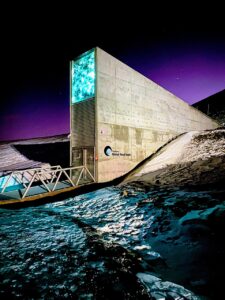
Inside Norway’s Arctic seed vault, where countries preserve the genetic diversity agriculture may need when a collection at home is destroyed or lost
I. The Fortress in the Permafrost
On the Norwegian island of Spitsbergen, roughly 1,300 kilometres from the North Pole, a wedge of concrete and steel cuts into the mountainside of Platåberget. More than 100 metres inside the rock lie three storage chambers. One is currently equipped for use and refrigerated to −18°C.[1]
Inside the mountain are backups of collections maintained by genebanks around the world. The vault is not an emergency grain reserve, and its seeds are not intended for direct distribution to farmers. They are insurance for the collections from which future research and breeding can begin again.
The idea predates the current building. Beginning in the 1980s, Nordic genebanks placed duplicate samples in an abandoned coal mine near Longyearbyen. In 2004, Norway committed to a permanent, purpose-built facility, which opened on February 26, 2008, with an initial deposit of more than 320,000 samples.[2]
By its 70th deposit event, on June 17, 2026, the vault held 1,401,285 confirmed seed samples, contributed by 134 depositing institutions and representing 6,539 plant species.[3]
Table 1: Vault specifications and inventory
| Metric | Value | As of / basis |
| Confirmed seed samples | 1,401,285 | June 17, 2026 |
| Maximum sample capacity | 4.5 million samples | Official facility specification |
| Storage temperature | -18°C | Official facility specification |
| Distance into mountain | 100+ metres | Official facility specification |
| Depositing institutions | 134 | June 2026 |
| Species represented | 6,539 | June 2026 |
| Inauguration | February 26, 2008 | Official vault history |
Sources: [1], [3].
These figures count stored seed samples, not unique varieties. Different genebanks may deposit duplicates of the same genetic material.
Each sample is dried and sealed in foil packaging before being placed in crates on metal shelving. The surrounding permafrost keeps the mountain naturally cold, which reduces the load on the cooling system, but it is mechanical refrigeration that holds the active chamber at -18°C.
Norway owns and funds the vault. NordGen coordinates seed deposits, maintains their records and runs the public Seed Portal. Statsbygg maintains and monitors the physical installation. The Crop Trust contributes funding and helps eligible genebanks prepare and ship their seeds.[4]
The FAO’s International Treaty on Plant Genetic Resources for Food and Agriculture provides part of the wider international framework for conserving and sharing crop diversity. Its funding mechanisms support related conservation projects, but the treaty itself is not one of the vault’s operating partners.[5]
The vault follows a black-box storage model. Norway owns the facility without acquiring ownership of the deposited seeds. Depositing genebanks retain ownership of their material and exclusive withdrawal rights. Storage is free for eligible genebanks, which remain responsible for preparing and shipping their seeds.[6]
The first withdrawal came in 2015. The institution requesting its seeds had already lost access to the genebank where its original collection was held: ICARDA, near the Syrian city of Aleppo.
II. The Fragility of Living Agriculture
In an earlier analysis of global diets, the FAO estimated that rice, maize and wheat supplied roughly 60 percent of the world’s food-energy intake.[7] The historical estimate illustrates how heavily global agriculture has depended on a small number of staple crops.
In 1969, researchers at the International Rice Research Institute identified strong resistance to grassy stunt virus in a wild rice accession of Oryza nivara collected in India. The discovery became particularly valuable as grassy stunt emerged as a major threat to rice harvests in South and Southeast Asia during the 1970s. Breeders had screened thousands of accessions already held in IRRI’s genebank before finding resistance in this single wild line, gathered years earlier and preserved in the genebank long before Svalbard existed.[8] IRRI released three resistant varieties in 1974.[8]
The discovery illustrates why preserved diversity matters, not a role the vault itself played in this case. Its value emerged when a disease exposed a weakness in cultivated rice. Preserving useful diversity is only half the task: researchers must still be able to reach it. In Syria, war would later cut ICARDA off from its original collection, forcing it to rely on backups deposited elsewhere.
III. From Aleppo to the Arctic and Back
For decades, the International Center for Agricultural Research in the Dry Areas (ICARDA) ran its headquarters at Tel Hadya, near Aleppo, in the historic Fertile Crescent. Its collection held roughly 150,000 accessions of cereals and legumes: landraces and wild relatives of barley, wheat, chickpea, lentil, and faba bean, adapted over millennia to arid conditions.
As the conflict escalated, ICARDA’s international staff left Tel Hadya. By 2015, the genebank could no longer operate reliably, and ICARDA had lost access to its original collection.[9] ICARDA had already been sending duplicate material to Svalbard since the vault opened in 2008.
In September 2015, with its own facility inaccessible and the war still active, ICARDA became the first institution ever to request a withdrawal from Svalbard. Two further withdrawals followed, the final withdrawal in 2019:[9]
Table 2: ICARDA withdrawals from Svalbard
| Withdrawal | Year | Accessions |
| First | 2015 | 38,071 |
| Second | 2017 | 54,356 |
| Third | 2019 | 24,049 |
| Total | 2015–2019 | 116,476 |
Source: The table follows ICARDA’s November 2019 retrospective, which provides a complete and internally consistent annual series: 38,071 accessions withdrawn in 2015, 54,356 in 2017, and 24,049 in 2019, totalling 116,476.[9] A separate, earlier account published by the Seed Vault in 2017 reports that ICARDA had deposited 116,484 accessions between 2008 and 2014, and independently confirms that account’s 2015 and 2017 withdrawal figures (38,073 and 54,354); that 2017 account predates the 2019 withdrawal and does not itself establish a figure for that year. The 116,484 total describes ICARDA’s earlier deposit accounting, not the withdrawal series, and is not used in the table above.[9]
The withdrawn seed went to operational hubs in Lebanon and Morocco, where agronomists began regenerating the collection. The withdrawals and regeneration programme overlapped. As successive batches arrived, agronomists planted the seeds, monitored the crops and harvested new material. They were rebuilding working collections while further withdrawals from Svalbard were still underway. By September 2019, ICARDA had redeposited seeds from 42,729 accessions, most produced using material withdrawn from Svalbard.[9] Regeneration and further redeposits continued afterward.
IV. A Global Network of Sovereign Deposits
The vault is global because crop diversity itself is geographically distributed. An international network of crop research centres, including CIMMYT in Mexico, IRRI in the Philippines, and CIP in Peru, gathers and deposits collections drawn from dozens of countries apiece, not just the ones that host them.
Guatemala’s national genebank, operated by the Institute of Agricultural Science and Technology (ICTA), suffered a cold-storage malfunction in 2023 that threatened part of its collection.[10] Emergency support associated with the FAO Plant Treaty and the Crop Trust helped ICTA repair its storage infrastructure and regenerate threatened material. In February 2026, Guatemala made its first deposit at Svalbard: more than 930 accessions, including maize, beans, squash, amaranth and teosinte.[10]
Among them were approximately 115 samples from community seed banks supported by ASOCUCH through a project completed in 2019.[10] These comprised 97 maize accessions representing nine local races and 18 bean accessions. Community-bank representatives delivered material from that project to ICTA in 2018 and 2019. ASOCUCH’s wider contribution to the national collection has since reached 787 accessions.[10] Material first conserved by community seed banks now had a second backup thousands of kilometres away.
V. Rescuing Seeds Under Fire
Since fighting broke out between the Sudanese Armed Forces and the Rapid Support Forces in April 2023, Sudan’s Agricultural Plant Genetic Resources Conservation and Research Center, based at Wad Medani, has faced reported looting, artillery exposure, and sustained power outages.[11] A subnational genebank at El Obeid held backup material from Sudan’s national collection, reported at approximately 7,000 accessions.[11] With support from the Crop Trust, Sudanese scientists rescued seeds representing more than 2,000 accessions from the El Obeid genebank and arranged their transfer through NordGen.
With the main genebank in Wad Medani inaccessible, Sudanese staff prepared seed samples amid the fighting. Security trucks carried the material to Port Sudan for shipment abroad, while NordGen prepared it for the scheduled February 2025 deposit.[12]
In February 2025, Sudan deposited 1,884 accessions at Svalbard, following the rescue of more than 2,000 accessions from El Obeid.[12] Another 982 samples followed in June 2026, spanning 19 species including pearl millet, sorghum and legumes.[3] The deposits totalled 2,866 samples. The published accounts link the first shipment to the El Obeid rescue but do not provide a complete sample-by-sample reconciliation or establish the origin of every accession in the later shipment.[12][13]
VI. When the Arctic Thaws
In October 2016, an unusually warm and wet autumn in Svalbard sent meltwater through the vault’s outer entrance. Water entered the access tunnel but did not reach the storage chambers at the tunnel’s far end, and no seed samples were affected.[14]
Norway’s state property agency, Statsbygg, responded with an engineering overhaul between 2017 and 2019. The original tunnel was replaced with a waterproofed, roughly 100-metre concrete structure. Drainage channels were cut into the slope above the entrance to divert meltwater away from the building. Transformers and refrigeration equipment were relocated out of the tunnel entirely, into a separate service building.[14]
Statsbygg’s 2019 annual report lists an expected final project cost of approximately NOK 199 million, the agency’s estimate at the time rather than a subsequently audited figure.[15] The agency has described the rebuilt tunnel as designed for resilience against a warmer, wetter Arctic climate over a long design horizon, an engineering goal rather than a guarantee.[14]
Naturally cold permafrost reduces the burden on the vault’s cooling system, but it was never the whole of what protects the chambers. Refrigeration maintains the active chamber at −18°C; drainage keeps meltwater out of the tunnel. Both systems require ongoing inspection and maintenance.
VII. What Cold Storage Cannot Save
Svalbard is designed for orthodox seeds, which tolerate drying and long-term storage at low temperatures. Most cereals and grain legumes qualify. Cocoa and mango do not: their seeds cannot survive the same treatment.[16]
These are two different conservation problems. Species whose seeds cannot tolerate conventional drying and freezing may need field collections, tissue culture or cryopreservation.[17] Crops such as banana, cassava and many cultivated potatoes present an additional challenge: growing their botanical seeds does not reliably reproduce the genetic identity of a particular clone. Preserving those varieties therefore requires methods that maintain the original genotype.
Even for seeds that Svalbard can store, retrieval is only the beginning. ICARDA had to grow its withdrawn material through successive seasons to rebuild working collections. Breeders and seed producers then faced the separate task of developing and multiplying material for farmers. The vault protects the starting point of that process; it does not perform the work that follows.
VIII. Beyond the Seed Vault
Kew’s Millennium Seed Bank serves a different conservation purpose from Svalbard. Its broader wild-plant mandate combines long-term seed storage with research and restoration, complementing Svalbard’s role as a backup for eligible crop seeds.[18]
Preserving plants is not the same as preserving the knowledge and agreements governing their use. The Arctic World Archive, elsewhere on Svalbard, addresses that separate problem through long-term documentary storage, not through the storage of genetic material. It occupies a decommissioned coal mine known as Mine No. 3. Piql, a Norwegian company, founded the archive in 2017 on a site controlled by the mining company Store Norske.[19] It stores data as images on photosensitive film. In February 2026, the archive received a deposit of the Plant Treaty text in fourteen languages and four testimonial stories, according to the FAO.[20]
IX. Conclusion
ICARDA’s experience demonstrated what an Arctic backup could accomplish. Seeds withdrawn from Svalbard helped researchers rebuild collections in Lebanon and Morocco after the Syrian genebank became inaccessible.
Sudan’s experience begins earlier in the chain of preservation. Scientists working amid war first had to rescue material and arrange its transfer abroad before international backup storage could help secure it.
The vault can keep genetic material available through a crisis. Its value depends equally on the people and institutions that collect it, move it to safety and eventually return it to use.
References
1. Svalbard Global Seed Vault, “The Facility,” seedvault.no/about/the-facility/, on chamber count, dimensions, temperature control and storage capacity.
2. Svalbard Global Seed Vault, “The History,” seedvault.no/about/history/, on the 1980s coal-mine backup, Norway’s 2004 commitment, and the February 2008 opening.
3. Norwegian Ministry of Agriculture and Food, “Svalbard Global Seed Vault Crosses Major Milestone – 1.4 Million Seed Samples Secured,” regjeringen.no, June 17, 2026, regjeringen.no/en/whats-new/svalbard-global-seed-vault-crosses-major-milestone-1.4-million-seed-samples-secured/id3166080/.
4. NordGen, “Information for Depositors,” nordgen.org/our-work/svalbard-global-seed-vault/information-for-depositors, on the respective roles of NordGen, Statsbygg and the Crop Trust.
5. Food and Agriculture Organization, “About the Treaty,” International Treaty on Plant Genetic Resources for Food and Agriculture, fao.org/plant-treaty/overview/about-us/en.
6. NordGen, “Frequently Asked Questions: Svalbard Global Seed Vault,” nordgen.org/our-work/svalbard-global-seed-vault/frequently-asked-questions, on ownership, black-box governance, and depositor costs.
7. Food and Agriculture Organization, “Dimensions of Need: Staple Foods, What Do People Eat?” fao.org/4/U8480E/U8480E07.htm, drawing on FAO food-balance data from 1988–1990.
8. K. C. Ling, V. M. Aguiero and S. H. Lee, “A mass screening method for testing resistance to grassy stunt disease of rice,” Plant Disease Reporter (1970), pp. 565–569, documenting the 1969 identification of resistance; and Duncan Barclay, “Feral Play,” Rice Today, International Rice Research Institute, January 21, 2004, https://ricetoday.irri.org/feral-play-blank/, documenting the screening of approximately 7,000 rice lines, the resistant wild Oryza nivara accession from India and the release of three resistant varieties in 1974.
9. ICARDA, “ICARDA and Svalbard Global Seed Vault,” ICARDA Communication Team, November 8, 2019, icarda.org/node/13744, verifying the withdrawal series totaling 116,476 accessions; Svalbard Global Seed Vault, “Withdrawal of ICARDA Aleppo seeds accomplished,” seedvault.no/2019/09/11/withdrawal-of-icarda-aleppo-seeds-accomplished/, September 11, 2019, on the withdrawal chronology and the 42,729-accession redeposit figure as of September 2019; and Svalbard Global Seed Vault, “ICARDA Seeds Safe Back in Lebanon and Morocco,” seedvault.no, October 27, 2017, seedvault.no/2017/10/27/icarda-seeds-safe-back-in-lebanon-and-morocco/, on the earlier 116,484-accession deposit accounting and the 2015 and 2017 withdrawal figures.
10. Food and Agriculture Organization, “Guatemala Makes Its First Deposit to the Svalbard Global Seed Vault, Safeguarding National and Community Seed Heritage,” fao.org/plant-treaty, February 25, 2026, fao.org/plant-treaty/news/news-detail/guatemala-makes-its-first-deposit-to-the-svalbard-global-seed-vault–safeguarding-national-and-community-seed-heritage/en.
11. “Plant Genebank of Sudan: Towards Recovery from the Wreckage of War,” Plant Genetic Resources, Cambridge University Press, November 2025, doi.org/10.1017/S147926212510035X.
12. NordGen, “Dedicated Genebank Staff Saves Sudan Seeds Amid Civil War, Deposit Seeds in Svalbard Global Seed Vault,” nordgen.org, 2025, nordgen.org/news/dedicated-genebank-staff-saves-sudan-seeds-amid-civil-war-deposit-seeds-in-svalbard-global-seed-vault/.
13. Norwegian Ministry of Agriculture and Food, “New Seed Samples Deposited in Svalbard Global Seed Vault,” regjeringen.no, February 26, 2025, regjeringen.no/en/whats-new/new-seed-samples-deposited-in-svalbard-global-seed-vault/id3089623/, on the 1,884-accession Sudanese deposit.
14. Svalbard Global Seed Vault, “Towards a Watertight Access Tunnel,” seedvault.no, 2018, seedvault.no/?p=2435, on the 2016 water intrusion and the planned tunnel reconstruction, drainage, and service-building relocation.
15. Statsbygg, Annual Report 2019, dok.statsbygg.no/wp-content/uploads/2020/06/aarsrapport2019.pdf, on the NOK 199 million expected project cost.
16. NordGen, “Frequently Asked Questions: Svalbard Global Seed Vault,” nordgen.org/our-work/svalbard-global-seed-vault/frequently-asked-questions, question “Does the Seed Vault only contain seeds?”, on the orthodox-seed drying and freezing tolerance criterion and its major crop exceptions (coffee, cocoa, coconut, mango; potato and banana).
17. CGIAR Genebank Platform, “Cryopreservation,” genebanks.cgiar.org/the-platform/conservation-module/cryopreservation/, on cryopreservation and in vitro culture as conservation methods for crops that are vegetatively propagated or produce recalcitrant seeds.
18. Royal Botanic Gardens, Kew, “Millennium Seed Bank,” kew.org/wakehurst/whats-at-wakehurst/millennium-seed-bank, on the bank’s wild-species conservation mandate and research activities.
19. Arctic World Archive, “Arctic World Archive Foundation,” arcticworldarchive.org/about, on founding by Piql in 2017 and the Mine No. 3 site controlled by Store Norske.
20. Food and Agriculture Organization, “Seeds, Data and Knowledge: International Treaty Secures Global Crop Heritage in the Arctic,” fao.org/plant-treaty, February 26, 2026, fao.org/plant-treaty/news/news-detail/seeds–data-and-knowledge–international-treaty-secures-global-crop-heritage-in-the-arctic/en.
