

The seafloor holds metals critical to the global energy economy. Mining them could unlock a new mineral frontier while disturbing ecosystems we barely understand.
4,000 Metres Down
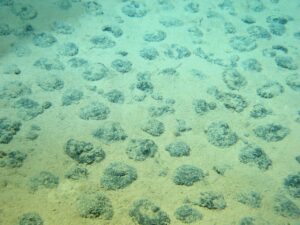
Four thousand metres beneath the surface of the central Pacific Ocean, sunlight is entirely absent, water temperatures hover barely above freezing, and hydrostatic pressure approaches four hundred atmospheres. Across vast stretches of this abyssal plain, the seafloor is carpeted with billions of dark, rounded stones resting unattached on pale pelagic clay. They resemble weathered cobblestones or charcoal briquettes scattered across an endless underwater desert.
These are polymetallic nodules. While deep-sea mining has focused on three principal mineral systems (hydrothermal massive sulfides clinging to volcanic vents, cobalt-rich crusts coating underwater seamounts, and polymetallic nodules resting on abyssal sediment), it is the nodules that have become the primary focus of the modern mining industry. According to assessments by the U.S. Geological Survey (USGS), abyssal plains between 3,500 and 6,500 metres depth hold immense volumes of manganese, nickel, copper, and cobalt. The geographic heart of this commercial interest is the Clarion-Clipperton Zone, a roughly 6 million-square-kilometre region of the central Pacific between Mexico and Hawaii.
The defining characteristic of these nodules is temporal. They do not form through rapid volcanic precipitation or tectonic upheaval. Instead, dissolved metallic compounds precipitate out of ambient seawater and sediment pore waters at an almost imperceptible pace, accreting in concentric layers around microscopic nuclei such as a basalt fragment, a shark tooth, or a fossilized shell. They grow extraordinarily slowly, accumulating mineral layers over geological timescales. A single nodule may record millions of years of mineral accumulation.
This creates an extraordinary physical contrast. An industrial harvesting vehicle can collect in a single operation what geological processes required millions of years to build. That profound mismatch between geological patience and industrial velocity is one reason the deep ocean has become such a contested frontier.
Why Anyone Would Go There
The impulse to send heavy machinery into the abyss is rooted in the transformation of the global energy economy. Decarbonization requires metals at an unprecedented physical scale. In its Global Critical Minerals Outlook 2026, the International Energy Agency (IEA) reported that global battery demand expanded by more than 35 percent in 2025 alone, surpassing 1.5 terawatt-hours. The expansion of electric vehicles and battery storage is increasing demand for battery minerals, while electricity grids and renewable infrastructure are driving substantial additional demand for copper.
Yet the case for seabed mining is not simply that the world is running out of terrestrial ore. Market dynamics are far more complex. As the IEA documented in its 2025 analysis of critical mineral markets, rapid mine expansion pushed lithium spot prices down by more than 80 percent from their 2023 peak. By late 2025 and early 2026, prices for several energy metals rebounded, with copper reaching record levels and structural supply deficits of roughly 25 percent projected for copper by 2035 based on existing project pipelines.
What makes these deposits strategically interesting is the concentration of existing supply chains. Terrestrial mineral extraction and refining are exceptionally asymmetric. The IEA reports that the average market share of the single largest refining nation across key energy minerals reached approximately 70 percent in 2025. China is the leading refiner for most of the key energy minerals tracked by the IEA, while Indonesia has become the dominant source of nickel supply growth.
For policymakers concerned about concentrated supply chains, this geographic chokepoint represents a structural vulnerability. Proponents of seabed mining argue that it could diversify supply while avoiding some of the land-use and environmental problems associated with terrestrial extraction, such as tropical deforestation and tailings dam risks. For governments seeking alternative mineral sources, seabed deposits are being evaluated as one potential source of supply diversification.
The Machine
For decades, harvesting nodules remained an engineering fantasy. Over the past five years, that fantasy has hardened into working steel.
The generalized operational architecture of nodule extraction is divided into four coordinated stages:
First, a remotely operated collector vehicle, weighing scores of tonnes on land, crawls along the abyssal floor on wide mechanical tracks, collecting nodules from the upper sediment layer.
Second, the collected nodules are transferred into a vertical lift system. A riser pipe suspended from a surface vessel transports the slurry four thousand metres upward through pumping or compressed-air lift systems.
Third, the mixture arrives on the deck of a surface production vessel. Specially engineered separation units dewater the slurry and extract the solid ore.
Fourth, the separated nodules are transferred to a shuttle vessel for transport to shore. The resulting water and fine sediment would then require management according to the project’s discharge design and environmental requirements.
The technology has moved beyond laboratory concepts. In 2022, an industrial-scale test demonstrated that a collector could recover polymetallic nodules from roughly four thousand metres depth in the Clarion-Clipperton Zone. However, commercial-scale deep-sea mining has not yet begun.
The industry is now scaling toward full commercial deployment. In May 2026, The Metals Company announced an agreement with offshore contractor Allseas to develop a commercial nodule collection system centered on the production vessel Hidden Gem, targeting an annual capacity of 3 million wet tonnes, with commissioning planned for the fourth quarter of 2027, subject to regulatory approvals. Long-term operational viability will ultimately depend on equipment reliability, maintenance cycles in remote ocean basins, and the capital costs of operating heavy subsea machinery under relentless hydrostatic stress.
What Happens When the Machine Leaves
The environmental consequences of deep-sea mining are far more intricate than a simple physical excavation scar.
The most immediate impact occurs directly on the seafloor. As collector tracks disturb the upper layer of sediment and remove the nodules embedded in it, they alter the physical habitat used by abyssal organisms. Some sessile organisms, including stalked glass sponges, hexacorals, and giant single-celled xenophyophores, use the nodules as hard substrate for attachment, making nodule removal a direct loss of habitat for nodule-associated fauna.
The empirical consequences of this disturbance are now being quantified. A 2026 study published in Nature Ecology & Evolution by Stewart et al. monitored the biological footprint of the 2022 industrial trial in the Clarion-Clipperton Zone two months after operations ceased. Researchers documented a 37 percent decline in macrofaunal density and a 32 percent reduction in species richness directly within the mining tracks compared with undisturbed reference zones. Interestingly, the study found no measurable change in total faunal abundance in the adjacent plume-affected areas, although species-dominance relationships shifted.
Beyond the crawler tracks lies the problem of sediment plumes. As the collector sweeps the seabed, it disturbs and resuspends fine sediment into bottom currents. A 2025 study in Nature Communications by Gazis et al. tracked an experimental plume at the abyssal boundary, finding that a heavy, gravity-driven sediment current flowed roughly 500 metres downslope, while ambient currents transported lighter particles throughout the 4.5-kilometre monitoring area. Within 50 metres of the extraction path, suspended sediment concentrations spiked up to four orders of magnitude above background levels.
Assessing ecological risk requires determining the biological thresholds of deep-sea organisms exposed to elevated turbidity and understanding how far functional community changes propagate across the benthic food web. Because new nodules form over geological timescales, the hard-substrate habitat removed by mining cannot be rapidly replaced, even if some biological recolonisation occurs. A 2025 study in Nature by Jones et al. found that, four decades after a test mining experiment, biological impacts persisted in many organism groups, even as some populations had begun to re-establish. Physical changes to the seabed also remained clearly visible.
Compounding these challenges is our profound baseline ignorance. Taxonomic studies in the Clarion-Clipperton Zone indicate that approximately 90 percent of the collected taxa are undescribed. Those baseline gaps make it difficult to establish reliable baselines for biodiversity, species distributions, and ecosystem responses to disturbance.
Who Has the Right to Mine It?
This scientific uncertainty has collided directly with an unresolved international governance challenge.
Beyond the limits of national jurisdiction, the seabed and its mineral resources are governed under the 1982 United Nations Convention on the Law of the Sea (UNCLOS), which defines the seabed beyond national jurisdiction as the Area and its mineral resources as the common heritage of mankind. To administer this commons, UNCLOS established the International Seabed Authority (ISA) in Kingston, Jamaica.
The ISA holds a dual mandate: it must organize and control mineral activities in the Area while ensuring the effective protection of the marine environment. The ISA’s current register lists 32 exploration contracts across polymetallic nodules, polymetallic sulphides, and cobalt-rich crusts. Concurrently, its regional environmental management plan for the Clarion-Clipperton Zone identifies 13 Areas of Particular Environmental Interest covering approximately 1.97 million square kilometres, which are designated for environmental protection under the regional management framework.
Yet there is a fundamental legal divide between exploration and exploitation. The ISA has yet to adopt a final exploitation regime. Negotiations and technical work on regulations, environmental standards, and financial royalty sharing remain ongoing among its member states.
While negotiations within the ISA continue, the United States is pursuing an independent domestic pathway. The U.S. has never ratified UNCLOS. Instead, it relies on its domestic legislation, the 1980 Deep Seabed Hard Mineral Resources Act, which provides a U.S. domestic framework for authorizing exploration and commercial recovery of deep-seabed hard minerals.
On April 24, 2025, the U.S. administration issued Executive Order 14285, directing federal agencies to establish American leadership in seabed mineral development. By mid-2026, this policy translated into regulatory action: NOAA determined that a consolidated exploration and commercial recovery application submitted by The Metals Company USA was fully compliant with applicable statutory information requirements, triggering a sixty-day public-comment window running from August 19 to October 19, 2026. On September 14, 2026, Reuters reported that U.S. officials anticipate moving toward issuing commercial seabed recovery permits within months.
This dual architecture places a domestic authorization system alongside the multilateral treaty framework designed to govern the seabed beyond national borders. If Washington authorizes commercial recovery under U.S. law, it would establish an independent domestic authorization pathway, raising unresolved legal questions regarding how American-permitted activities in the Area would interact with the multilateral regime administered by the ISA. Legal friction has already emerged before international tribunals. On July 18, 2026, the Seabed Disputes Chamber of the International Tribunal for the Law of the Sea (ITLOS) issued unanimous orders in Cases No. 34 and 35, prescribing provisional measures concerning due-process protections in the disputes brought by two subsidiaries of The Metals Company (Nauru Ocean Resources Inc. and Tonga Offshore Mining Limited) against the ISA. Subsequently, on July 20, 2026, the ISA Council approved a five-year extension to NORI’s exploration contract, effective July 22.
EU institutions, meanwhile, have taken precautionary positions. The European Commission supports a precautionary approach to deep-sea mining until scientific gaps are filled, harmful effects can be ruled out, and the necessary environmental provisions are in place. In its resolution on Norway’s advance toward seabed mining in the Arctic, the European Parliament reiterated its call for an international moratorium on commercial exploitation. The positions of governments therefore diverge over how quickly seabed resources should be developed and how much scientific uncertainty should be tolerated before commercial exploitation.
Do We Actually Need the Seafloor?
Even if the legal hurdles clear and extraction proves technically feasible, an essential economic question remains: is deep-sea mining genuinely necessary?
Geological abundance does not by itself establish commercial viability. The ocean floor undoubtedly holds immense reserves, but converting abyssal deposits into marketable metal requires massive capital expenditures. Operators must finance dynamic-positioning surface vessels, robotic crawler fleets, vertical lift pipes, specialized offshore maintenance, and custom onshore processing facilities.
History provides a cautionary lesson. Commercial seabed mining was widely expected to develop in the 1970s and 1980s, attracting substantial investment from industrial consortia. Many of those plans subsequently lost momentum as commodity prices fell.
Furthermore, technological shifts on land are rapidly altering mineral demand. In the battery industry, Lithium Iron Phosphate (LFP) chemistries have rapidly expanded at the expense of nickel-based chemistries in several markets. In its Global EV Outlook 2026, the IEA reported that LFP accounted for more than 55 percent of global EV battery deployment in 2025 and contains no cobalt. Sodium-ion batteries are also entering commercial scale-up. They eliminate lithium, but their chemistries can still depend on materials such as manganese and nickel, so their supply-chain advantages are more limited than the simplest descriptions suggest. Nonetheless, these emerging architectures are expanding the range of battery chemistries that can compete with nickel-based systems, particularly in stationary storage and other applications where energy density is less critical.
Recycling represents another powerful alternative. The IEA expects recycling to become increasingly important, with secondary supply potentially doubling its contribution by 2040 under today’s policy settings. When paired with material efficiency gains and terrestrial supply diversification, seabed extraction remains one potential supply pathway among many, subject to shifting cathode chemistries, recycling scale, and sovereign industrial policy.
The Race
Time operates on radically different scales here. A polymetallic nodule takes millions of years to form; a collector vehicle can disturb its habitat in a single operation.
At this exact historical juncture, several disparate currents have crossed: mineral demand is surging; terrestrial processing remains concentrated in a handful of geopolitical chokepoints; robotic subsea technology has proven its ability to harvest ore at four thousand metres depth; the United States is moving through a domestic process that could lead to commercial recovery permits; and the international regulatory body in Kingston remains engaged in ongoing negotiations.
Meanwhile, marine scientists continue working to establish ecological baselines before commercial operations commence. Industrial engineering and domestic policy are advancing rapidly, leaving international regulators and benthic ecologists to determine whether enforceable environmental thresholds can be established before extraction begins at commercial scale.
References
European Commission. Marine non-living resources. EU Blue Economy Observatory. (https://blue-economy-observatory.ec.europa.eu/eu-blue-economy-sectors/marine-non-living-resources_en)
European Parliament. European Parliament resolution of 7 February 2024 on Norway’s recent decision to advance seabed mining in the Arctic (2024/2520(RSP)). (https://www.europarl.europa.eu/doceo/document/TA-9-2024-0068_EN.html)
Gazis, I.-Z., de Stigter, H., Mohrmann, J., Heger, K., Diaz, M. et al. Monitoring benthic plumes, sediment redeposition and seafloor imprints caused by deep-sea polymetallic nodule mining. Nature Communications 16, 1229 (2025). (https://doi.org/10.1038/s41467-025-56311-0)
United Nations. The International Seabed Authority and Deep Seabed Mining.
(https://www.un.org/en/node/25427)
International Energy Agency (IEA). Global Critical Minerals Outlook 2025. (https://www.iea.org/reports/global-critical-minerals-outlook-2025)
International Energy Agency (IEA). Global Critical Minerals Outlook 2026. (https://www.iea.org/reports/global-critical-minerals-outlook-2026)
International Energy Agency (IEA). Global EV Outlook 2026. (https://www.iea.org/reports/global-ev-outlook-2026)
International Seabed Authority (ISA). Exploration Contracts. (https://isa.org.jm/exploration-contracts/)
International Seabed Authority (ISA). Environmental Management Plan for the Clarion-Clipperton Zone. (https://isa.org.jm/protection-of-the-marine-environment/regional-environmental-management-plans/ccz/)
International Seabed Authority (ISA). The Mining Code: Draft Exploitation Regulations. (https://isa.org.jm/the-mining-code/draft-exploitation-regulations-2/)
International Seabed Authority (ISA). ISBA/31/C/36: Decision of the Council of the International Seabed Authority relating to an application for extension of the contract for exploration for polymetallic nodules with Nauru Ocean Resources Inc. (https://isa.org.jm/documents/isba-31-c-36/)
International Tribunal for the Law of the Sea (ITLOS), Seabed Disputes Chamber. Case No. 34: Case concerning an inquiry by the International Seabed Authority (Nauru Ocean Resources Inc. v. International Seabed Authority), Provisional Measures, Order of 18 July 2026. (https://www.itlos.org/fileadmin/itlos/documents/cases/34/Provisional_Measures/Order_180726/C34_Order_18.07.2026_orig.pdf)
International Tribunal for the Law of the Sea (ITLOS), Seabed Disputes Chamber. Case No. 35: Case concerning an inquiry by the International Seabed Authority (Tonga Offshore Mining Ltd. v. International Seabed Authority), Provisional Measures, Order of 18 July 2026. (https://www.itlos.org/fileadmin/itlos/documents/cases/35/Provisional_Measures/Order_180726/C35_Order_18.07.2026_orig.pdf)
Jones, D. O. B. et al. Long-term impact and biological recovery in a deep-sea mining track. Nature 642, 112-118 (2025). (https://doi.org/10.1038/s41586-025-08921-3)
National Oceanic and Atmospheric Administration (NOAA). Ocean Exploration: Deep-Sea Manganese Nodule Field. (https://oceanexplorer.noaa.gov/expedition-feature/okeanos-ex2104-features-nodule/)
NOAA National Ocean Service. Deep Seabed Hard Minerals Mining. (https://oceanservice.noaa.gov/deep-seabed-mineral-resources/deep-seabed-mining/)
Reuters. US aims to issue deep-sea mining permits within months, Interior Secretary Burgum says. September 14, 2026. (https://www.reuters.com/legal/litigation/us-aims-issue-deep-sea-mining-permits-within-months-interior-secretary-burgum-2026-09-14/)
Stewart, E. C. D., Wiklund, H., Neal, L. et al. Impacts of an industrial deep-sea mining trial on macrofaunal biodiversity. Nature Ecology & Evolution 10, 318-329 (2026). (https://doi.org/10.1038/s41559-025-02911-4)
The Metals Company. TMC and Allseas Sign Commercial Agreement for the First Offshore Nodule Recovery Operation. May 11, 2026. (https://investors.metals.co/news-releases/news-release-details/tmc-and-allseas-sign-commercial-agreement-first-offshore-nodule)
United Nations. United Nations Convention on the Law of the Sea (UNCLOS). (https://www.un.org/depts/los/convention_agreements/texts/unclos/unclos_e.pdf)
U.S. Federal Register. Executive Order 14285 of April 24, 2025: Unleashing America’s Offshore Critical Minerals and Resources. (https://www.federalregister.gov/documents/2025/04/29/2025-07470/unleashing-americas-offshore-critical-minerals-and-resources)
U.S. Geological Survey (USGS). Deep-Ocean Polymetallic Nodules and Cobalt-Rich Ferromanganese Crusts in the Global Ocean. (https://pubs.usgs.gov/publication/70231662)
